Bread

I’ve gotten several requests lately for my bread “recipe”. I don’t use a recipe for bread, and I don’t even really measure. In general, in order to make good food, it much better to learn techniques that get you toward an end goal than to follow a recipe. Baking a cake involves careful measurement, but bread does not.

I learned everything I know about bread from reading Peter Reinhart’s books and experimenting. I started with his recipes, but I’ve adapted them to my kitchen, temperament, ingredients and perferences. If you want a recipe, buy one of his books. Artisan Breads Everyday is probably a good place to start these days. That said, I’ll let you know what I do.

I’ll cover both sourdough and bread from commercial yeast. Other than the yeast source, I don’t do things much differently. I aim for a chewy, rustic, hearth-style artisan bread. I judge success by a loaf with a crumb that has nice large, irregular holes. I want the crust to be brown, ideally with some caramelized sugars on top that got there via enzymatic production.

I start with yeast and water. For commercial-yeast, I use SAF Red Instant. Any yeast will do, but if you use “active dry” yeast, you need to activate it with lukewarm water (100 degrees F). If you use instant yeast, this is not necessary, and I usually use cold, filtered watered from my fridge. I use one “packet” of yeast, though I buy it buy the pound and have a 2-1/4tsp measuring cup that is the same as a “packet”. I do measure the yeast.

I use roughly 2.5 cups of water. If I’m making sourdough, instead of yeast, I add roughly 8oz by weight of starter. I keep my starter as a 50/50 by-weight mix of water and flour which makes it easy to mix and easy to feed.

I use a mixer with dough hook. You don’t have to, but I’m lazy, and much of my techniques are optimized for laziness. Even if you’re planning on kneading by hand, it’s nice to bring everything together in a mixer. The nice thing about a mixer is that you can deal with very wet dough which, in general, produces a better result than dough that’s comfortable to work by hand.

I add 1 tablespoon salt. (I do measure the salt. For commercial yeast, I taste and correct the dough, but I’m not a fan of consuming raw sourdough, so I try to get it right.) Then I’ll add flour slowly, running the mixer incrementally until it looks like I have a dough that’s clearing the sides, but still sticking to the bottom of the mixer. I turn off the mixer and wait awhile. 5 minutes to half an hour. I try to mix at medium-high speed for 5 minutes, let it rest 5 minutes and repeat until it seems like it’s done. I aim to leave the dough too wet to comfortably hand-knead. Note that it’s much easier to add flour than water, so I try very hard to never wind up with a dough that’s too dry.

After mixing, I take it out, put it in a zip-lock bag. If I’m planning on baking the next day, or it’s always if it’s sourdough, I leave it on the counter for a few hours. When it’s roughly doubled, I let the air out, seal it up and stick in the fridge. Overnight is fine, 24 hours is better, 4 days is starting to push it. The longer you let it go, the more flavor you get. If you’re making sourdough and are seeking a more “sour” flavor, go for 3 days in the fridge. More than 4 days and the dough starts to break down.

I take it out in the morning and put it back on the counter for 4 hours or so, at which point it’s warmed up and happy again. Because the dough is way too wet to handle, I dump it onto a well-floured counter. I carefully shape it into a loaf and place it on some parchment paper. I try not manipulate it more than necessary, and use shaping techniques that result in a stretched outer surface. I cover it and let it proof until it’s ready.

Ideally that should happen it about 4 hours. I preheat my oven to 550 with a baking stone in the lower third of the oven. Don’t use convection settings unless you want a moon rock. I score the top of the bread with a razer blade for better oven spring. You want to make sure the stone is very nice and hot. When Jonah yells at me the oven’s been hot forever, I put the bread in and pour about a cup of near-boiling water on the bottom of the oven for steam. (You should probably use a pan, but I’m lazy and I have a gas oven, so I just pour on the bottom.) Close it up, reduce the temperature to 425 and bake for 15-20 minutes or so until it’s golden brown. You can thump it and it’ll sound hollow, but after you dial in your process you can tell by crust color. Let cool for at least half an hour. Ideally you should let it cool overnight, but it’s hard to resist warm bread.

In order to keep the crust crusty, I either cut it so I can balance the cut side face-down on the cutting board, or cover the open portion with aluminum foil. Don’t wrap the whole thing in plastic or you’ll ruin the crust.

Things that are important: Use good flour. If you want rustic bread, it’s hard to get good results with all-purpose flour. It doesn’t have enough gluten and will be too fluffy. Good bread should not be fluffy, nor should it be too dense. Americans have a thing for bland, flavorless, fluffy, white bread. If that’s what you’re after, the supermarket will sell you a loaf for $1.50 baked that day, and you can save yourself the trouble.

I’ve settled on King Arthur bread flour until recently because quarantine bakers have made it completely unobtainable for me. I’ve ordered a 50-lb bag of high-gluten ADM flour, and I’m excited to see how that works out. It has substantially more protein than King Arthur, and it may be that extra kick I’ve been looking for. Or it might make rocks…

It’s harder to make dough too wet than too dry. The wetter the better in the long run. It requires less kneading. If it’s too wet, you can’t get it to hold its shape. In my experience, it should be unpleasant to handle–it’s going to want to stick to everything if you’ve gotten it right.

You can bake bread the same day you mix the ingredients, but it won’t be anywhere near as good, and you probably need to work it a lot more for decent texture. I consider overnight to be an absolute minimum fermentation time for this sort of bread. Long, cold, slow fermentation makes for great flavor. Additionally, you get good enzymatic breakdown of the flour which makes it easy to shape, and gets you that beautiful irregular cell structure.

I do sometimes use bread pans if I want squarish loaves for sandwiches. I find them to be a lot of bother, and I’m generally okay with oval sandwiches. Even when using a pan, I still bake on a stone. If you’re shopping for a stone, you want the biggest, thickest one you can find. Thin pizza stones don’t absorb/transfer enough heat.

Baking without parchment paper is a lot harder–corn meal works, but it’s still almost impossible to move dough as wet as I like from wherever you’re proofing into the oven without parchment paper–it’s just too sticky.
Fleet Registration

I love Andrew, but he’s full of shit. It’s one of his many endearing qualities. I don’t believe anything anyone says, but when Andrew says something, I especially don’t believe it.

In some ways, this isn’t fair. He probably spouts truth at a rate that far exceeds the general population, but I also don’t talk to the general population. Many of them voted for Trump. I can’t imagine that Andrew is organized enough to vote, but if he were, he wouldn’t vote for Trump.

Last year, I bought a Formula Vee, and Andrew, who is one of the people that is privileged enough to be able to see my position on Google Maps whenever he likes, asked why I was in Denver. When I told him it was to buy yet another car, he told me about fleet registration.

I went so far as to look it up in the Colorado Code of Regulations (also known as Creedence Clearwater Revival) and found that there is, in fact, a provision that allows the owners of fleets to register them all at once. There are two sorts of fleets, according to CCR. One requires that you get fleet plates, and the other allows for bathrooms on the right.

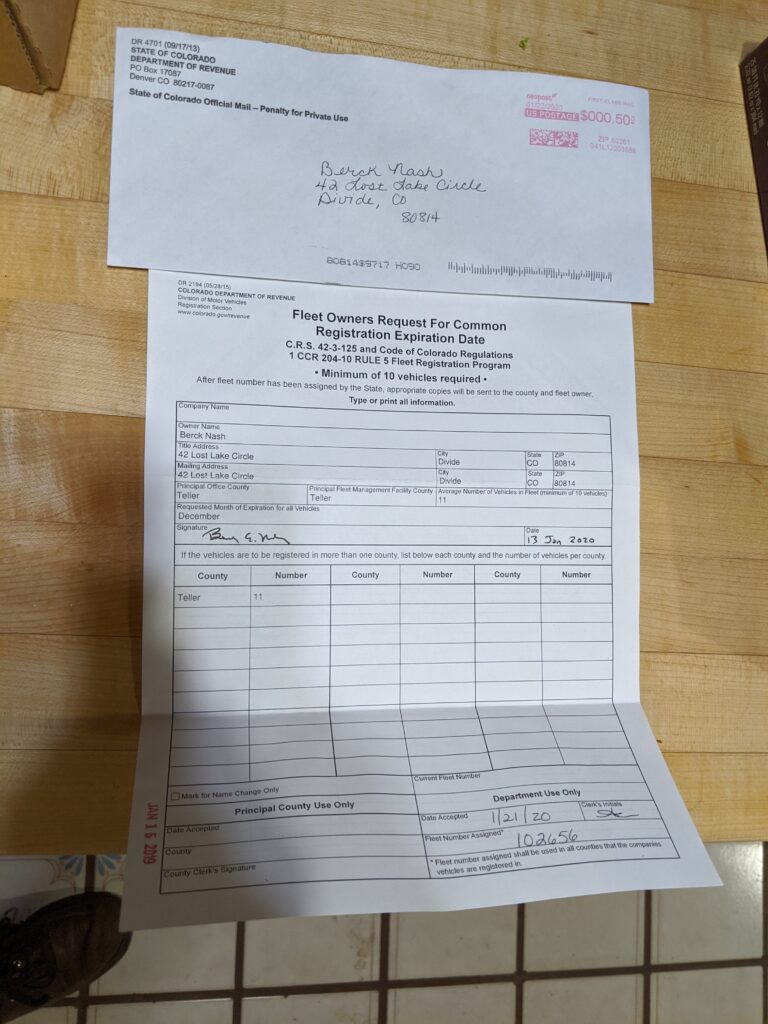
I dutifully filled out form DR 2194 and then found a mailing address that seemed vaguely appropriate and sent it off. The form is the least promising of government forms that I’ve ever seen. It does not appear to require much information at all, and there was no information in CCR 204-10 RULE 5 about what would happen after I filled it out. I expected nothing to happen, but dutifully checked the mail whenever Jonah deigned to bring it inside… just in case.

Today, this appeared in the mail!

My form 2194 mailed back to me in a hand-addessed envelope, but with the “Department Use Only” block in the lower right-hand corner filled out.

I have no idea what’s next, but it’s Car Girl’s move.

Yolanda Hayes

Colorado doesn’t have a DMV. We have a County Clerk & Recorder with a Motor Vehicle Department (or sometimes Division) that everyone calls the DMV. The one in Woodland Park is maybe the best DMV in the country.

I’m a car guy with some income that I dispose on an ever-growing fleet of used cars, so I’m always going to the not-DMV. I don’t mind. In Teller County, there is no line; there is merely three women sitting at desks.

I’m not entirely sure what the protocol is. There are signs that tell me that I’m not to use my “cell phone”, which is presumptuous for a number of reasons, not the least of which being that there are no cell phones left in the world. But I get the meaning. Otherwise, I don’t know what the rules are.

The first time I went in, there were people at the first two desks and the young woman at the far end was free. She greeted me, and then jumped into an excited discussion of Subaru vs. Ford when she saw that I was registering Jonah’s new Focus RS. There aren’t many car girls in the world, and I certainly never expected to find one working full time at the not-DMV.

Every time I’ve been to the not-DMV since, the woman at the first desk greets me when I walk in, while Car Girl sits at the far end and does not look up. I’m guessing it’s possible that I could simply walk straight up to Car Girl, but I don’t know the protocol and it seems odd to bypass not one, but two perfectly nice and efficient women just to visit my not-DMV employee of choice. So instead, Closest Woman helps me with the exact sort of polite efficiency and lack of obtrusive questions that I desire in all transactions while I wonder about the banter with Car Girl that I’m missing out on.

Today, I headed to the not-DMV with a renewal reminder for Simon and the paperwork for my latest Audi disaster. I was delighted to discover that Closest Woman appeared to be on vacation and Middle Woman was busy with another customer. I headed over to Car Girl’s desk.

She raised an eyebrow about the dealer I’d purchased it from, “Golden Motors,” and I assured her that it was every bit as shady as she might be imagining, without going into detail about the Russian proprietor who seemed like he’d rather be doing anything other than selling cars. “Well, I hope the car is good,” she said. “Oh no, it has a blown head gasket and is in pieces in my garage.” She comisserated then pointed out that there was no need for me to register the vehicle today if I’m not driving it. “But I thought I only had 60 days to register without late fees?” “That’s true, but we automatically wave late fees on all dealer sales.” Super useful information! I went ahead and renewed Simon’s registration (one day he’ll be a full-on race car and I won’t have to bother), and asked about fleet registration. She said I could only do that with the state and that it’s a fairly involved process. She also mentioned that if I had a fleet that I should consider something called broad form insurance. I hadn’t heard of it, but told her I’d research.

I’ve often wondered why I have to insure each of my vehicles and can’t instead just insure the ones I’m actually driving at any given time. It turns out that terribly-named broad form insurance will actually let me do just that–insure drivers rather than cars. It means my cars won’t be insured if other people drive them, and it’s not legal in all states, but it is in Colorado. It would be a clear win if it were just me, but I’m married and want Jonah to be able to drive all the cars, so that means buying two broad form policies…. but it still looks like it might save me $200/year or so, and for that I thank Car Girl!

Buran

I’ve always been perplexed that the Soviets bothered to copy our Space Shuttle. The shuttle was a terrible design, it made no economic sense, it was unsafe, unreliable, and a great example of design by committee and execution by democracy.

The Soviets’ version, Buran, was way better than ours. It could fly unmanned and even land itself, something it did on its only flight. Ours theoretically had an autoland system, but the one time it was tried, it was clear early on that it was going to botch the landing, so the commander took over. Buran, although it only ever flew unmanned, had an escape system that could be used at all phases of flight that likely would have saved the crews of both of our shuttle disasters. Not to mention that the Columbia disaster couldn’t have happened to Buran because it didn’t have external foam.

So why did the Soviets bother to build it, and if it was so good, why did it only fly once?

They didn’t believe NASA’s absurd cost predictions (which were obviously false), so they assumed that it was a poor disguise for a military vehicle. Possibilities the USSR considered:
(1) The obvious advantage of the space shuttle was that it could bring things *back* from space. So, maybe the USA was developing a space-based laser missile-defense system that could only be developed and calibrated in outer space. The space shuttle would allow the USA to deploy, test, then recapture these laser satellites.
(2) The shuttle was a first-strike nuclear bomber in disguise. We had a plan to be able to launch the shuttle from Vanderburg and have it land after a single orbit. Our claim is apparently that we wanted to be able to service spy satellites on such a single-orbit mission, but it theoretically had the capability to drop a nuclear bomb on the USSR during that orbit. That would make it the fastest nuclear strike option available to us. It’s also possible that the space shuttle could while in a stable orbit, at the last minute, adjust its orbit, pop into the atmosphere, drop a bomb, and make it home with no warning.

Even more concerning to the Soviets was the possibilities they hadn’t yet considered. They were so worried about this, they decided that they needed to have one just because we had one. When the military advantage we were hoping for became obvious, they’d have their platform all ready. So, they flew it once, proved it worked, and waited to see what to do with it.

It turns out, we did service Hubble with it, which is probably the only thing it did that we couldn’t have just as easily done with a cheaper expendable system. Also, reusability fit in well with the newly-formed religious fervour surrounding environmentalism.

I’m curious to find out if one day we’ll get some declassified documents that show we did, in fact, have some of the very sorts of ideas the Soviets were worried about. It’s not paranoia if they’re out to get you.

New Hampshire

I’ve managed to talk my way out of coming to New Hampshire so far, but most of the rest of the competent folks at work have put in their shift. I reluctantly agreed, not because of any dislike for New Hampshire, but because the purpose of the work trip seems to me to have little value.

I’ve been saying for awhile that I’ve been to every state in the U.S. except for Alaska, but I’m not entirely sure that’s true. I was able to come up with a concrete example for every state except New Hampshire. My airline flew into MHT, so it seemed likely I’d done that at some point, but my logbook says I haven’t.

So now I’ve been to New Hampshire. It’s a weird state to have missed, but being an airline pilot is a weird way to see the country.

For whatever reason, the folks who went a year ago managed to go during prime leaf changing season, but the event this year was a few weeks later and the few remaining leaves are brown. The weather is not hot, which is good, but of course I’ve missed a big snow storm at home. It always snows when I leave home. (Home. I have a home, now. I don’t think I’d have said that a decade ago.)

As I watched an airline pilot go through a known crewmember checkpoint, I wondered if flying for a living is any better than it was a decade ago. There was only one known crewmember checkpoint in the country at the time I got furloughed. The airlines are now more desperate, and the pay is slightly better, but I’m not sure the quality of life has improved at all. My biggest complaints were that 5-on, 2-off is a stupid schedule for anyone, but is especially asinine for commuting pilots.

So my complaint wasn’t at all about travel. I like travel, though I hate flying in the back of airliners. The old Southwest biddies managed to keep the cabin temperature at about 78F on the way over, and I find that sort of heat in a closed airline cabin to be claustrophobic-inducing.

I miss geographic displacement. It’s good for the soul. But spending all day in this building is not:

This is my coworker unboxing our stuff. People I work with make questionable decisions regularly. That’s a box that was shipped on a pallet. It contained a single 4U rackmount unit that could have been shipped via UPS had it been packed in, you know, a normal box. The room is a lot bigger, but we’re under NDA’s so I had to make sure that I didn’t photograph anything anyone might care about.

I spent 10 hours in there yesterday, mostly working remotely and offering moral support to my coworker who dealt with other people. Our particular product, for some reason, has fans that at full volume produce noise levels comparable to a 737 at takeoff. I spent much of the morning figuring out how to throttle them back, but even so, the noise was bad. About 15 minutes before we left, I experienced piercing tinnitus unlike anything I’d ever experienced before. I actually thought someone else had turned on something louder than our box, before I realized that it was all in my head. It persisted for an hour before it finally started to fade. I was worried it was going to be permanent, and I don’t think I’d have been able to live with it. So today I brought my noise-canceling headphones.

We managed to get what we needed to get done a little early today and headed out shortly before 3pm. I gave Gopal the choice of visiting a submarine or heading up the coast. He picked heading up the coast.

I managed to get the second-best rental car I’ve ever had by pure luck. I always choose “compact”, but more often than not I get “upgraded” to some American barge. I usually argue when this happens, and the rental companies never understand why I don’t think it’s an upgrade. I didn’t get upgraded, and was shocked to discover that my car was a loaded Ford Focus hatchback. It’s the same basic car as Jonah’s, only with more comfortable leather seats, heated seats, power seats, sunroof, heated steering wheel, navigation system, fog lights. It has a better turning radius, more comfortable suspension and more pleasant interior that Jonah’s car.

It’s also grey, (the second-worst color for a car), has a terrible automatic transmission (actually, it’s one of the best automatics I’ve ever used, but all automatics are terrible), isn’t very fast, doesn’t make a very good noise, is front wheel drive, exhibits a fair amount of torque steer for not actually producing any torque, and did I mention it has an automatic transmission?

The best part about it is that I know where everything is, and the second best part is that it has Android Auto. Which means I don’t need to use the terrible ford-supplied navigation system and can, instead, have google maps on a giant screen where it’s convenient. I don’t know how anyone ever found their way around New Hampshire without GPS.

I’m taking some amusing joy in knowing that I get to drive around in a Ford Focus rental while Jonah is driving around in a GMC cruise ship waiting for her Ford Focus to get fixed.

Here’s some photos.

I’ve always thought Kennebunkport was one of the more ridiculous place names and was surprised to drive through it accidentally.

My plan was to meander up to Portland, getting there about the time it got dark and find a good dinner. It gets dark at about 4:45pm here this time of year, so I misjudged by a bit, and ended up hopping over to I-95 after it did, since there didn’t seem much point in driving the winding beach roads in the dark.

Kelsey eventually returned my phone call. I’d called him because I knew he’d have a good recommendation for a place to eat in Portland, since he’d just spent weeks there. He did, and it was fantastic.


Belgian fries fried in duck fat.


Duck poutine. Fries fried in duck fat, duck confit, duck gravy, and a duck egg sunny side up.

I second his recommendation of Duckfat in Portland.