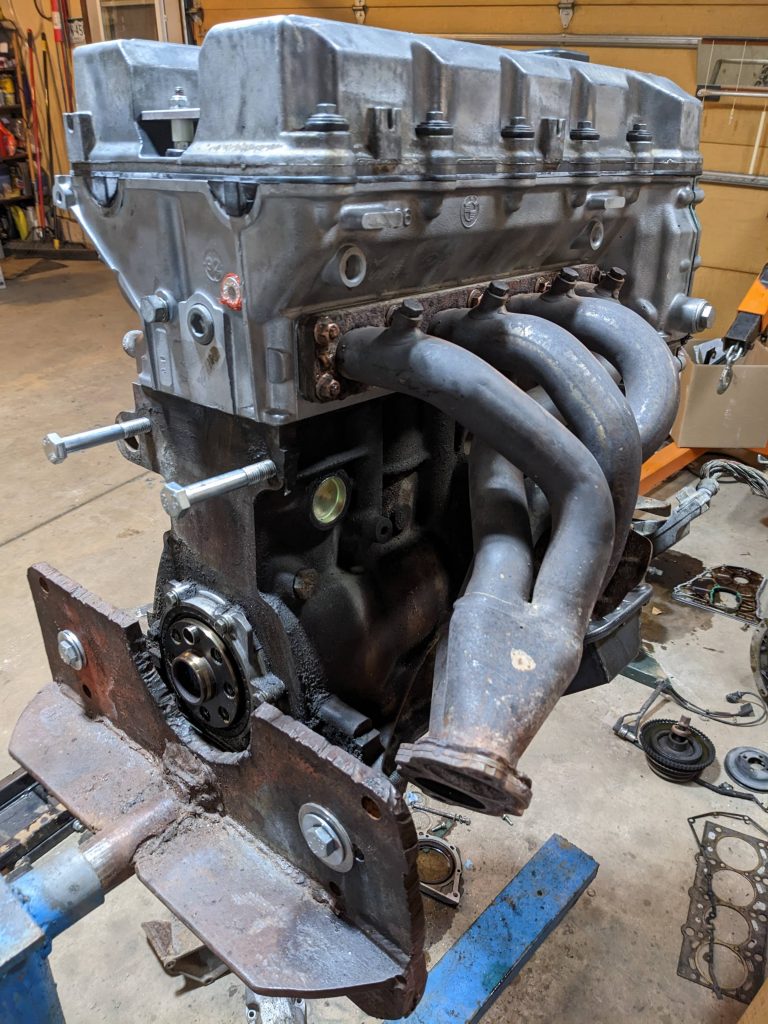
Rally Colorado 2024

I finished a rally!

My goals this year were, in order:

  • Don’t die
  • Finish the rally
  • Have fun

I probably didn’t do as much car prep as I could or should have, but I did repair the damage from last year. Replaced all the broken suspension on the front left corner, replaced a bunch of a sheet metal and the busted driveshaft support bearing.

I spent a bunch of time installing the RallySafe bits, doing general maintenance and making sure I’d accounted for all the rule changes. I had various ideas for improvements/upgrades, and basically none of that happened. Mostly because I couldn’t shake the image of a crumpled rally car making any such efforts moot.

Recce the third year in a row meant that we had prior notes for all of the stages and didn’t have to write notes from scratch. The stages that were the same as 2023 were backwards, though, so that meant that the usable notes we had were from 2022. When I had absolutely no idea what an R3 over crest was.

The first stage was Valley of the Gods and the notes were rough. The stage started from a slightly different place, and our notes were truly terrible. Jack got lost reading them on recce so we marked a whole section as need-to-fix. In prior years when we messed up a corner, we’d cheat and back up a corner to fix it. Since the RSLite app was going to nag on us and disqualify us for such insanely unsafe behavior, this wasn’t an option.

We ran most of the stages once, a few of them twice, fixing up bad notes as we went. For Douglas Creek, we had Jemba notes from 2018 to start with. These were verbose, but way better than anything we created and were both confidence-inspiring and a useful tool for me. In many places, Douglas Creek better resembled a rock crawl than a road and I wasn’t sure whether my car would even make it. We didn’t run it last year at all, and the year before the car blew up before we got a chance.

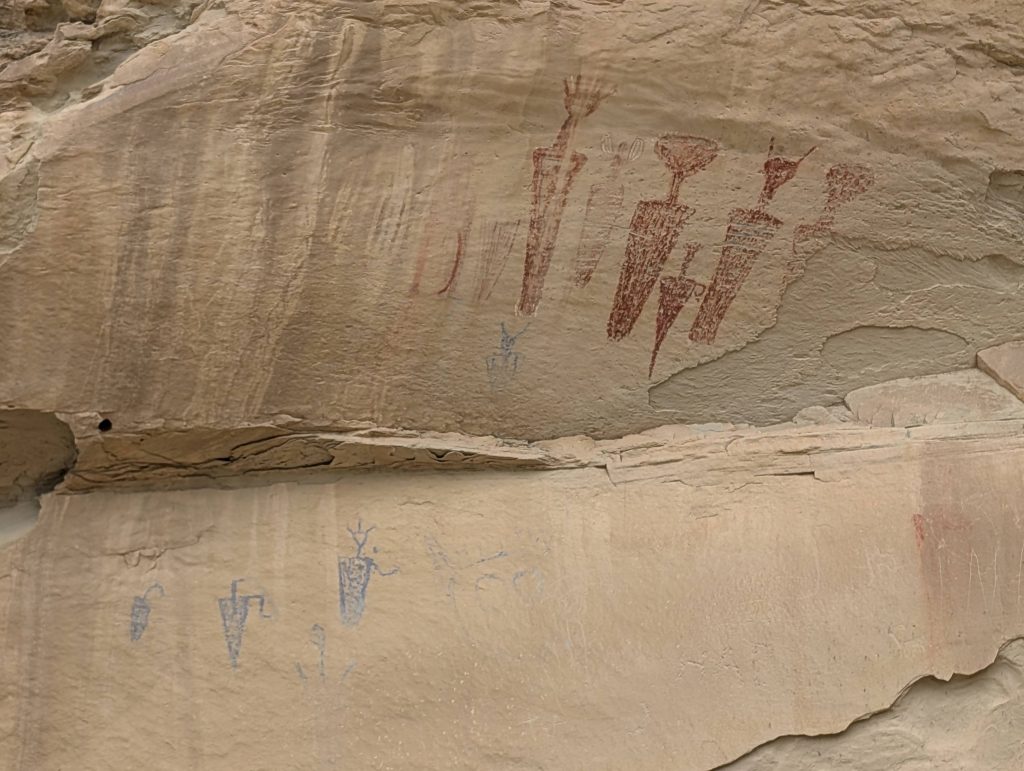
We stopped to view one of the petroglyph sites near the stages.
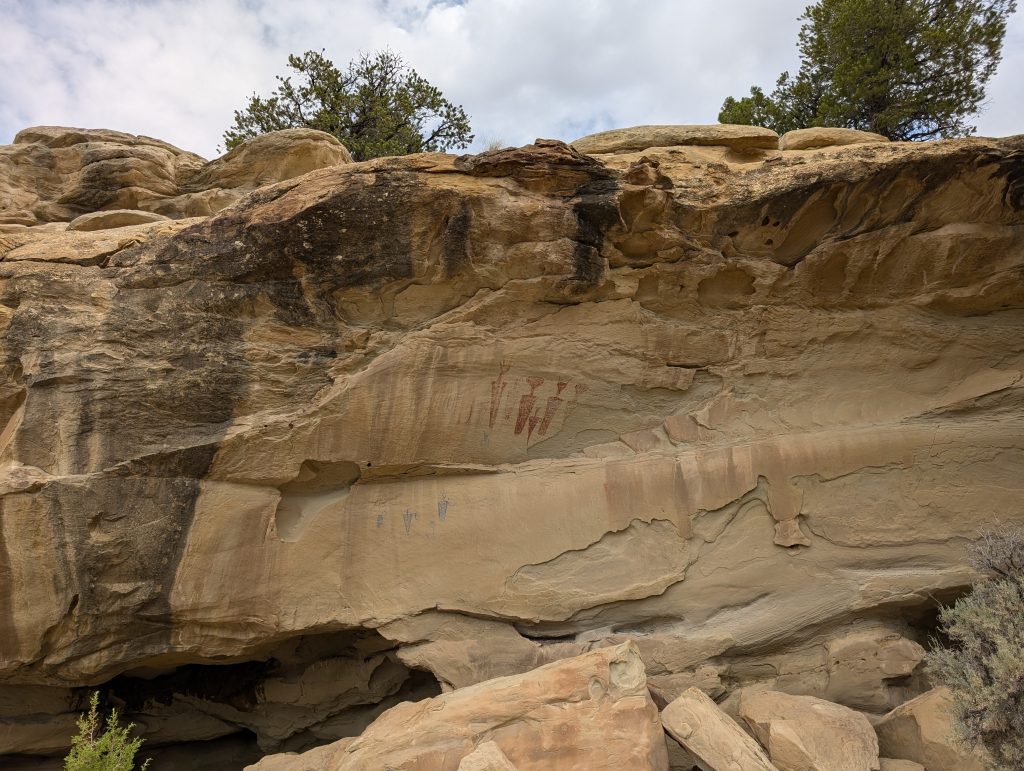
We ended up doing Valley of the Gods 4 times in recce before we were happy with the notes. Normally, this wouldn’t have been an option, but given that we were able to do a quick single pass on the stages for which we already had notes, we could.

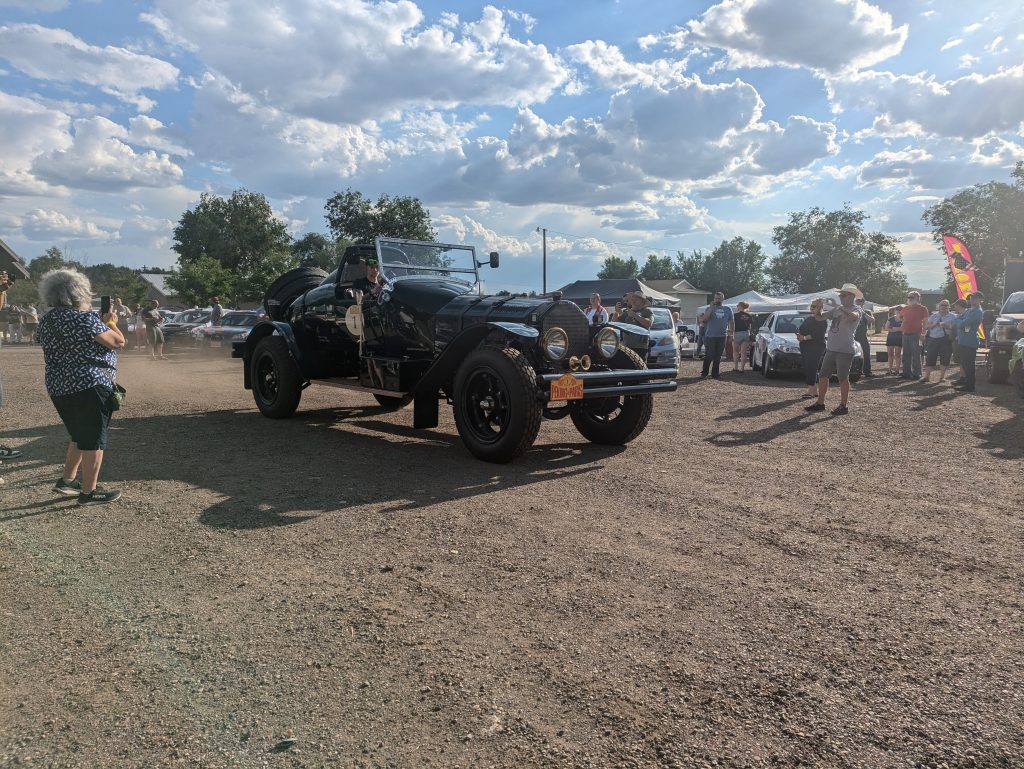
Parc Expose at the Rangely Car Museum was as hot and brutal as ever. The unexpected addition this year of speakers blasting bro country didn’t help things. The fact that the car museum took their 1915 American La France Speedster (which participated in the 2016 Peking to Paris Rally) out for the parade was pretty cool, though.

A rally car among rally cars:
After the parade, I checked out the car one last time. It was leaking coolant from the lower radiator hose. I have no idea why–it’s a new radiator, a new hose, and a new hose clamp. The clamp was tight, and I hadn’t touched it since last year. I replaced the clamp, and it stopped leaking.

Thursday morning we headed out of the service park toward Valley of the Gods.
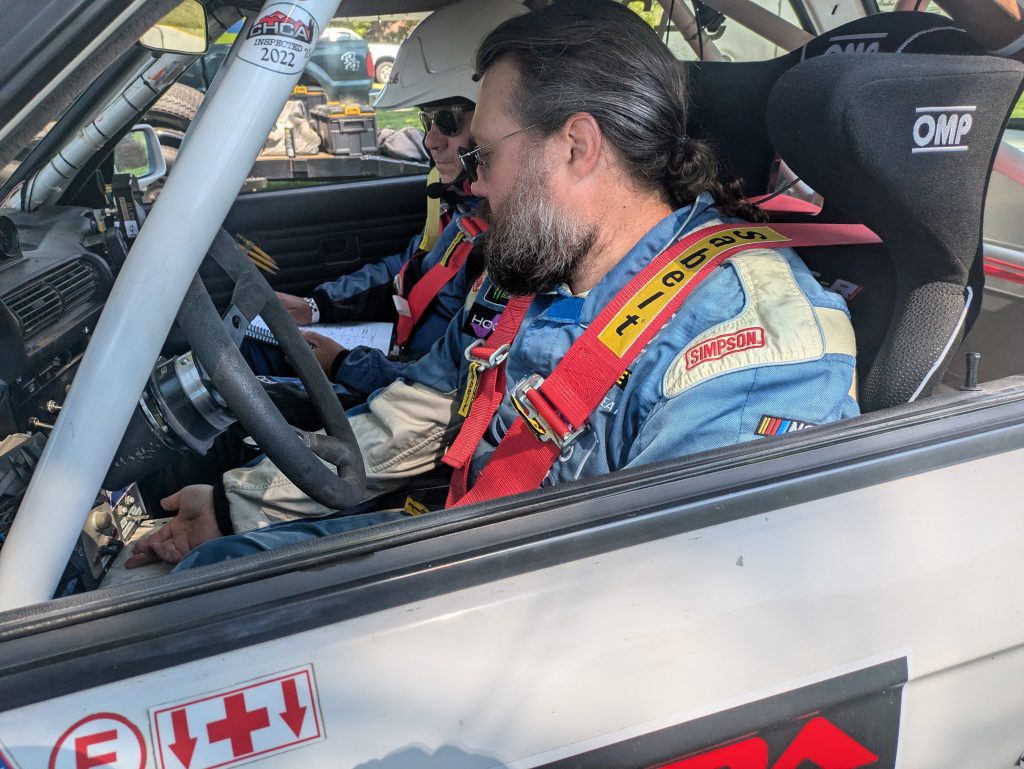
We were supposed to start last, but the car that should have been in front of us was waiting for a miscalculated start time or something. So we went ahead and started ahead of them. I’m not sure what the rules are here, but I wasn’t entirely sure what to do and there were no penalties involved.

I, of course, took it easy at the start, trying to remember what it was like to drive on dirt and listen to notes. I had not managed to get into any sort of a groove by the Mile 3 where we ran into this:
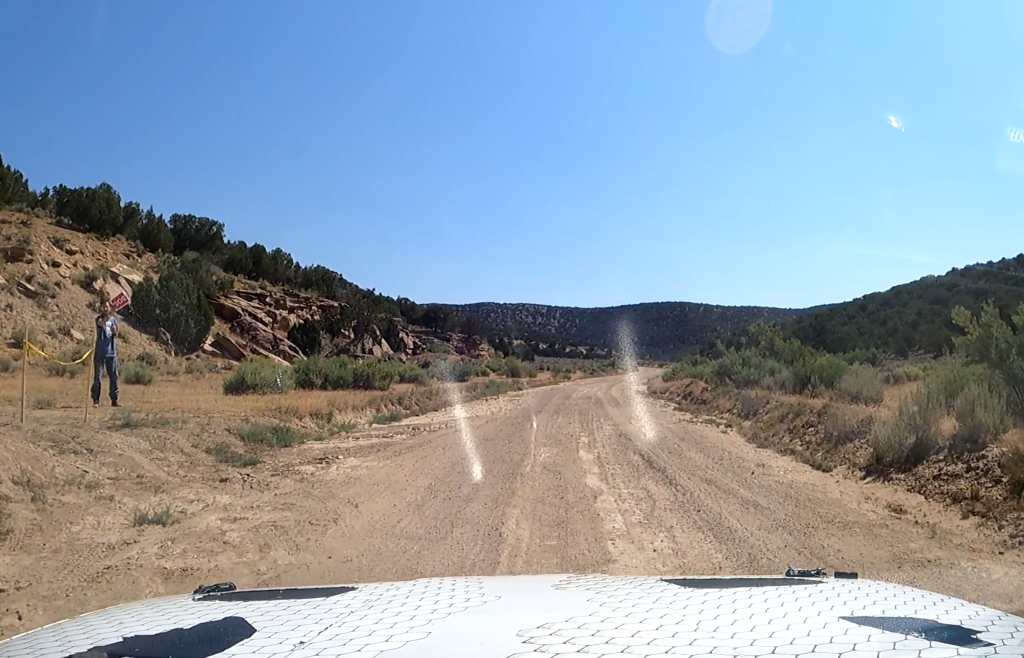
That’s the volunteer manning a radio checkpoint waving an SOS sign at us. No one ever really mentioned this was a possibility, so it was a bit confusing, and the guy who stopped us wasn’t really sure what we should do anyway. Jack set up our triangles.

Information from the radio was vague, medical SOS, but maybe not a medical. It turns out that Bret Hunter had maybe managed to the roll the Zombie CRX for the last time after breaking a tie rod, winding up in a rock. The road was narrow and had quite the exposure on one side, so it’s pretty lucky they managed to stay on the road. Fortunately, the crew was uninjured, but the road was impassable, thus the SOS.

It took forever to get the road cleared and then forever for us to transit on to the next stage. We arrived at Quest for Darwin hours late–around the time we should have been leaving service for the second section.

Quest for Darwin is the stage on which we blew an engine the first year and the same stage (in the other direction) on which we crashed the second year. I’m not a superstitious person, but humans are pattern-matching animals and it’s hard not to go into it with a bit of trepidation.

It went fine. The road was full of even deeper piles of silt than I remember from either recce or previous years. There are long, fast sections through piles of silt where the front runners do 115mph. I managed 84mph before the car started sliding around enough that it seemed like I was mostly just hanging on and backed off a bit.

It managed to get miserably hot by the time we made it to Earl’s Bad Day. This stage would probably kill me without a co-driver–there are some truly misleading corners and some places that, without trying hard, you could easily go over a crest and then off the side of the mountain. I drive those sections excessively slowly, because Goal #1 remained no death.

We made it back to service with no complaints about the car. Dan looked it over, pronounced it great. We checked times and were astounded to learn that we were not the slowest car out there–we were significantly faster than the Civic in last place! We tried to hydrate and headed out for Valley of Gods the second time.

This went really well. Part of it is that we’d driven the stage a bunch in recce, part of it was that the notes were good, and part of it is that the stage isn’t insane. There are exposures and plenty of opportunities for death, but they’re not sneaky. The road is rough, but not a rock crawl. There are uphill sections, but not so uphill I have the choice of wheel spin at redline in first gear, or lugging in 2nd gear.

There were about 2 minutes where I genuinely had fun. The Hoosiers gripped way better than the Maxxis ever did. I’d removed a bunch of toe in from the front so only a smidge remained, and that helped the car turn in. I’m left-foot braking where possible and that’s helping get the car rotated. There was a long section where it felt like I was driving fast, the notes were good, and I wasn’t terrified.

We made it to the end and beat lateness….by 6 seconds. That was discouraging until I looked at the times at the end of the day and realized that we were faster on the stage than 3 cars, and pretty close behind a 4th. Actual competition! I have no idea why Rally Colorado sets lateness times such that a bunch of competitors genuinely trying can’t beat it, but it’s rough.

While waiting to check in at ATC, I generally kill the car and run the fan. It’s 95-100F and letting the car cool before each run seems to keep the temps down. I still haven’t installed a real temp gauge, so I have no idea by how much or how hot the car actually gets.

Anyway, as we approached our minute outside of ATC for Quest for Darwin the second time, I belted in, and tried to start the car and it refused. Cranked happily, but just refused to start. I double-checked that the fuel pumps were on. I cycled the ignition off and on and tried again. Nothing. Not a pop or anything. Jack said he was going to go walk our timecard in so we weren’t late. I told him not to bother, that I didn’t have any ideas. He ignored me.

I opened the hood to check for loose wiring. I didn’t see anything. I tried to start it again. Nothing. I cycled the master switch off, back on, tried to start it again. And it started. I closed the hood and picked up Jack, who’d checked in with seconds to spare. We rushed to get belted in. I think they took some pity on us and gave us a later start than they otherwise would have without a penalty, but it’s hard to know.

We were distracted for the first half of the stage, and the second half of the stage I was just miserable. It was hot, the car felt like it had less grip than the previous run, and the pacing of the notes was off. It felt terrible, but somehow we managed 7 seconds faster than our previous run.

The last stage was mostly just an exercise in fighting heat exhaustion. I was guzzling as much water as I could between stages, peeing constantly, and was completely soaked in sweat and still felt dehydrated. It was hard to concentrate and all I wanted was to get through the stage and out of the car. Which we did.

We never did figure out why the car wouldn’t start. It’s worked every time after that. Maybe just a minor hint of our Quest for Darwin curse remained.

Saturday evening was free barbecue in the park with all the teams and volunteers. I slept in a bit Sunday morning. We headed to the first running of Douglas Creek with a bit of trepidation.

The stage had been SOS’d before we got there. As we found out later, about 1.5 miles into the stage, the 3rd place car went into a “L4 tightens to L2” with only the “L4” part of the note. The driver said by the time he got the “tightens to L2” part of the note, there wasn’t much to do. They sailed off the side of the mountain and rolled 3 times coming to a rest 50 feet below the road. The stage was canceled and they took the crew to the hospital. The co-driver suffered a minor concussion, but otherwise they were fine. The crew managed to relay the cause to everyone before we ran the stage a second time, which was great, because we got to add a caution to that section of the notes so we didn’t make the same mistake.

After a long wait, we all headed to Dragon Trail. If we were going to lose a stage, I was kind of glad it was Douglas Creek, the rock crawl stage that was bound to break cars.

Even though there were only 22 cars, we were (thankfully!) running 2 minute intervals for dust. This meant a pretty good wait before we could go. For reasons I don’t understand, they instructed us all past ATC and gave us all the same impossible “ideal” start time.

The first section of Dragon’s Trail is 6 switchbacks with a steep grade. The switchbacks are too tight for 2nd gear, but 1st gear is just a spinny disaster. The grade is steep enough that the M42 barely gets the car to any speed at all before slowing again for the next one. After the initial hill climb stage though, the road is fast, smooth and usually grippy for quite awhile. This is where I do not shine–the really fast stuff scares me.

After Dragon’s Trail is Presser, a fast 1-mile stage with a few kinks and crests. They have us start on a little trail perpendicular to the road, and they let spectators line the road we didn’t use. So it’s a tight L2 in front of spectators while we get up to speed. I shifted to second before the turn, didn’t get the car to rotate and managed to look quite lame.

Still, headed back to service with nothing wrong the car and real hopes of actually finishing a rally.

While we were waiting for the start at Douglas Creek, we watched a Honda Fit climbing the massive hill at the start. “Wow. Look at how slow that Fit is going up that hill,” Jack said. “We’re going to be just as slow,” he continued. “Nope,” I said, “I think you’re wrong. We’re going to be slower.” I’m not sure if we were or not, but man was it painful. I knew that my chances of beating the turbo Subaru in front of me (which, at service, were 7 seconds ahead of) completely disappeared. They’d have no problem putting 30 seconds on us in that one straight section that we’d be doing at 20mph.

Douglas Creek was just as brutal as we’d feared. We passed the formerly 2nd place Volkswagen of Steve Bis and Kelly Keefe. Later on, after a particularly brutal rock crawl skid plate test section that I really should have slowed down more for, we passed the Subaru of Eliza Coleman and Alessandro Gelsomino.

Jack somehow not only made an off-by-one error doing the math for our check-in time at Dragon Trail, he realized it the instant the volunteer handed us our time card back. He was really upset about it, even though the one minute penalty made absolutely no difference to our finish order. At the time he was worried it might, and he felt like it was an inexcusable mistake. Given the fact that I was making mistakes at the rate of one-per-second, all of which added up to far more than a minute, I wasn’t even a little bit upset.

Our second run of Dragon’s Trail felt faster, but wound up being 20 seconds slower. I have no idea why. The second running of Presser I just kept it in first at redline around the L2 at the start, and got properly sideways for the spectators.

And then, for the first time, after 3 years of trying, we handed in our timecard at the finish. And not even the last place finisher!

It’s not traditional, but they gave champagne to all the finishers. I was going to play nice and just drink it, but Jack picked a fight that I won. It felt like we earned it.
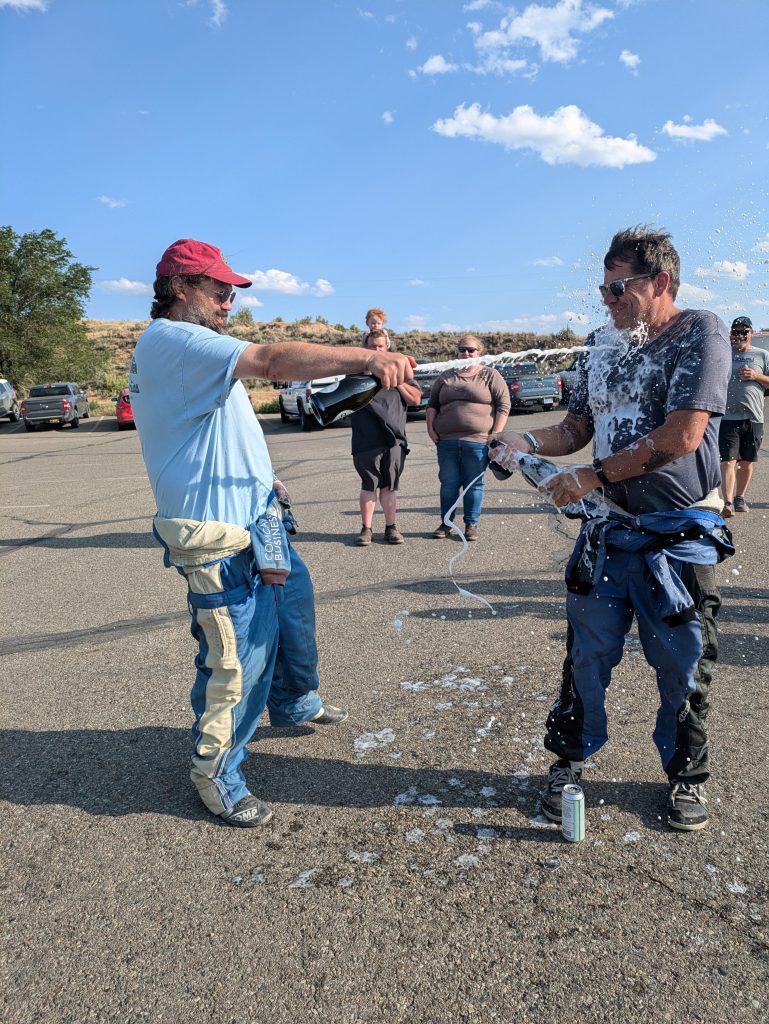
I’m realizing that if I want to figure out how to get any good at this, I’m going to have to do it more often than once a year. And, for once, I don’t have a completely destroyed car to fix before I can do it again.

I’m thinking about the Overmountain Tennessee Rally in September…
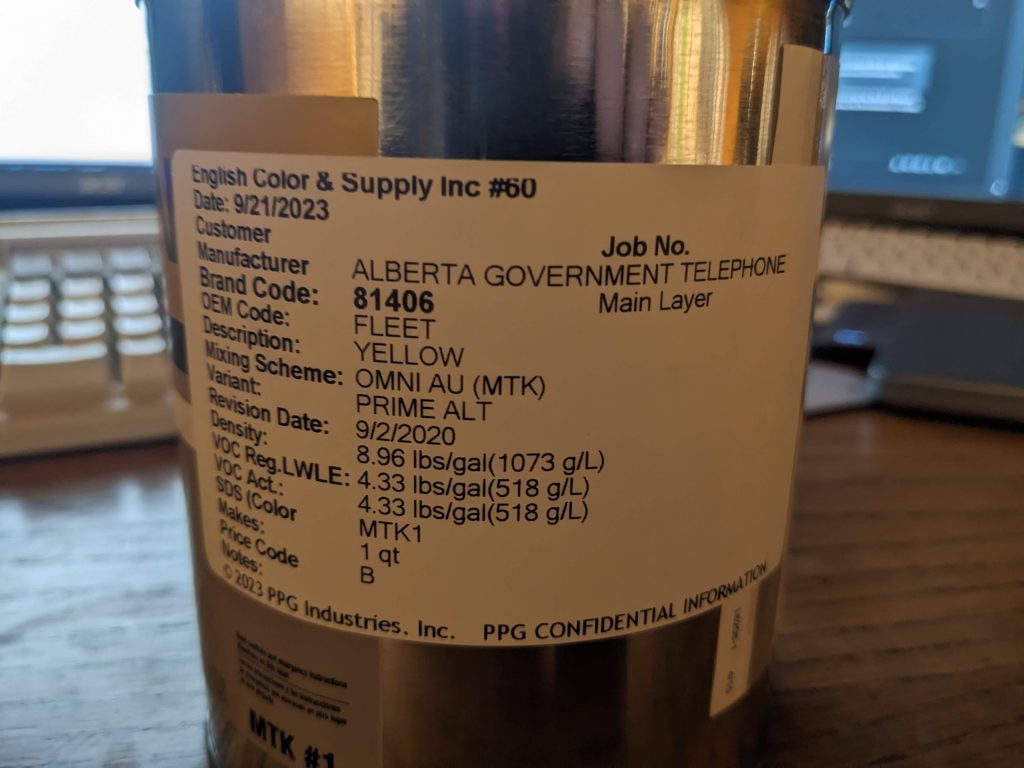
Alberta Government Telephone

I took off work a few hours early to go buy paint.

As far as I can tell, there are two places to buy automotive paint in Colorado Springs: Sherwin Williams or English Color. I went to English Color even though they spelled their name wrong.

Brian used Valspar TB550 Urethane, and I have all the magic numbers needed to recreate the appropriate colors, but no one in town sells Valspar TB550. The English Color in Denver sells it, but I’d have to drive up there. They’re not open on weekends and I’ve got work to do during the week. So I figured I’d just grab the tail cover of my car and head to the English Color in the Springs which sells PPG, and PPG Concept is a favorite single stage of the Internet.

The ladies at English Color put their magic scanner on my tail cover and mixed up a small amount of both the blue and the yellow. It’s hard to tell from wet paint, but it looked mostly right. The yellow seemed maybe a little dark and the blue seemed maybe a little light. “Do you want to take it outside and compare under the sunlight?” they asked. “Nope.”

“What kind of paint do you want?”

“Whatever single stage urethane you have.”

“Well, what do you want?”

“Concept.”

“We don’t have that.”

“Right. So what do you have?”

“Omni.”

“That’s what I want, then.”

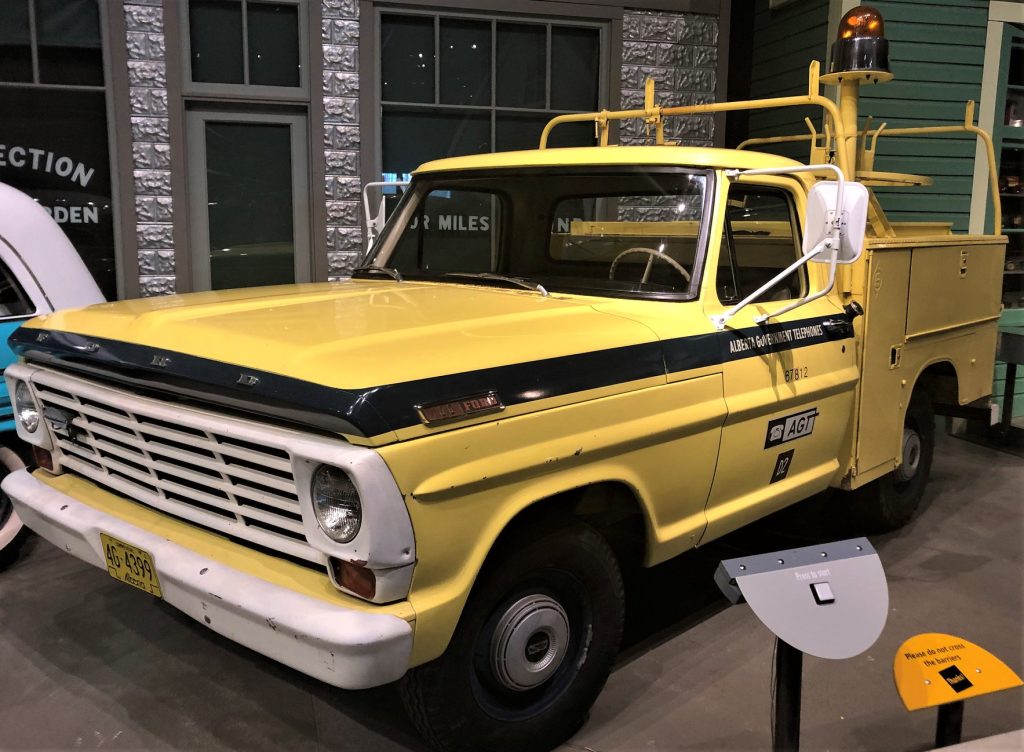
They remarked that my Blue matched with a color called “Volvo White” on their computer. Maybe “white” means blue in Swedish. But when I got home, I was shocked to notice the name of my yellow:

Alberta Government Telephone?!? A little Googling turned up the answer:

Apparently, the yellow on my Vee is a match for the repair fleet trucks that Alberta Government Telephone used some long time ago. When Brian asked what shade of yellow I wanted, I said, “Just use whatever the color of Jared’s car is.” “That’s midlife crisis yellow.” “Perfect.” Only, the shade he used is way lighter than midlife crisis yellow. Now I know that it’s Alberta Government Telephone Yellow.

I have no explanation for Volvo White.

Ready for a Rally

Finally, I managed to start fixing things faster than I was breaking them this weekend.

First up, the alternator. The internet let me know that some E30s refuse to charge the alternator if the charge light wasn’t working.  There’s some disagreement about what year that change was made, or if it was universal. My charge light wasn’t working, but I was pretty sure that it’s never worked.  But not certain.  I verified that with the ignition powered, I got 12V field/excitor voltage to the D+ terminal which is the thing that gets interrupted with a busted charge light.

With that in mind, I turned to the spare alternator from the second engine, but it subjectively looked worse than mine.  It’s also filthy.  But mostly I reasoned that it was very likely that the failure was the voltage regulator, and I didn’t want to condemn an entire alternator if the problem was just the voltage regulator.  Here’s the Bosch regulator that was on the unknown alternator:

The one in the car was not Bosch and the lettering was impossible to make out.  I swapped this one in, and the alternator worked just fine.  The charge light never comes on.  Not sure if it’s burned out or bypassed in some way.  The aforementioned joys of a car with an unknown history.

I wanted to replace the 20 year old seats with modern containment seats.  Irish44j’s photos make me think it’s maybe possible to fit an HTE-R XL in there, but it’s not certain.  My codriver is quite a bit smaller than me, and he claims he fits comfortably in an HTE-R 400.  In fact, he had one that he’d purchased for a Pike’s Peak car that didn’t run this year, so he gave it to me to install it.  So I set about installing this seat, and it gave me fits.

First, it’s about an inch narrower than the seat I had.  I’m unclear about the wisdom of mounting a seat with spacers and longer bolts (seems maybe bad), so I flipped around one of the seat brackets which took up right about the right amount of space.  I still had a heck of a time getting it in there, I think the brackets are *slightly* too tight now, but I did, eventually, get it.  For reasons that make no sense at all, the seat is now farther forward.  This is apparently due to the new seat just sitting farther forward of the mounting points than the old one did, but looking at them doesn’t look that way.

I really need to move the seat brackets after about 2 inches, but given that I was running out of time, I think this will work fine.  I needed to move the fire extinguisher forward a bit, and Jack has less leg room now, but I could fit in there and he’s shorter than me.

My harnesses went out of date in 2022, so I installed new Sabelt ones.  I really like Crow harnesses because the material is soft and easily adjustable, but the SFI-only certification is a bit frustrating.  And while you used to be able to send them back quite a few times for re-webbing for like $60, they will now only reweb them a single time.  Which means only 4 years out of a set.

I’m loving the adjust-at-the-buckle 2″ lap belts these have.  Super easy to get the lap belt much tighter than with the standard pull-up 3″ belts.  The shoulder belts are pretty hard to adjust because they’re so stiff, though.

I put the old co-driver seat in place of mine, because the cover on mine is torn and it made tech upset last time.  If I and the car make it through this event, I’ll figure out how to get a proper containment seat on my side, too.

I got the ugly new graphics badly installed.  I worked really hard on the last decals, and I’m annoyed at having to replace them with uglier ones so I spent less time on it this time.  Trimming the windshield banner carefully is hard, and the black hides mistakes way better than the white.  Oh well.

I’ve driven about 60 miles and it seems good.  I cranked the idle up too high (about 1,200rpm) to keep the oil pressure high enough at idle to not flip the fuel pump shutoff relay.  This would be bad for a street car, but I think it’s fine here.  My impression is that the car is slower than it was with the old engine, but that could just be in my head.  The new clutch is way stiffer than the old one, but it’s also fine.  My $30 ebay short shifter is working great and makes it easier to get it into 1-3-5 while belted in.  I should probably get one of the tall ones and bend it a bit, but this is fine for now.

The rear lights (which they actually checked at tech last year) like to stop working.  Removing and reinstalling the bulb fixes it for a little while.  I decided to pull them all and spray them with contact cleaner hoping that they’d at least work long enough to get through tech this year.  Of course, one of the tail lights disintegrated on removal.  Drove to the auto parts store to acquire a replacement.

I also plugged the new inspection port on my transmission with a rubber plug.

Went ahead and loaded it on the trailer!  

BMWs are Dumb

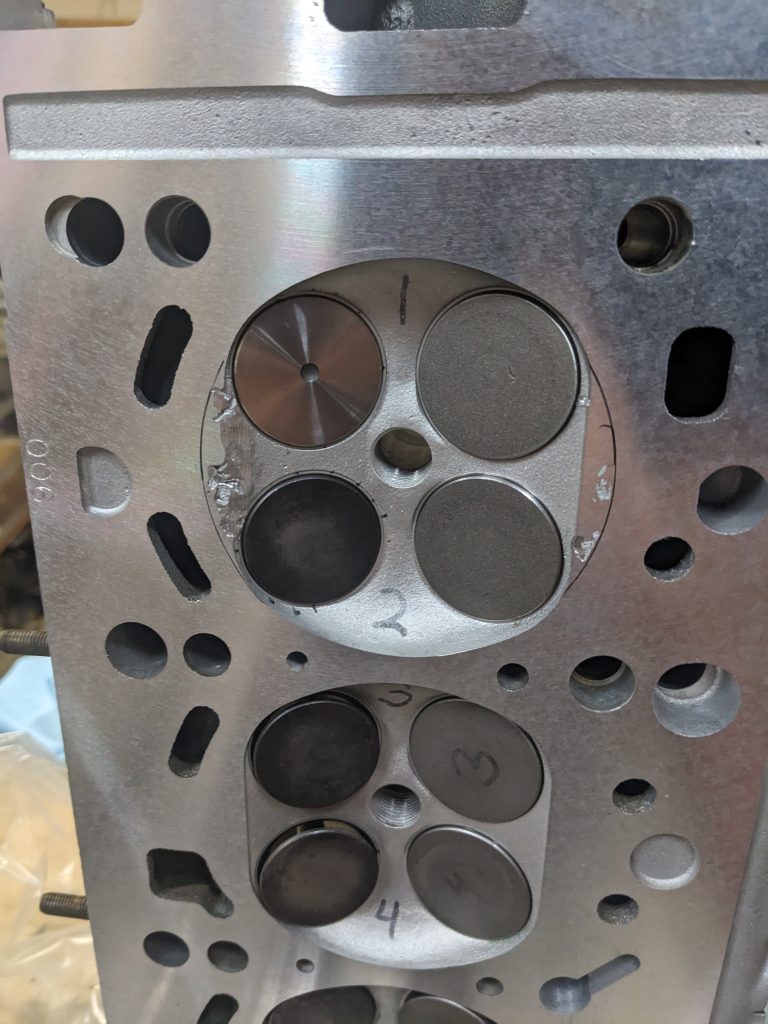
The machine shop called to say that three valves were bent, and they were having trouble locating replacements. I quickly browsed all the German car part sites, and most of them didn’t have any intake valves in stock, but ECS tuning did. That should have been a warning sign, but I just ordered them with overnight shipping and figured it’d be fine.

They called shortly after delivery to let me know that the exhaust valve was correct, but the intake valve was the wrong size. After much searching, it turns out that the 6mm intake valves on the M42 were only used for one year, and they’re NLA from BMW. After much searching, it turns out that Rock Auto, of all places, actually has some aftermarket ones readily available. They don’t, of course, list the valve in a part search for my car, but once I managed to find the magic part number (RV1359), they appear. And unlike most sites, Rock Auto actually lists all the relevant dimenstions in a diagram, so I was able to be sure they were the right ones before ordering. Unfortunately, while RockAuto would happily ship next day, they said they wouldn’t ship for 3 days.

Luckily, they lied, and the shop got the valves on Friday, in time to return the head to me on Saturday.

Not good as new, but hopefully good enough:

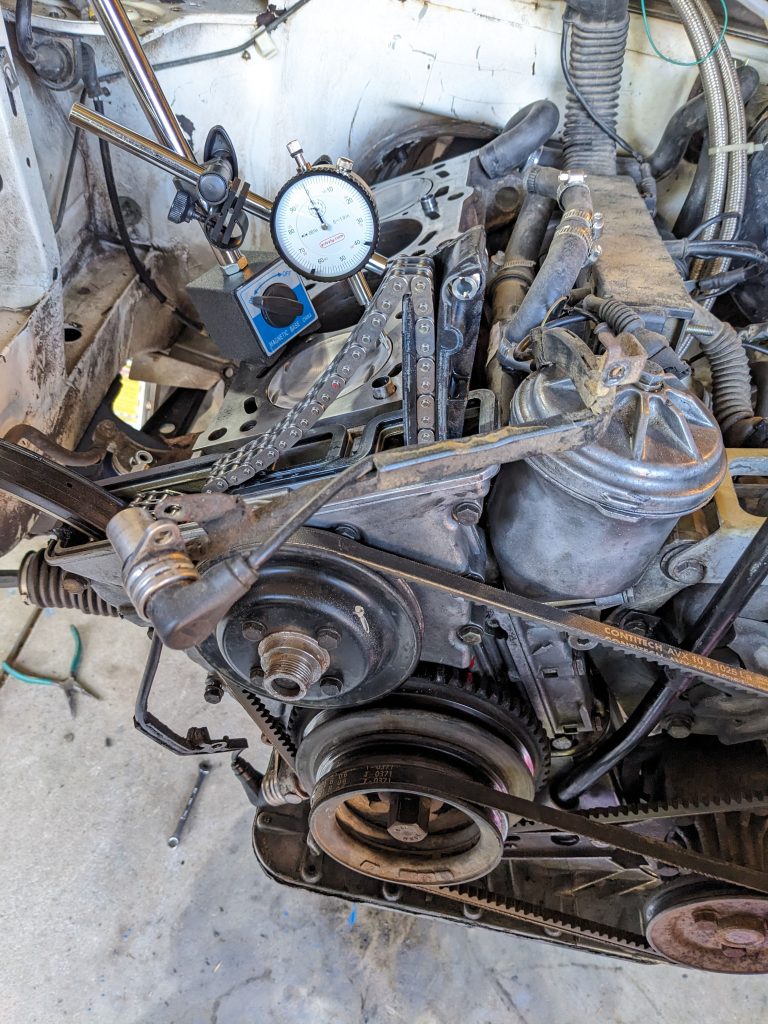
A continued annoyance when reassembling this thing: BMW can’t be bothered to mark TDC (or anything else) on the M42 crank pulley. Just… why not? Yes, the stock flywheel has a hole that lines up with a hole in the case that you slot a tool through to lock the crank in TDC, but I don’t have a stock flywheel. And you still have to locate TDC to stick the tool in. This seems like the most basic thing you do to make an engine serviceable. I’m so over BMW. Problem solved for now:

I got it mostly bolted together on Saturday evening (at least everything with sealant on it) so it could cure overnight. Finished up Sunday morning. Cranked it over to prime the oil system, got 30PSI of oil pressure on the starter motor. Then flipped on the fuel pumps and hopped out to leak-check the fuel system.

I had a geyser of fuel spraying from one of the braided stainless hoses on the firewall. It had leaked there once before, and tightening the connector fixed it. It did not this time.

I pulled the fuel hose, cut an inch off the end and reattached the AN fitting. An even bigger leak. Curious how I bungled that so badly, I did it again, and it leaked again. This time when I pulled it off, I noticed the rubber hose inside was cracked several inches. I cut it off past where it was cracked, reattached the connectors and tried yet again. This time the geyser came from the middle of the hose. At this point, I’d probably been screwing around with this hose for 3 hours, I was drenched in fuel and furious.

After looking it up, apparently it’s normal for this stainless braided rubber fuel hose to disintegrate after just 5 years? This stuff is probably as old as the original build (2007), but what the hell? OEM rubber fuel lines often last 40 years with no problems! I think the fact that it spent a year drying out when the engine was disconnected is probably the biggest problem.

Anyway, AN-sized braided fuel line isn’t something that auto parts stores seem to have in stock. I ordered a bunch of replacement stuff from Amazon, this time PTFE (teflon) which supposedly lasts longer than the rubber. But it won’t get here until tomorrow. And registration for Rally Colorado ended last night.

So, I went ahead and registered even though I have no idea the car even runs, much less drives. I have 9 days. I’m sure it’ll be fine?

Presidential M42 Progress

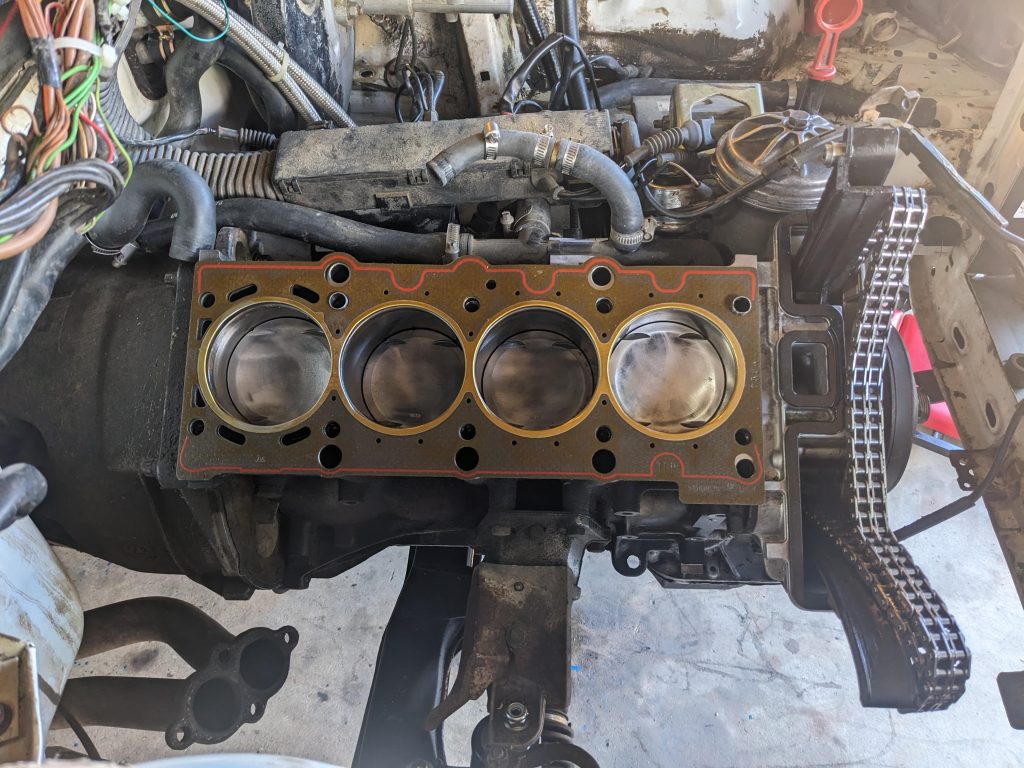
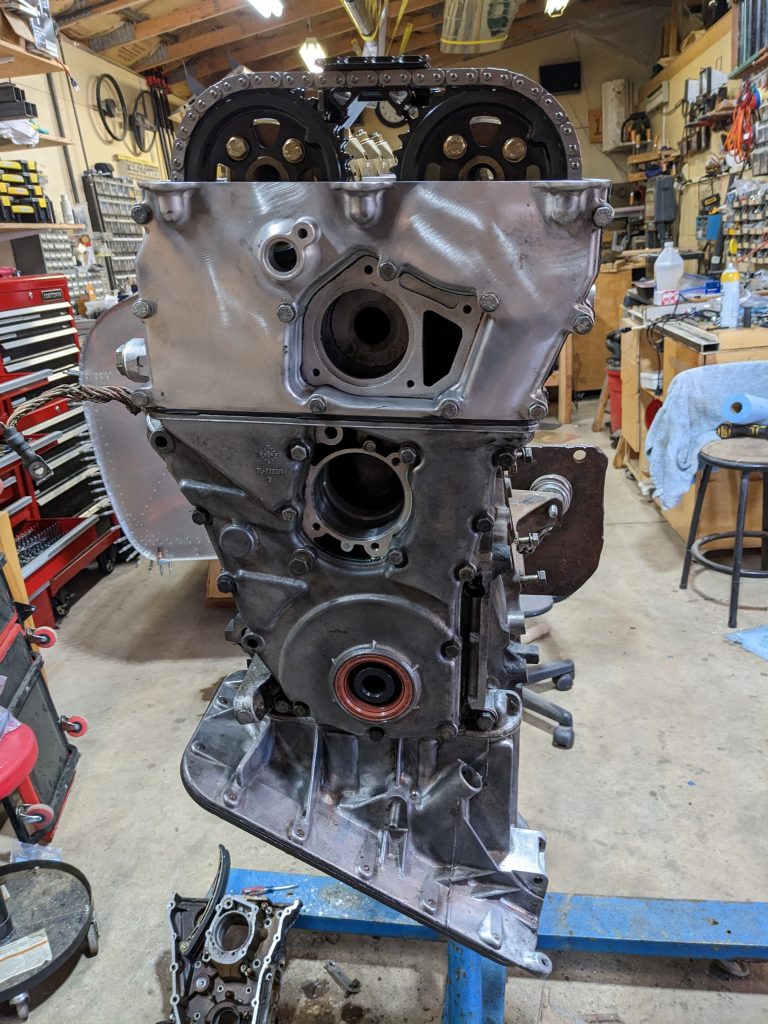
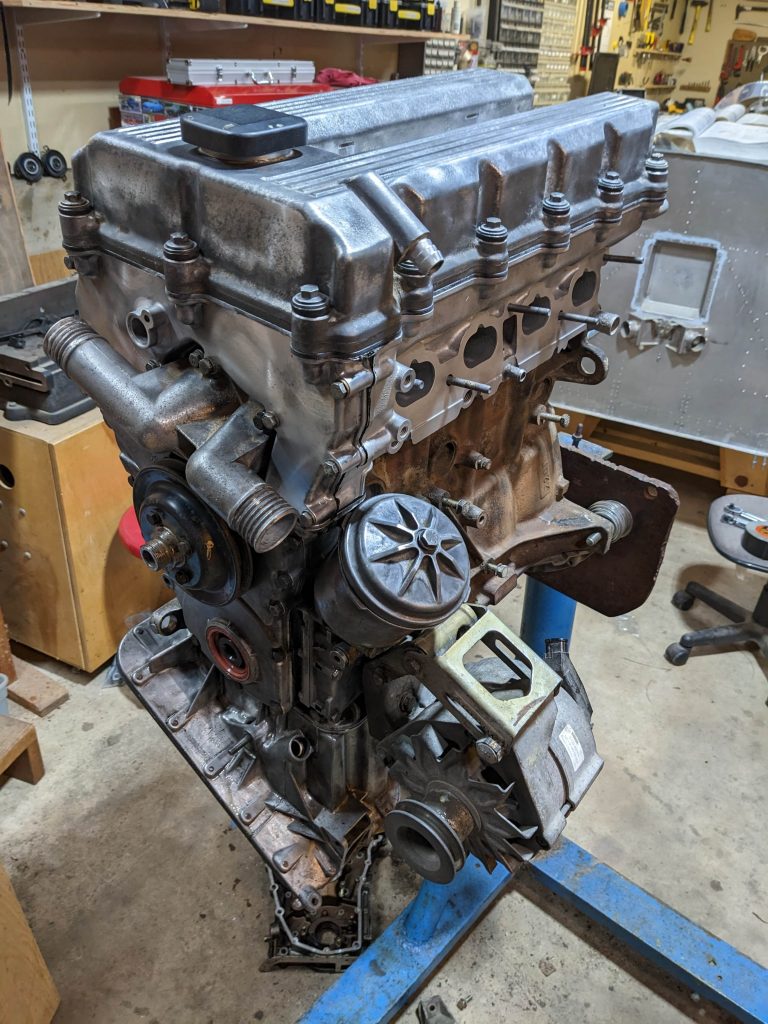
The timing covers on the front were leaking profusely from both engines. As others have mentioned, “they do that.” That’s disappointing and annoying, but I’m not here to solve age-old BMW problems. The engine my car came with managed to completely coat the inside of my skidpan with about 5 miles of driving so, hopefully I can do better than that? The way these timing covers seal with a fiddly “profile” gasket in some places and a super thin paper/composite gasket in others is problematic. I’m normally not one to use RTV on gaskets, but it seems like anything might help here. The replacement M42 came completely coated in RTV squeeze-out as well as oil leaks, so it’s clear that RTV alone doesn’t solve the problem. I used a very thin layer on both sides of the gasket, and a bit more where the rubber profile gaskets join. The inner part of the profile gasket protruded a bit on one side after torquing the head down, so I trimmed it flush with a razer blade. The outer section of the gasket that rides between the timing covers is more problematic. It’s clearly meant to be compressed downward to (1) seal the forward edge of the gasket, and (2) provide a flush surface for the valve cover to mount to. Only, there’s no good way to apply downward tension on it. Worse, the holes in the upper timing cover are oblong, which means that you can line up the holes and bolt it together completely misaligned. I used some vice grips to compress the upper timing cover such that its top surface was level with the valve cover while I torqued down the bolts. I don’t think I’d recommend this technique as it put some ugly gouges in the timing cover, but you won’t be able to see them over the inevitable oil and dirt covering anyway:) The whole thing is a pretty unimpressive maintenance-unfriendly design.

I told myself I wasn’t going to clean any of this stuff up and just stick all back together with the outsides dirt and oil covered as long as the inside was clean, but I just couldn’t help myself and even wire-wheeled the valve cover a little bit. In any case, the engine is mostly reassembled, minus the intake and cooling stuff on this side.

I know how these block heaters are held in place, yet like an idiot, I went ahead and completely removed the bolt on the front before thinking it through. That left the nut and expanding wing bit to drop into the water jacket. And of course they’re stainless, so I couldn’t fish them out with a magnet. I spent an hour and got one piece out by tilting the engine over on the stand. I got the other one out by duct taping a piece of tiny silicone hose to my shop vac, which let me fish it out.

Anyway, shiny freeze plug installed. I also removed the German-tastic studs-welded-to-a-flange thing the exhaust header has going on. I now have 2 of these in my possession, and on both 2/3 studs break loose, but the third stays firm. There is absolutely no reason that these should be studs welded to a flange as bolt heads are perfectly accessible even when this is installed in the car. Fixed.