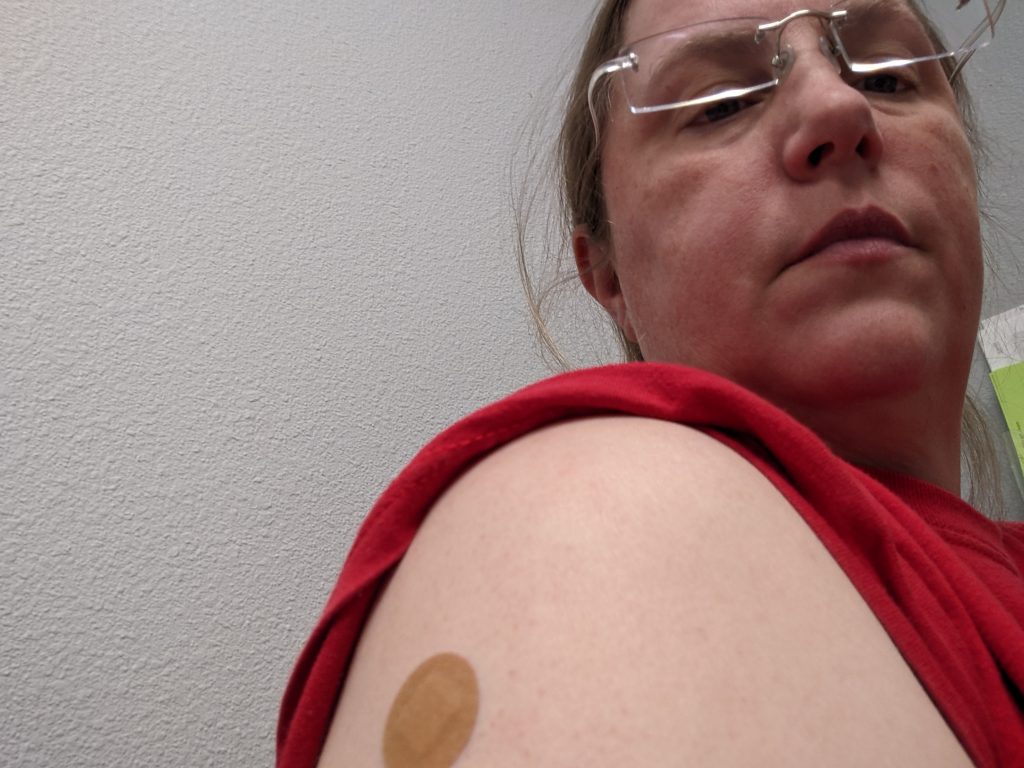
I received my third Novavax injection two days ago. The last couple times I’ve been at the Lynn Institute, the staff has had a hard time coaxing blood out of my arm for testing. The last time I was there, Angel tried and gave up, then Max tried, and then they went and got Bobbie, and Bobbie had success. So this time I was chugging fluids all day. I kept my coat on in the clinic too, to try to keep my arm warm. And Angel got lots of blood from me first try!
Then the doctor (one I hadn’t seen before) gave me a physical and said my blood pressure was too high. But not too high to get boosted.
Bobbie excitedly showed me the syringe, with no tape around it this time. “Look! It’s not blinded! You can actually see it! It looks like water, but it’s in there.” She gave me a quick injection, which I hardly felt.
I entered my current symptoms into the app on my phone that night after taking my temperature, which was completely normal. I said my arm didn’t hurt at all, which it didn’t. Then I lay down in bed, and my arm immediately started hurting.
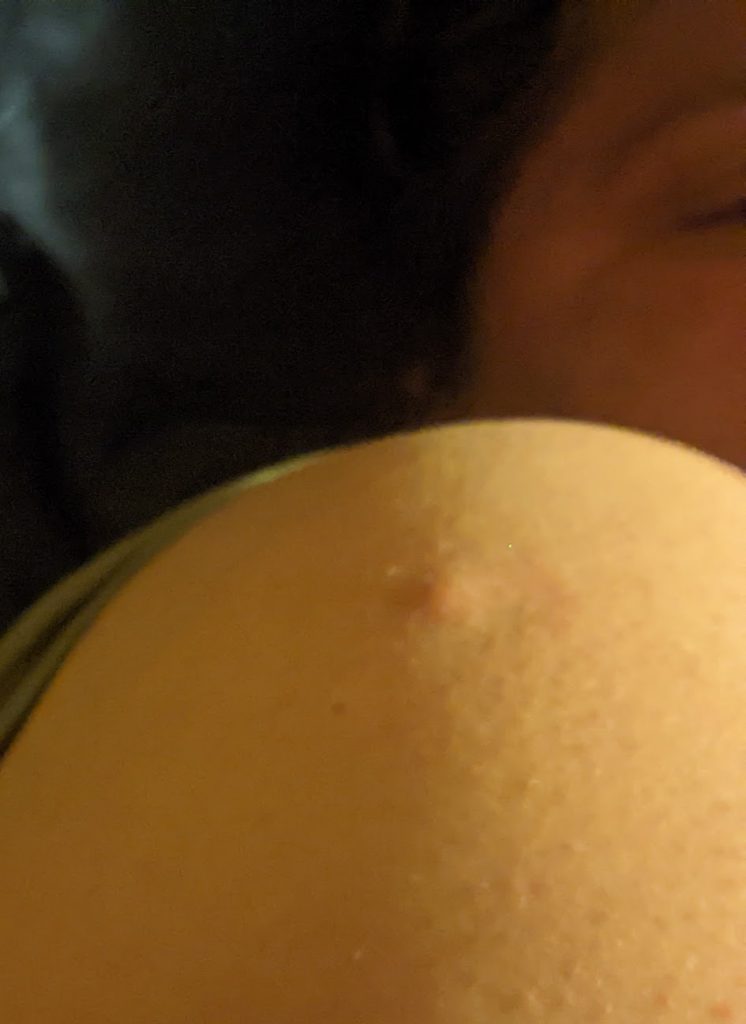
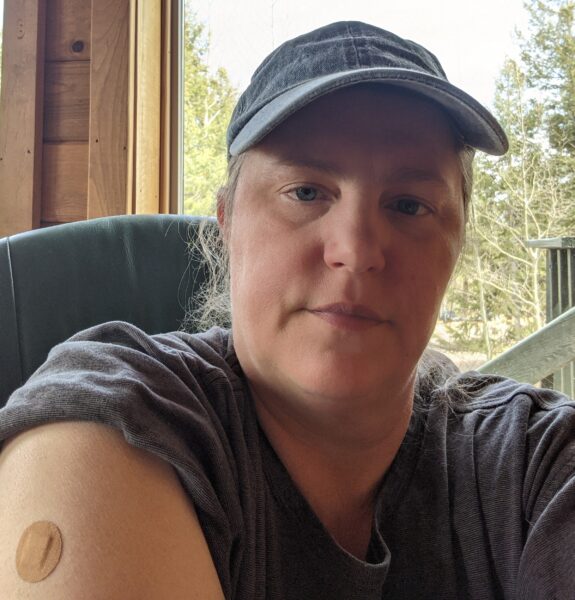
The next day my arm hurt pretty good but not as much as my flu shot in November. I developed what looked like a bug bite at the injection site. Here’s a blurry picture I took.
blurry injection site
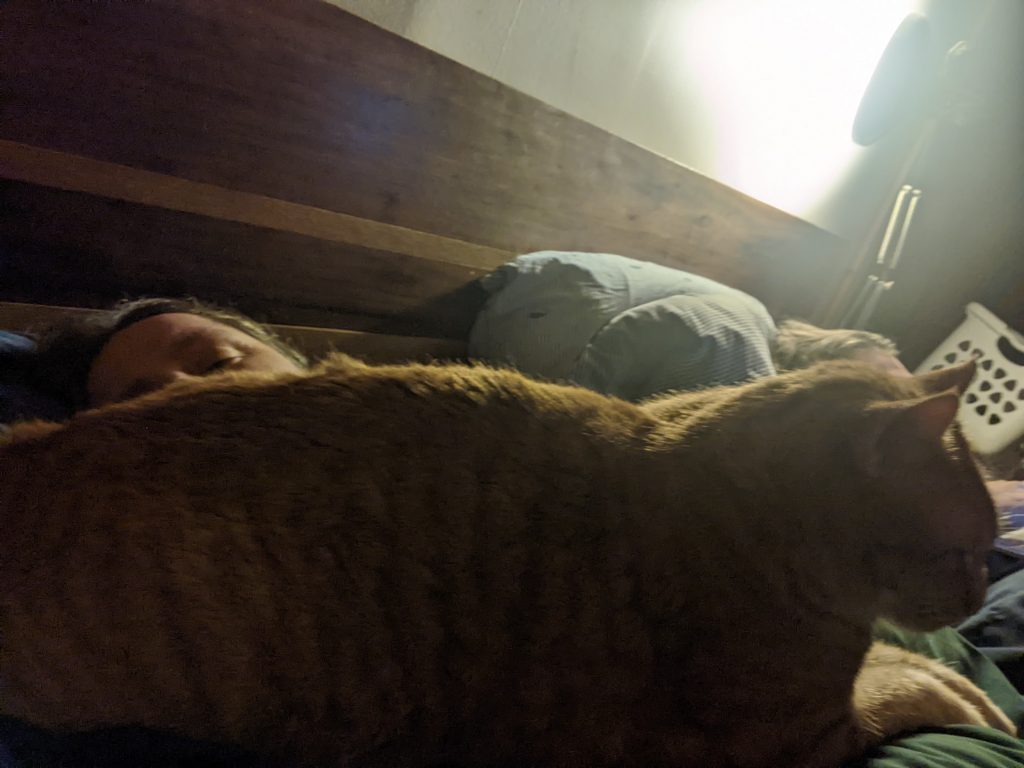
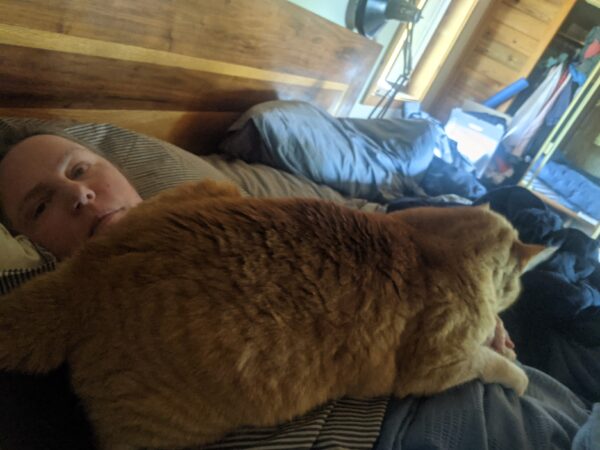
Other than the sore arm, which only really hurt if if I moved it, I felt fine all day. That is, until around 8pm in the evening. My whole torso felt sore, from my neck, shoulders, down to my lower back, and suddenly I felt really fatigued. That’s why I didn’t bother trying to take another photo of my arm. Here I am very mopey with a cat atop me.
feeling awfully mopey
Today, two days later after the injection, I feel perfectly fine. My arm feels a little bit of soreness. My upper arm is a little swollen, but the bump is going down. I have to measure it for the app. The bump is 2 millimetres wide, I think.
A vaccine is a drug that is administered to get the body to activate its immune system against a certain disease. There are many different kinds of vaccines. Some are made by killing the virus and then injecting it into you. Others may be a weaker form of the virus. Some may just be pieces of the virus, not the whole thing. Once these are injected into you, your body is fooled into thinking that you are infected and your immune system attacks and destroys it. Your immune system now remembers that, and should you get infected with the real thing, your immune system is primed and ready to react much faster than before.
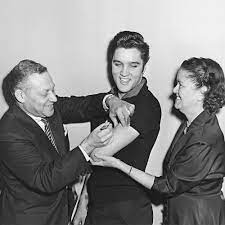
One of the most amazing vaccines ever created was the one to fight polio. However, there was a terrible accident soon after the polio vaccine was invented. One of the manufacturers didn’t weaken the polio virus they were using and actually infected people with polio instead of giving them a weakened virus. Many people were then terrified to receive the vaccine. Fortunately, that problem got fixed. Polio is such a terrible disease that people eventually overcame the fear of receiving a botched vaccine and got vaccinated. Polio has been eradicated in the US and only exists in a couple of places in the world now. Elvis getting photographed getting vaccinated helped convince people to receive the vaccine.
Novavax, the vaccine trial in which I’m enrolled, is a vaccine that injects a protein that is the same as the one the virus that causes COVID-19 uses to attach to the cells in the body. The protein all by itself (and not attached to a virus) is harmless to us, as far as scientists can tell. The protein is grown in moths, which have been infected with another virus that scientists have genetically modified to infect the moths and trick them into making the same protein that is on the COVID-19 virus. The Novavax vaccine also includes an extract from Chilean soap tree bark (a substance which is also used to make root beer foamy) that when injected acts to attract the immune system cells to the injection site, so they can see the foreign proteins and attack the proteins and remember them for the next time the proteins enter the body. Novavax works very, very well, but it probably won’t receive emergency authorization from the FDA because there are already plenty of other vaccines available that already work very well. Also Novavax is having a hard time getting enough supplies to make their vaccines. But hopefully, they’ll be able to make a lot that will be available for the rest of the world. The US government under Operation Warp Speed has given lots of money to Novavax to develop the vaccine. The normal process for a vaccine to be approved by the FDA is quite lengthy, so it will probably be a long time before it is available in the U.S.
So far Novavax has only performed limited trials of their vaccine, but the results have shown it to be very safe among the thousands of people who have received it. But it may take millions of doses for rare health effects to show up. However, the protein injection approach used by Novavax was first implemented for the hepatitis B vaccine, which has been used in the U.S. since 1986. The pertussis (whooping cough) vaccine, which is required for almost all children in U.S. public schools, is also made this way. Some people who have been wary of getting the mRNA vaccines may find Novavax more appealing.
The Johnson & Johnson vaccine uses a common cold virus that has been genetically modified to infect cells in the human body and tell the cells to create proteins like the one on the surface of the COVID-19 virus, which then the body’s immune system sees as a threat and attacks and remembers that particular protein. This type of vaccine is called a vector vaccine. After millions of people were injected with the Johnson & Johnson vaccine, a few developed a strange reaction. Nearly all reports of this serious condition, which involves blood clots with low platelets, have been in adult women younger than 50 years old. Some doctors have hypothesized that it may especially affect women who are are on hormonal birth control. The problem can be treated effectively with an anticoagulant drug, as long as someone who starts suffering symptoms (which usually start around a week after the vaccination) seeks medical attention. Unfortunately, the anticoagulant drug heparin, which is typically used for blood clots, actually makes the situation worse. But now medical professionals are aware of the problem with heparin and now use other drugs. This blood clotting reaction appears to be extremely rare, around one or two in a million, so it only appeared after millions of doses had been administered. The Johnson & Johnson vaccine has also been linked to an even rarer condition called Guillain-Barré syndrome, a rare neurological disorder in which the body’s immune system damages nerve cells which can result in pain, numbness and muscle weakness, progressing to paralysis in the most severe cases. Most people fully recover from the disorder.
The Oxford-AstraZeneca is also made from a genetically modified common cold virus, but this one is a virus that chimpanzees catch. It also has the very rare blood clotting problem, and the risk of death has been approximately one or two in a million. AstraZeneca has not been approved by the FDA and is not available in the US. It has been used widely in the United Kingdom and the rest of Europe. Australia has recommended that people under age 50 receive Pfizer instead. Scientists don’t know what causes the blood clotting issue. Yet.
The Russian made Sputnik V is also a vector vaccine and works by using a genetically modified common cold virus in its first injection, and a second different common cold virus in the second injection three weeks later. It is very effective and seems to be very safe. There haven’t been any reports of any blood clotting issues. It is not available in the U.S.
The Pfizer and Moderna vaccines are a brand new type of vaccine that has never been used before. Instead of modifying a virus that already exists like the vector vaccines, it is a string of genetic code that is manufactured in a laboratory, wrapped in fat particles, and then injected into human muscle cells. The genetic code is accepted into human cells, that recognize it as instructions to produce proteins that the immune system gets excited about and attacks. This sort of vaccine is call a messenger RNA or mRNA vaccine. It is an astonishing marvel of modern science. Scientists are working on mRNA vaccines for all manner diseases, and the possibilities are quite promising. Because the genetic code is produced in a lab, scientists can change the recipe at any time and create a brand new vaccine that’s ready to go as soon as it can be produced in a factory; this will come in handy with a mutating disease like COVID-19. Some people have received the mRNA vaccines have had rare instances of myocarditis, which is inflammation of the heart muscle, mostly in male adolescents and young adults age 16 years or older. Symptoms include chest pain, shortness of breath, and feelings of having a fast-beating, fluttering, or pounding heart. People who have suffered myocarditis after receiving an mRNA vaccine who have received medical treatment have had their symptoms resolve. Scientists don’t know why the mRNDA vaccines apparently cause myocarditis in a very small percentage of people. Yet.
There are other vaccines as well that are in research and other vaccines that are being produced in other countries. One of the biggest ones is Sinovac, which is a Chinese inactivated vaccine, which means it’s the COVID-19 virus that has been killed and then injected. Unfortunately, it’s only about 50% effective (as opposed to Novavax, Sputnik V, Pfizer, and Moderna, which all have effectiveness in the 90% range), though it does seem to be very effective against death.
All of the vaccines have some side effects that might make you feel sick after you get them. That’s your body’s immune response trying to fight the invasion of foreign stuff being injected to it. This response is a good thing because it means your body immune system is working like it should.
The bodies of people who have previously been infected with COVID-19 have developed a response to the virus that help keep people from being infected again. There have been very few documented cases of people catching COVID-19 twice, but it has happened. There are also people who have caught COVID-19 even after being vaccinated, though their chances of being hospitalized or dying are far, far lower than otherwise. Scientists who have measured the immune response in people who have had COVID-19 verses people who have been vaccinated have found more antibodies—proteins made by the immune system in response to an infection or vaccination—in people who have been vaccinated. That’s why scientists and medical professionals are urging everyone to get vaccinated, even those who have had COVID-19. But there is also an argument that people who already have had naturally produced antibodies should foregoing getting vaccinated until those who are completely unprotected have the opportunity to receive a vaccine, and there are a lot of people in the world who haven’t been vaccinated who would really like to be. I think at this point everyone who really wants to get vaccinated in the U.S. has had the opportunity to get vaccinated. But I don’t think the U.S. government is going to be sharing all our vaccines anytime soon. There’s evidence to suggest that the antibodies our bodies produce decline after around six months. So people who have had COVID-19 should go probably just go ahead and receive a vaccine.
All viruses mutate (change), and the mutations that stick usually end up making vaccines more transmissible. The COVID-19 virus is no exception. At some point, we’re all probably going to need either a booster shot (a vaccine for the original COVID-19 virus further in the future to remind our immune system) or a new vaccine for a mutated COVID-19 virus.
The only way the human body defeats COVID-19 is by its own immune system finding and killing all the viruses. We can help the body by giving it a cheat code to recognize the virus as soon as it shows up before it has a chance to attach to our cells and take over, reprogramming our cells to do its bidding and create many more viruses, eventually either making us spread the virus to other people, making us sick, or even killing us.
Of course, all of these vaccines are new, and there could be long term health effects we aren’t aware of now. But COVID-19 is also really new, and we’re only beginning to discover just how devastating the damage it causes can be. We don’t know yet if the human body can recover from the damage COVID-19 can cause to the lungs, joints, heart, and even brain, and that’s if COVID-19 doesn’t kill you first. So far it looks to me that the dangers of COVID-19 far outweigh what appears to be the extremely rare side effects of any of the vaccines.
I find the human body amazing, and I find science amazing too. The very idea that we can genetically modify viruses that can fight other virus is super cool. The promise of mRNA vaccines I find especially exciting. Scientists are even working on mRNA treatment for cancer! Human might be able to treat all sorts of diseases like we never have before because of the research that has been going on recently.
I am not a scientist or a medical professional. I am just a person who is interested in science and medicine. I have tried to write this to be as easy to understand as possible. I have not included any citations because I find citations distracting and/or intimidating. If you would like a citation to anything above, let me know, and I will provide it. If I have made any errors or you think I should add any clarifications, please let me know along with your evidence, and I will try to edit this as quickly as I am able to.
Yesterday was my fourth and final Novavax trial shot. Berck got his last week. That night he reported that his whole back hurt and he felt terrible, although that was a pretty good excuse to not have to drive home from Serrano’s. Also, he couldn’t sleep on his arm.
The fourth shot felt about like the third one, hurting going in. Then my muscle felt like it was hurting a little bit while I waited for the 30 minutes before I could leave. It felt like I had worked out really hard at the gym.
Then last night I woke up around 2:30 a.m. with my arm hurting really badly and I couldn’t go back to sleep. I had told my boss that I would plan to work from home the day after my shot just in case, but then yesterday I got an e-mail saying there would be mandatory COVID testing at work today. So I dragged myself out of bed and headed to work. My low back and neck and shoulders all ached, and felt lousy. I worked until 11:15, when the testing nurse showed up. She asked me my name and then asked if I had any symptoms. I told her I’d had my second (real) shot the day before and felt pretty lousy. And she answered that I couldn’t be tested because I might present a false positive. So I clocked out for lunch and drove home.
Even though I’d had two cups of coffee that morning, I crawled into bed and fell asleep. The cat was happy to have a napping partner. I slept lightly for a couple of hours and then felt a lot better and went back to work.
So I’m fairly certain I had a placebo the first two shots and the last two were the real thing. Berck is too.
I’d say I’m pretty relieved to now be fully vaccinated, although I don’t know if anyone knows how long it takes after the second (fourth) shot to be fully activated. I’m not proud, just relieved.
My next appointment for the vaccine trial is in December. They will be continuing the study for another year after that to take my blood and study the long term effects.
Today was my third Novavax trial shot, in the crossover trial. So if I got two placebo shots previously, today I got a real Novavax vaccine. And if I got two shots of the Novavax vaccine previously, today I got a placebo.
Today’s shot seemed to hurt worse going in and then started hurting/burning within a few seconds, which went away after a few minutes. Then a couple hours later, my arm really started hurting for a couple of hours. It’s calmed down quite a bit now and isn’t really bothering me as much.
If I compare this reaction to my first shot, it is very different, and they both hurt! So now I still have no idea when I’ve received a placebo and when I’ve received a vaccine. My final shot is scheduled for three weeks away, and then I’ll finally be fully vaccinated.
The governor has announced that everyone in the state is eligible to get a vaccine as of Friday.
On the other hand, we have appointments to receive our third injections in the Novavax crossover trial in three/four weeks.
Do we abandon the trial and get some real shots? (The Lynn Institute instructed us to let them know if we had the opportunity to get an approved vaccine, and they would un-blind us to let us know if we are already full vaccinated or not.)
Or do we stick to the schedule? I put myself on a waiting list for a vaccine the other day because I figured I qualified under two or three qualifications under tier 1B.4. But I didn’t get a notification for an appointment.
I wonder how long it would take to get a notification for a vaccine appointment being in tier 1B.4. It seems like I might get an appointment before the general populace, which can start trying to get an appointment in three days. Would that be before my next Novavax appointment on April 26 at 9 a.m.?
When I signed up for the Novavax trial, it seemed like a good way to cut in line. I either got a vaccine months early or I qualified to be in tier 1B.4, one step ahead of everyone else. And it made me look like a hero! It didn’t seem like a hard decision.
Also, science!
But now that it comes down to it, I’ve been doing what I’ve been doing for a year and two weeks now. I could keep doing it for four more weeks and help scientists who are developing a highly effective and easily storable/transportable vaccine and help protect the world.
Or I could take my place in line, rightfully so according to the state, and get a “real” vaccine (which I might or might not actually be able get in the next four weeks anyway). And I could give up my status as a hero, as little as my part to play is.
So I took myself off the wait list.
Science.
Of course, I might have been fully vaccinated since January.
(Berck will tell you this is not a hard decision.)