foot hurts swollen top

My foot started hurting on Friday.

 
It got worse over the weekend, and was really hurting yesterday.  Yesterday I wore sandals to work, so I knew it couldn’t be my shoes that were the problem.  Last night, despite taking Aleve all day, it hurt badly, it was hot, and once I took my sandals off, I realized it was quite swollen.  Berck asked why I was limping around. “Because my foot hurts.”
 
“Why?”
 
“I don’t know!” 
 
“Well, take drugs, ice it, and go to a doctor.”
 
“What’s a doctor going to do?”
 
“Tell you to take drugs and ice it.”
 
I decided to save myself a couple hundred dollars and continue taking Aleve and ice it.  There hadn’t been any trauma, so I didn’t see how it could be broken.  I’ve had broken bones, and that’s a very specific type of pain.  Palpitating didn’t indicate any one area of severe pain.  While I iced it, I decided to Google “foot”, “hurts” and “swollen”.  Google suggested adding “top”, and I accepted that, because it did hurt on the top of my foot.  Google knows everything.
 
I’m not a doctor, nor do I play one on TV.  But I have worked in the medical field, and my job as a paralegal in a law firm that does work comp and Social Security disability involves reading lots and lots of medical records.  I also know that doctors hate it when you try to self-diagnose using WebMD.
 
But as soon as I hit enter, Google said I had  extensor tendonitis and directed me to podiatrynetwork.com.  Here’s what it has to say:
“A common area of pain occurs near the middle of the top of the foot, generally a bit to the outside of the foot. In this area of the foot the tendons that go to the toes can become inflamed. This is called extensor tendonitis. One cause of this condition is excessive tightness of the calf muscle. When the calf muscle is tight it places excessive stress on the tendons on the top of the foot that pull the foot upward and against the tightness of the calf muscles. Wearing a shoe with a one-inch heel will help to take the stress off of the tendons on the top of the foot. Aggressive stretching of the calf muscle is also very helpful. Oral anti-inflammatory medications can help.”
 
Wearing heels to cure foot pain seems awfully counterintuitive. I don’t really have a pair of daily heels, or even pumps, so I started stretching my calf.  And today my foot feels a lot better.  I haven’t even taken my night Aleve.
The moral of this story is that aging sucks.  And sometimes Google can tell you the most amazing things.

Totality Snapshots

We were listening to this podcast on our way down to Mexico this spring and thought, hey, maybe this total eclipse thing is worth seeing. We’d both seen partial eclipses before and were like, that’s pretty cool, but it didn’t really seem worth going out of the way to see.  But if all hotel rooms were booked a year in advance all along the path of totality and all we had to do was drive a few hours north to Wyoming to see it?  Why not?  So as soon as we got back from Mexico, I put on my company calendar that I would be out August 21.  Berck ordered some eclipse glasses from Amazon.

A couple weeks before the eclipse, our friend Andrew called Berck to ask about flying up to the path of totality.  Berck told him there were too many variables involved in flying, and besides, we had already planned to drive Frances the Land Cruiser to Wyoming the day before and find a good place to camp, or at least park, and watch the eclipse the next day.  And that we had an empty back seat.  He decided to join us on our adventure.

Berck got an e-mail from Amazon saying that they had been unable to verify from the manufacturer that the eclipse glasses they’d shipped us were safe, despite saying all over the package that they were (it also said they were made in China).  By now we had tried them out by staring at the sun with them on. Fortunately, he Thursday before the eclipse, one of Berck’s coworkers gave him two certified eclipse glasses.

Saturday I baked buns, and Berck cooked brats in beer.  Berck cut up and gathered two plastic tubs of wood for a campfire.  Then he checked one more time and saw that a fire ban had been put in place for Wyoming.  He took the tubs of firewood back out of the Land Cruiser.

Sunday morning we got up early and packed up.  Berck had me buy 60 pounds of ice, only 50 of which we could fit in our cooler and mash tun (which also happens to be a cooler).

Stopped in Boulder and had a delicious brunch with Andrew and his girlfriend Kayleigh, who was also able to come.
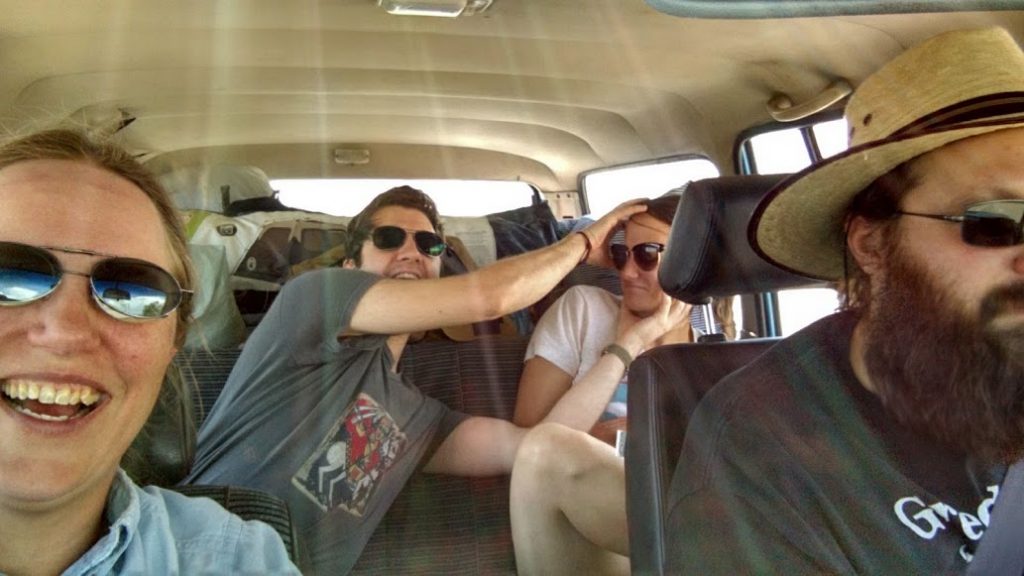
Andrew made me check if we were in the path of totality yet every five minutes or so of driving.

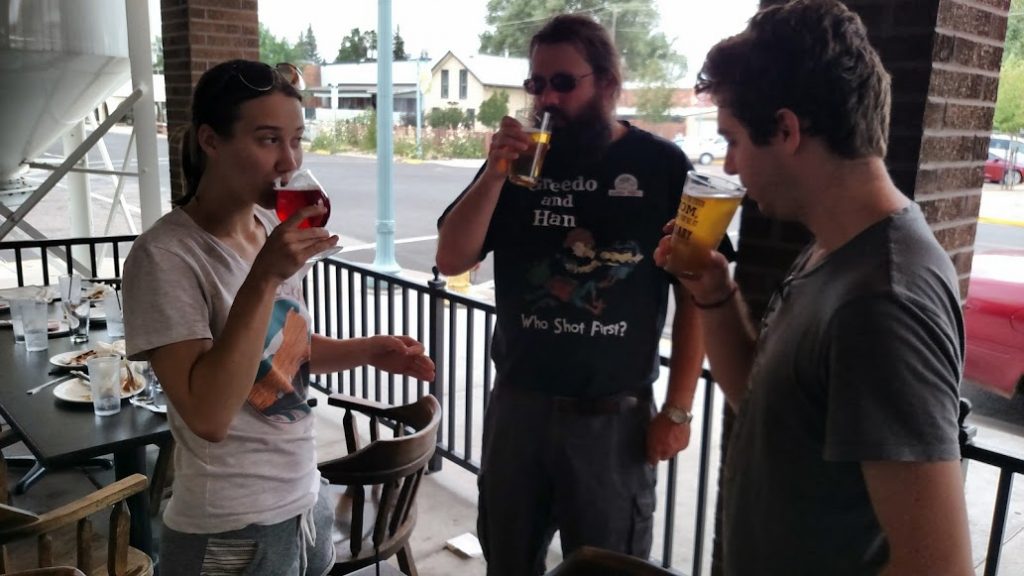
Stopped in Laramie for ice cream and beer.  Had to drive a whole block away to find a parking place.  Guy at the brewery said they were slammed with all the out of town traffic.
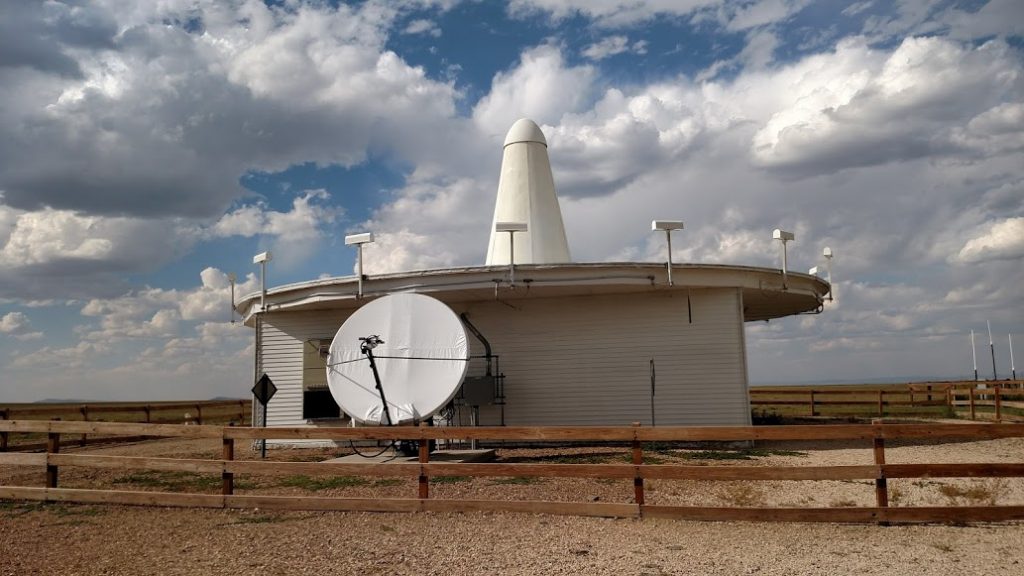
Stopped at the Medicine Bow VOR, which Berck had flown over countless times but never seen from the ground.  Kayleigh was mostly amazed at the amount of cow hair stuck to the fence from them scratching against it.
We gassed up in Casper in the middle of horrible dust storm, but it was the last gas until Shoshoni.  We pulled off in the thriving metropolis of Moneta for Andrew to take a photo next to the unincorporated municipality sign then headed south from Highway 24 down Castle Garden Road.  Our research had told us that this area was likely to have clear weather and that all the land we were on was BLM land, on which it is perfectly legal to camp anywhere, as long as you’re 100 feet from any water source and bury your poop at least six inches.  I’d bought a shovel the week before at a military surplus store.
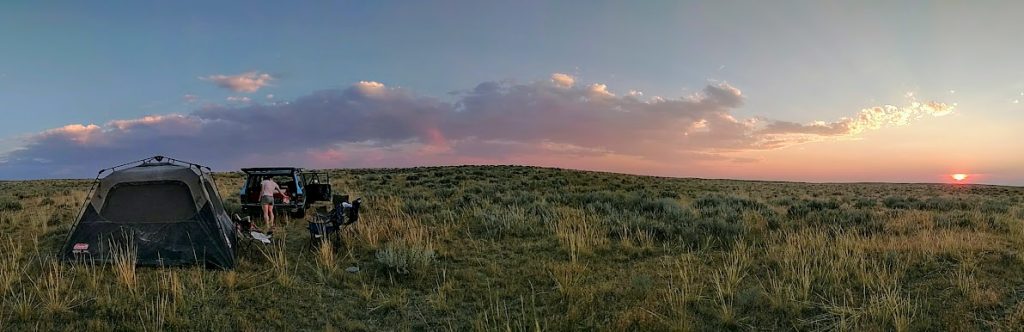
Andrew and Kayleigh set up their tent, and we blew up their air mattress from the cigarette lighter in the Land Cruiser; then we blew up ours.  We set our air mattress out on a tarp on the ground, after a search for the area with the fewest cacti.
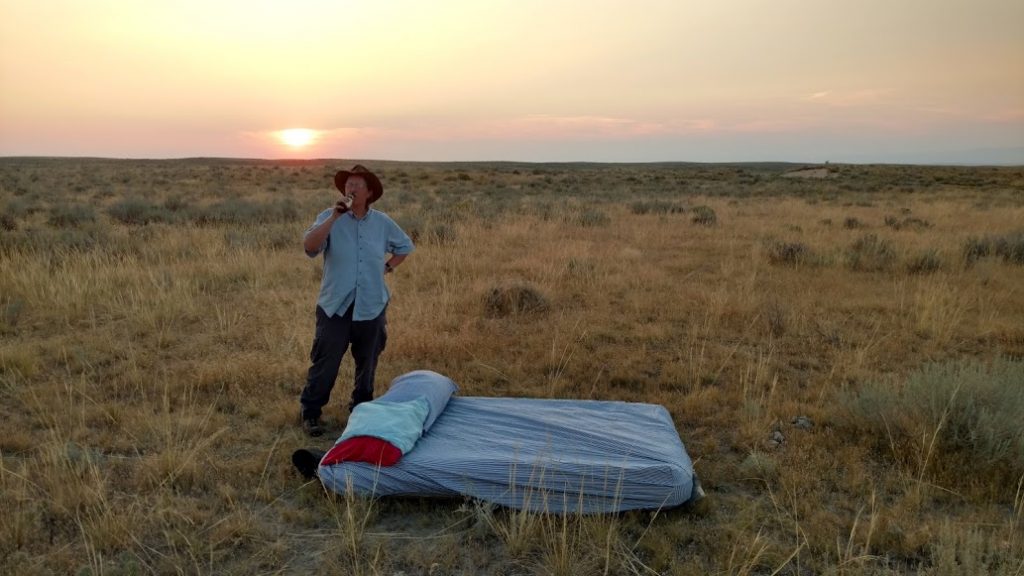
 

Andrew and Kayleigh thought that was such a great idea that, after stuffing their air mattress into their tent, they extricated it and laid it out in another area relatively free of cacti.
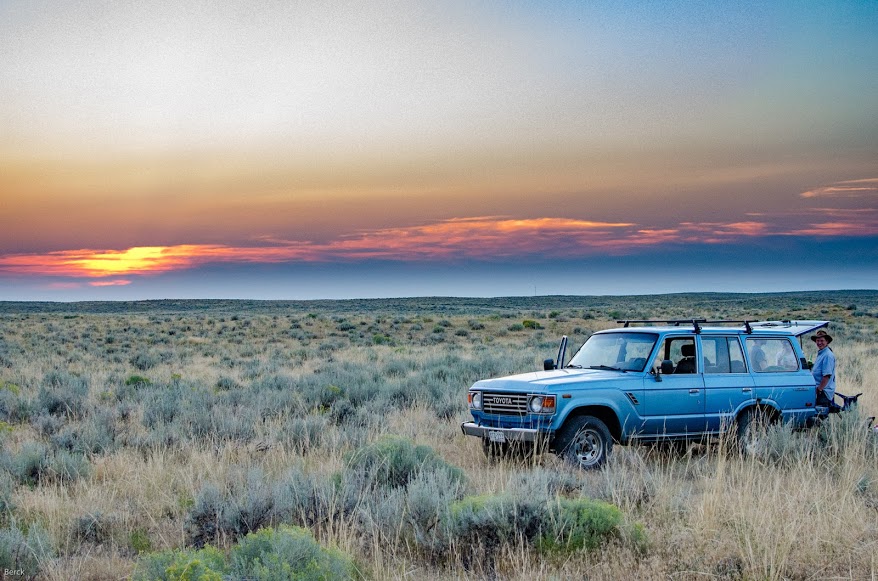
Berck set up the camp stove and heated up the brats.  We opened the cooler and popped open bottles of beer and sat in our camp chairs and ate, eventually turning out the lantern and admiring the Perseids streaming out of the north sky. The weather was perfect, and the biting flies only bit so much (I got a nice bite on my right hand and side of my neck). We slept under the Milky Way.

I awoke just as the sun was rising.
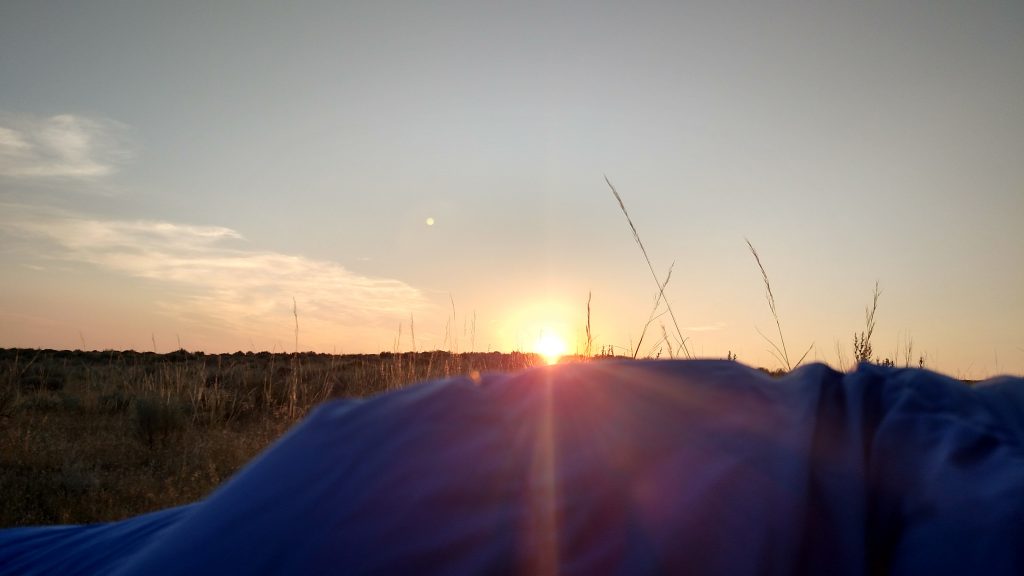
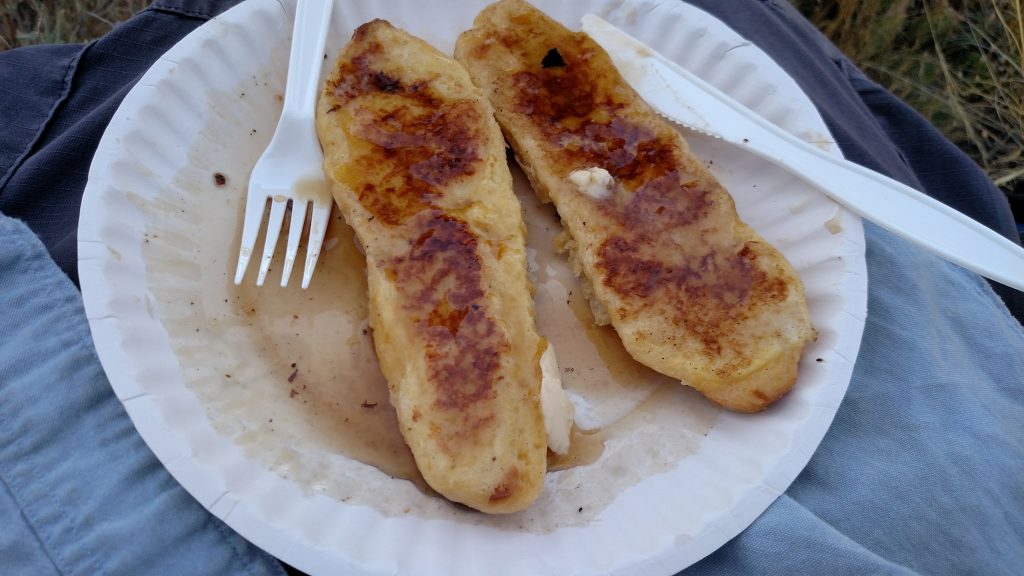
Everyone else stayed asleep, so I went for a walk and then read my book.  Once Berck and Kayleigh were awake, I cleaned the brat pot to heat water for coffee and make bacon and French toast.
Andrew set up a pop-up, which was awfully nice to be under once it started getting hot.
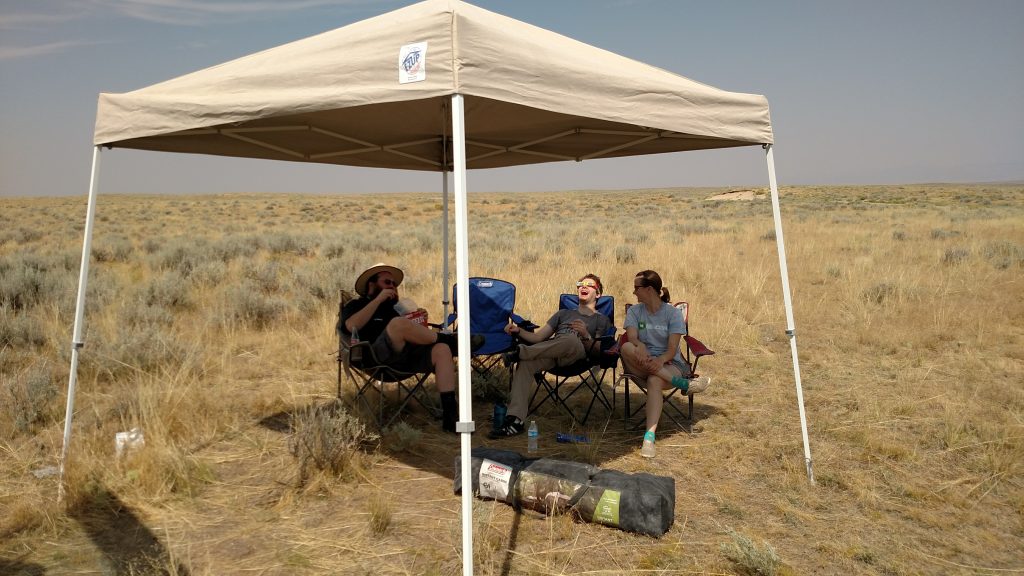
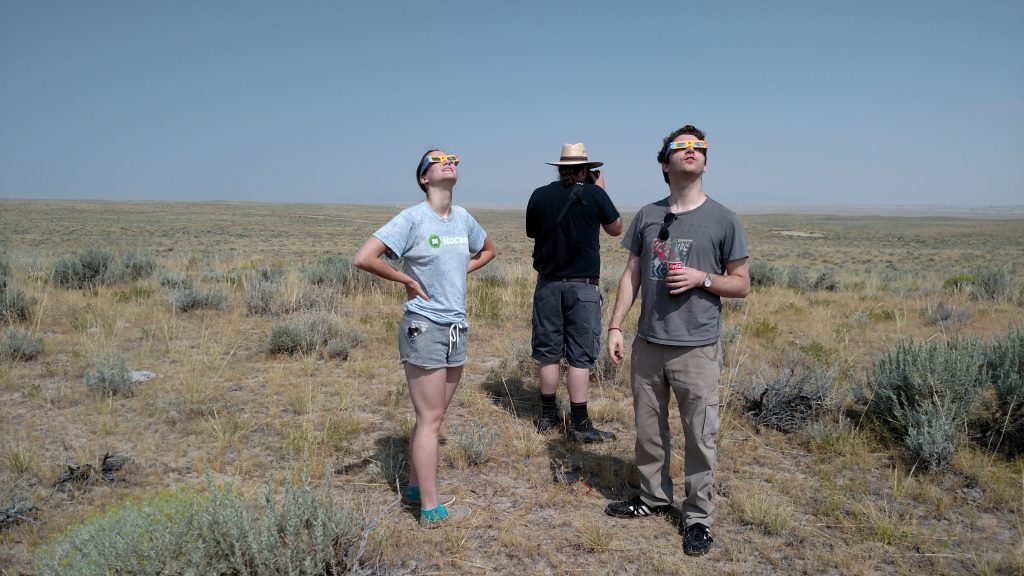
As the partial eclipse started, we put on our glasses periodically to watch its progress. You can’t see anything else wearing them.
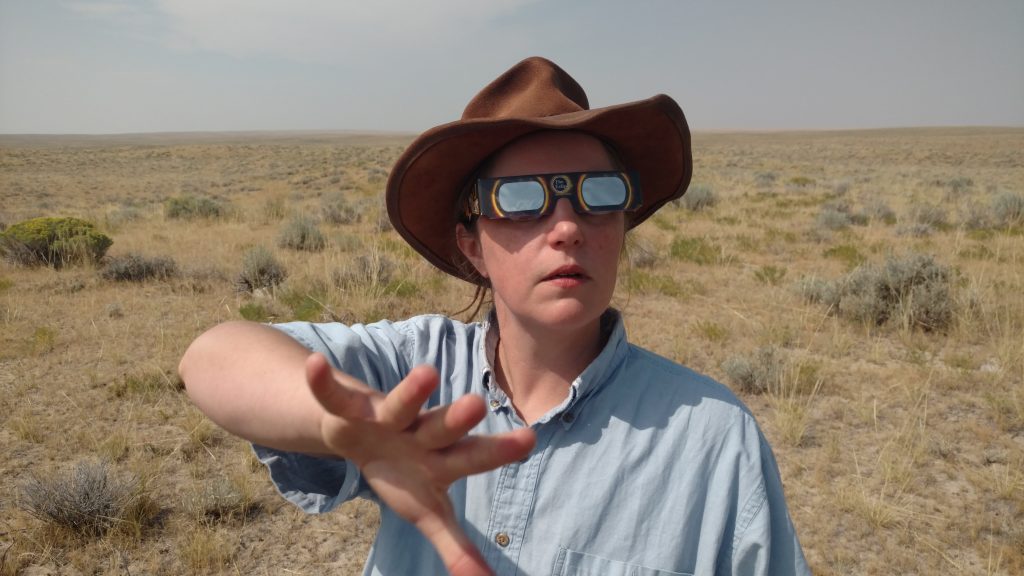
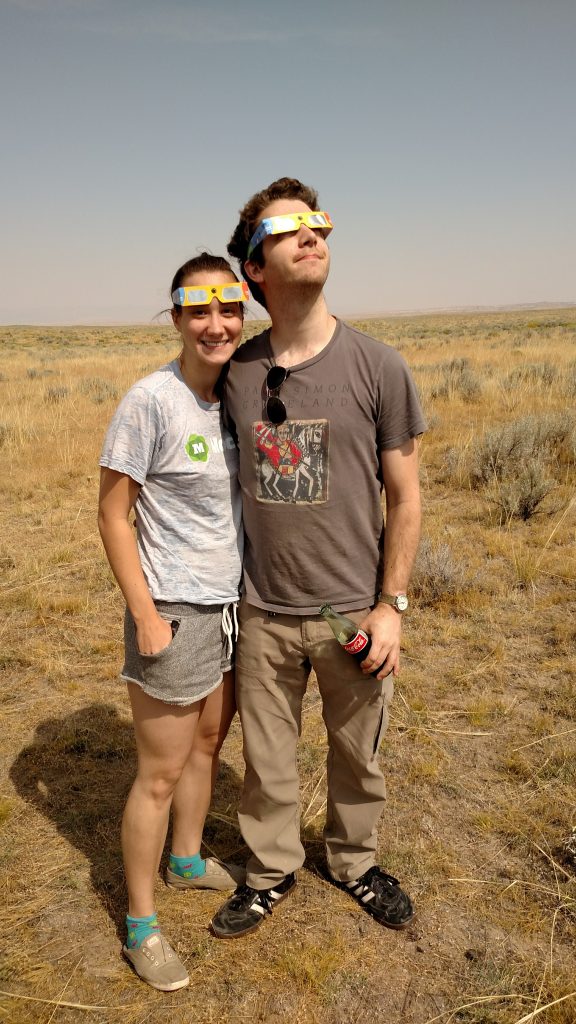
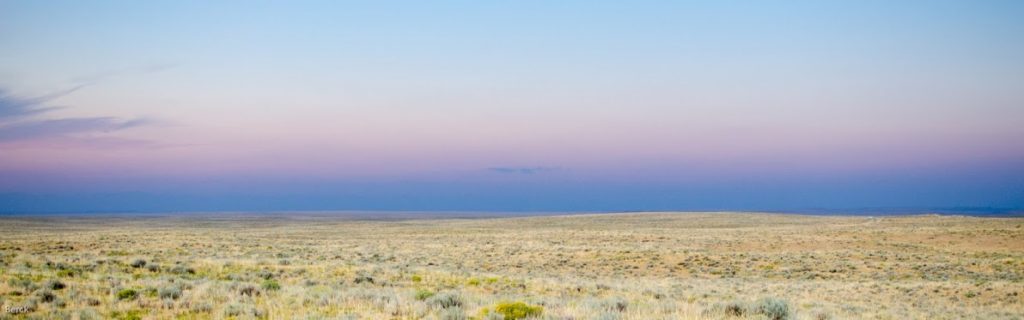
Totality was getting close, so we decided to hike up to the top of a nearby hill to watch.  Here’s the darkness approaching from the west.
Finally, the last little bit of sunshine disappeared, and we took off our glasses.  We’d been listening to Pink Floyd’s Dark Side of the Moon play on a Bluetooth speaker Andrew was carrying around.  Andrew had set the album to start playing so that the final song “Eclipse” would come on right at this moment, and it did.

For the weeks prior to the total eclipse, the news media had been doing stories on the eclipse non-stop.  I listen to a lot of Public Radio, so I’d heard story after story of eclipse chasers and people who say it’s an amazing experience.  The media had played recordings of people watching past eclipses, and the sounds of rapture were amusing and alluring all at once.  People just couldn’t seem to be able to keep from shouting when totality happened.

And that’s what happened to us.  Despite the fact that the four of us were standing close together atop a hill, watching something we had come here specifically to watch, we started shouting in amazement anyway.  I’ve seen lots of photos and videos of totality, and nothing seems to be able to truly capture it.
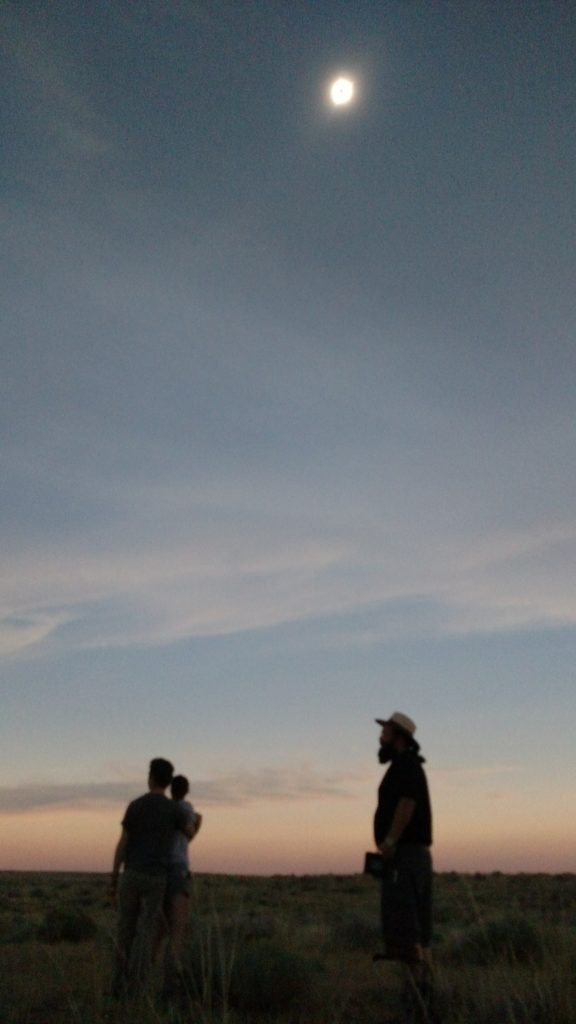
Here’s a picture I tried to take with my phone.  It’s blurry because it was pretty dark, like dusk, but the sun’s corona is still really bright.  What you can’t see is the black hole where the sun should be.  It was dark enough that we could see Jupiter clearly.  It wasn’t quite dark enough to see stars.  After much fiddling with the settings on his SLR, Berck was able to take this photo, which is closely cropped.
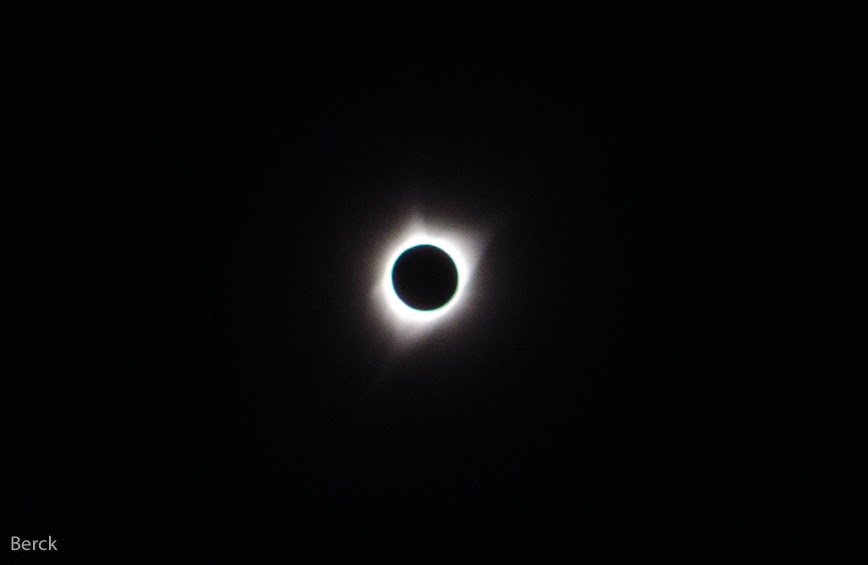
It didn’t look like that because the sky was still blue.  The air got cold.  And then it started getting light around us and the sun poked out a tiny ray of sunshine.  Our bodies cast shadows again, and warmth came back.  And right then Pink Floyd’s “Eclipse” ended and the next song Andrew had set to play came on, Bonnie Tyler’s “Total Eclipse of the Heart”.

The total eclipse was definitely worth seeing.  Even if we had to sit in traffic on two lane highways for three hours in the Wyoming sun on our way home.  Because we were willing to take backroads, we probably had to wait in traffic for a lot less time than a lot of people, and Andrew’s plan to take the west route home instead of back through Casper turned out to be an excellent decision, as I later heard from my friends trying to get back to Colorado Springs from Casper (a 13 hour trip). But we’d gassed up in Shoshoni, and I’d brought enough water and snacks for a small army.

Once we got to I-80, things got a lot easier, and we even had time to meet our friends Laura and Jared in Ft. Collins for dinner at an excellent Afghan restaurant, where Andrew got to exclaim, for the very last time this trip, “The difference between a partial eclipse and a total eclipse is LITERALLY night and day!”
Koch Brothers

I just finished listening to Freakonomics’ two-part interview with Charles Koch. (I found part II much more interesting than part I.)

I was somewhat dreading listening to these, figuring I had a pretty good idea of what Charles Koch would have to say, given the sort of candidates he’s donated to. I was mostly wrong. I was very surprised to find out that he and I actually have very similar political views on most issues. He identifies as a classical liberal, as do I.

He believes that freedom is very important. He’s generally pro-immigration, pro free trade, anti politician, and possibly above all, anti special interest. He’s anti war on drugs, and, in general, espouses fairly liberal views on social freedoms, though it’s clear these issues are not at all important to him.

I’d generally believed the idea that Koch brothers spend most of their money in support of their own interests. Suurprisingly, they loudly advocate for causes and positions that would, in fact, cost them lots of money.

So I’m left a bit dumbfounded at the list of politicians the Koch brothers have backed. Take, for instance Scott Walker. Scott walker is anti-abortion, pro foreign military involvement, anti immigration, anti same-sex marriage. These positions are in direct contradiction with the stated positions of both Koch brothers.

The closest I can come to reconciling their statements and the candidates they’ve backed is simply that social issues aren’t at all important to the Kochs. David Koch, in an interview with Barbara Walters, said in response to a similar question, “What… I want these candidates to support a balanced budget. I’m very worried that if the budget is not balanced, inflation could occur and the economy of our country could suffer terribly.”

So it’s not that we disagree on most of the issues, but I do think we seriously disagree about the priorities. I don’t think that liberal economic policies are anywhere near as terrible as he does, and he doesn’t think that socially conservative policies are anywhere near as terrible.

Fundamentally, while we both rate freedom as the most important thing, I think we actually disagree about why it’s important. I view freedom as a necessary first principle, without which we cannot possibly get anything right. Koch believes that freedom is not just a good in its own right, but in fact, a *sufficient* good.

Take, for instance, his position on global warming. He believes that it might be a problem in the future, and he thinks innovation is our best way to solve the problem. He believes that all the regulation enacted to date to address the problem is merely symbolic and will do nothing to actually solve it. I agree with him up to this point. But then we diverge. He believes that we can achieve the necessary innovation by simply “removing regulatory obstacles to innovation”, and solutions will, somehow, magically flow forth.

I disagree entirely. I don’t believe that there is regulation hindering innovation. Furthermore, I believe the exact opposite: regulation is one of the best ways to achieve innovation! How did we get awesome LED lights that work better than incandescent bulbs and are now affordable? Regulation that outlawed incandescent bulbs. Sure, there was a terrible period where all we could get were awful CFL bulbs. But now we have awesome LEDs that provide higher quality light at lower power for cheaper long-term prices than incandescent bulbs. This never would have happened so fast without the regulatory pressure.

Furthermore, I think it’s just absurd to think that freedom will solve all our problems. We need freedom in order to solve them, but freedom alone isn’t going to do it.

Biscuits in Divide

Jonah used to make excellent biscuits, but then we moved to Divide. The difference in altitude (6,000ft to 9,000ft) was enough to turn her biscuits into greasy blobs suitable for packing to your next arctic exhibition. So I fired her from biscuit making and decided to try it myself.

There are a lot of myths about baking at altitude. Rules of thumb that say “add/subtract ingredient X per thousand feet of altitude” are generally terrible advice. Corrections that work at 6,000 feet may need to be completely reversed by 8,000 feet. In Colorado Springs, we mostly got by without changing much, but our house is at 9,200ft now, and that changes everything.

The most important information I’ve found is in a book that someone (she can’t remember who) bought for Jonah: Pie in the Sky by Susan Purdy. She actually has recipes for 10,000ft, all of which she worked out in Breckinridge, so they actually work. Looking at the altitude tables for each recipe in this book illustrate just how different things are at each altitude.

When it comes to biscuits, she had the most important piece of information: buttermilk biscuits are just not going to work at 10,000ft. The reaction is too quick, releases too much pressure, and eventually results in collapsed biscuits. She says that she had an incredibly hard time finally producing biscuits for this altitude.

So, I took that information, and her otherwise boring biscuit recipe and combined it with techniques from Peter Reinhart as well as a few tricks of my own to produce the first biscuits I’m actually happy with in Divide.

1/2 cup heavy cream
1/2 cup vodka
1 stick frozen butter
1 tablespoon + 1 teaspoon baking powder [EDIT: 1 TB is sufficient]
1 teaspoon salt
2 cups all-purpose flour (though half pastry flour would be better if I could ever find it)

Grate the frozen butter into the flour, add the rest of the ingredients. Roll/fold the dough at least 4 times then cut into biscuits. Bake on a stone at 425F.