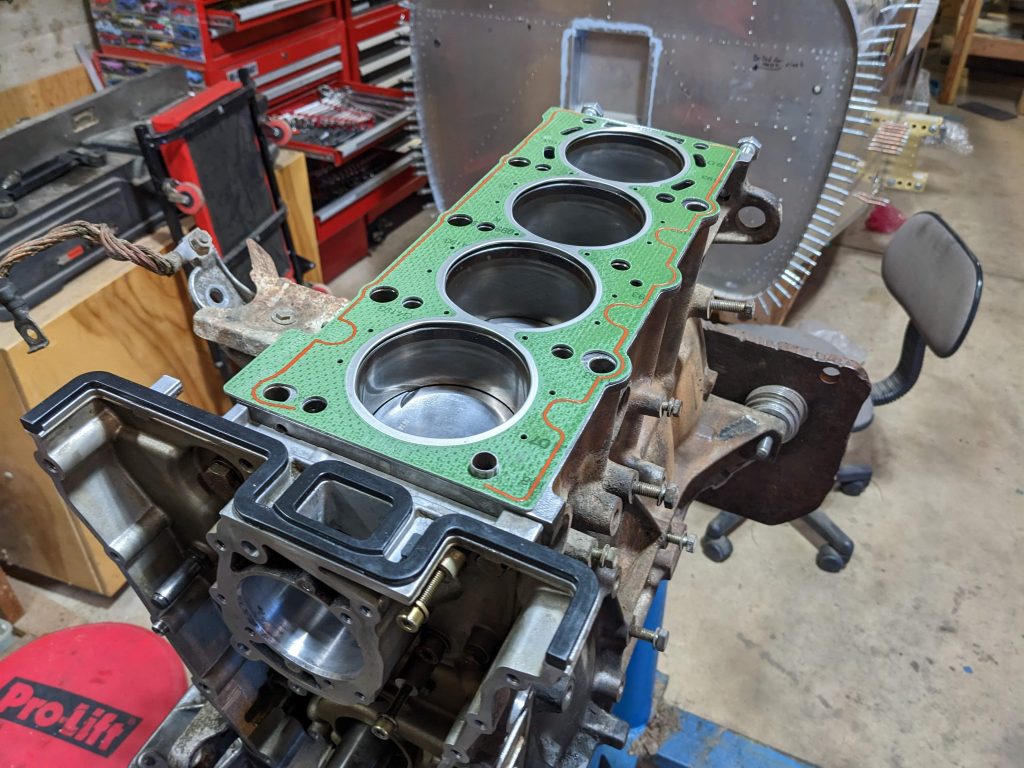
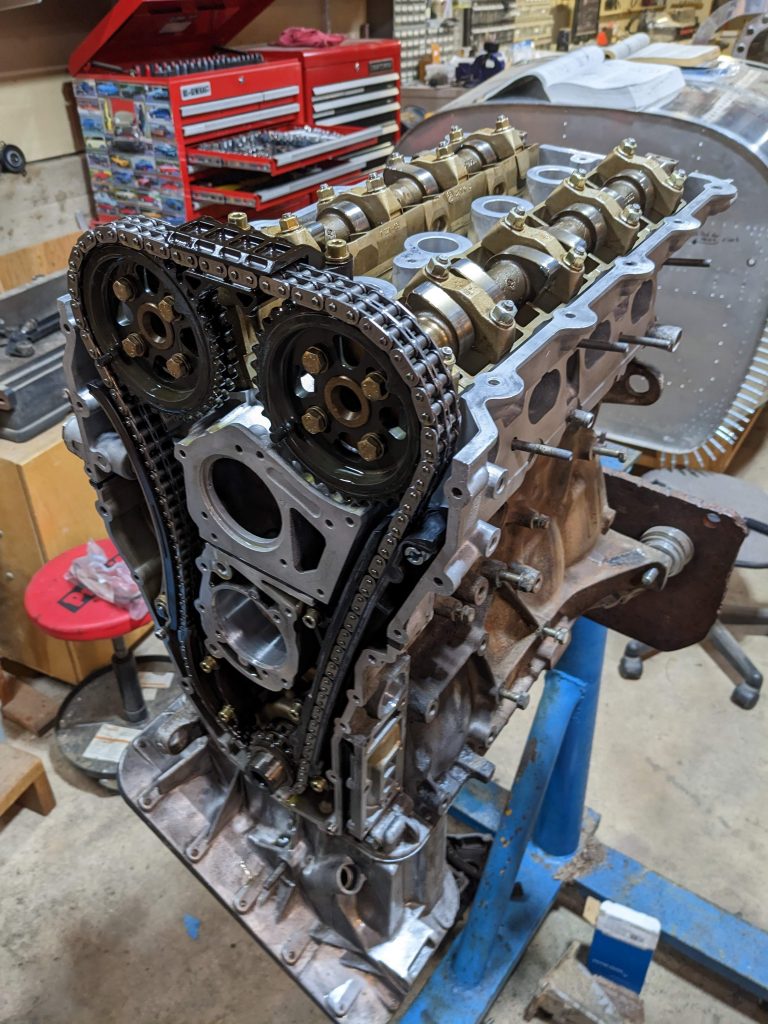
Forward progress. I’d forgotten, initially, to loctite the bolts that Josh said to loctite. I remembered to do it before the lower oil pan though, so I went back and did that, as well as the oil pickup bolts since apparently they’re problematic as well. I went ahead and doubled the lower oil pan gasket and hope that it works out.
Other frustrations–the Bentley manual talks about an oil supply check valve that goes in the block, but neither of mine had any such thing. Some internet searching found lots of other perplexed people. Apparently the part is listed, but it doesn’t actually fit unless you machine the threads in the block. Not having any interest in that, I’ve chosen to believe the parts of the internet that say such a valve was only for later years. It probably does need a valve–possibly related tow hy it takes 20+ seconds on a cold start to get oil pressure? Or maybe that’s because my oil pickup was smashed into the bottom of the pan.
I feel like there must have been more than one alignment sleeve between the block and the head, but the head came back with only one in the baggy of bits of they removed. Possible it stayed with the block and I lost it. Possible there was only one. I put it back together with one.. How misaligned could this get, anyway?
I used the cams and caps that came with my car, because the ones that came with the replacement engine looked servicable, but noticeably more worn. Some of the hydraulic lifters that came with my car had some pretty significant pitting on the surface, so I swapped the questionable ones out. They have different part numbers. I hope that works out.
I thought I’d ordered new bits for all the timing chain stuff. The old version of the guide that goes against the tensioner is NLA, but the new one is still available. Only, for some reason, it appears my new timing case had the old style installed. The difference appears to only be that the stud it pivots on is much, much larger on the new version. Not having a new stud, I used the better of my two worn ones. I’m sure it will last long enough for me to drive into a tree, right?
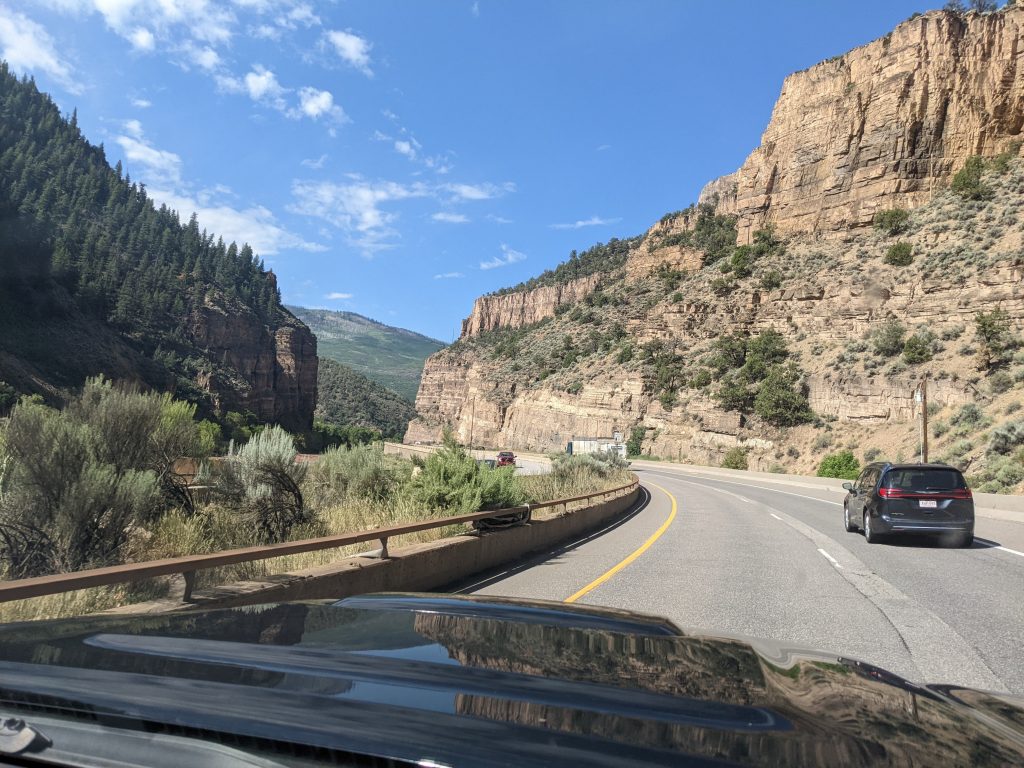
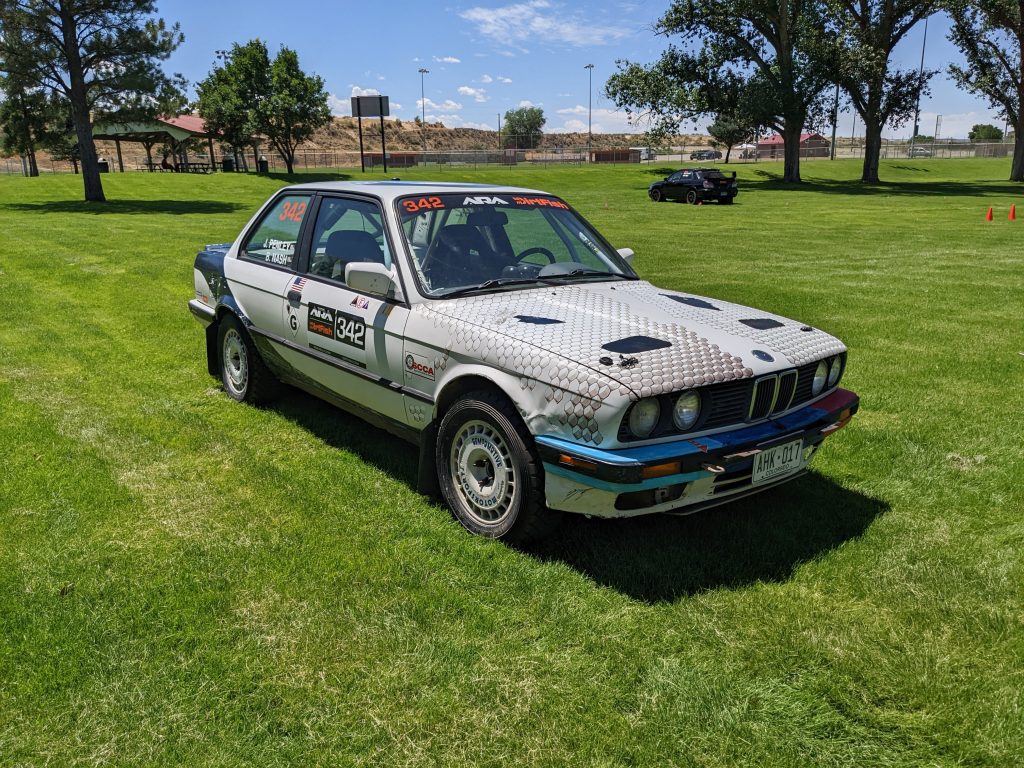
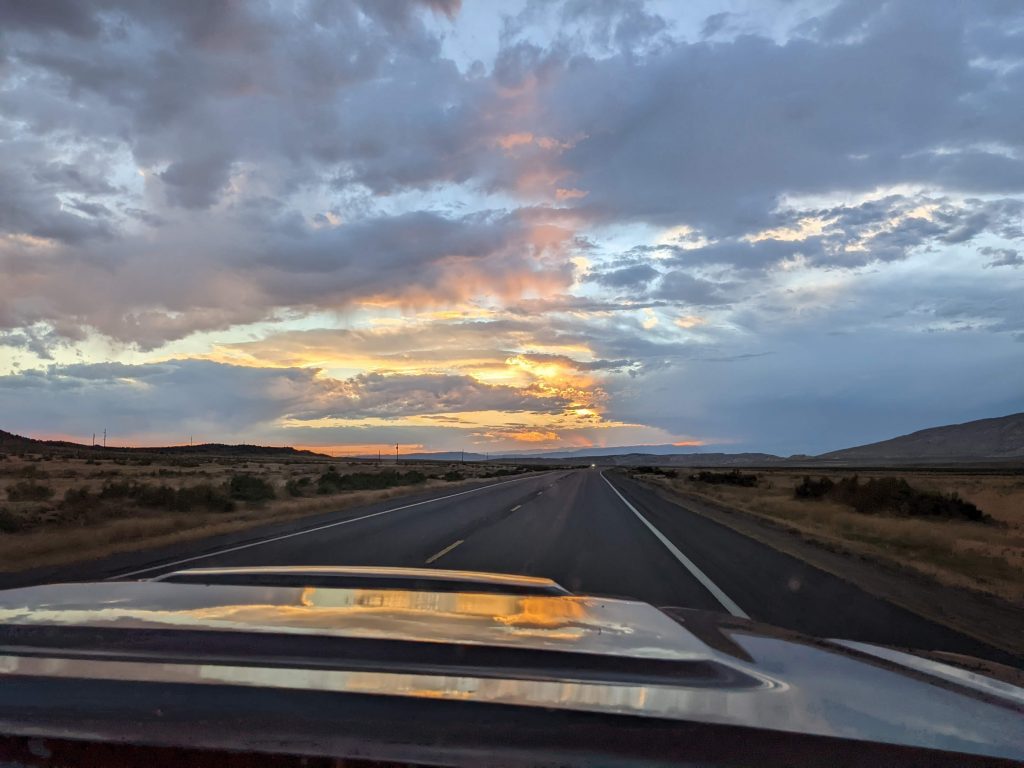
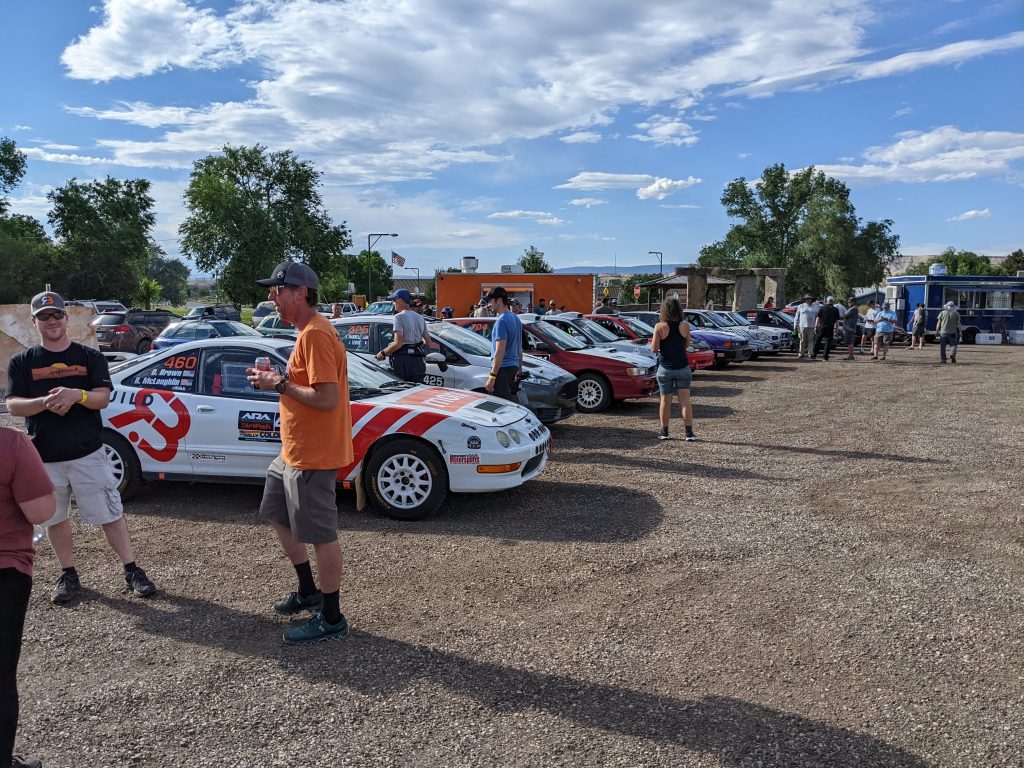
The prep for Rally Colorado was complicated by the fact that the Race Against Kids’ Cancer in the Vee is the very next weekend. That meant I had to prepare two race cars before the event. Rally Colorado was a 5.5 hour tow away. There are some pretty intense mountain passes between here and there with some first-gear switchbacks.
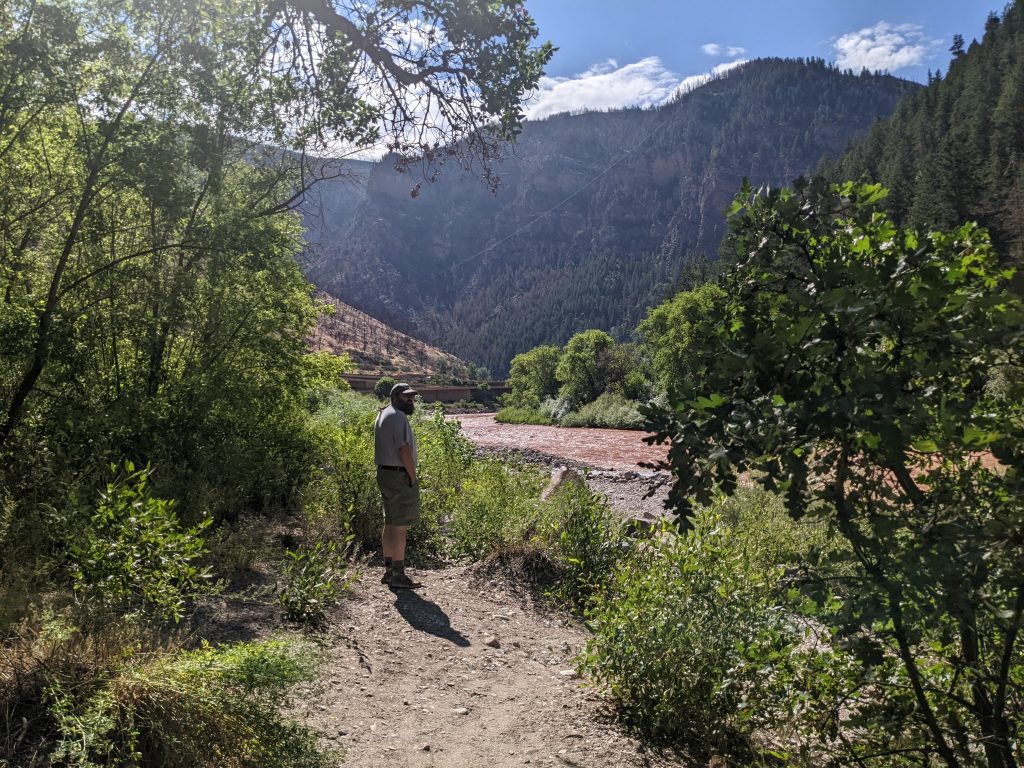
Colorado River in Glenwood Canyon
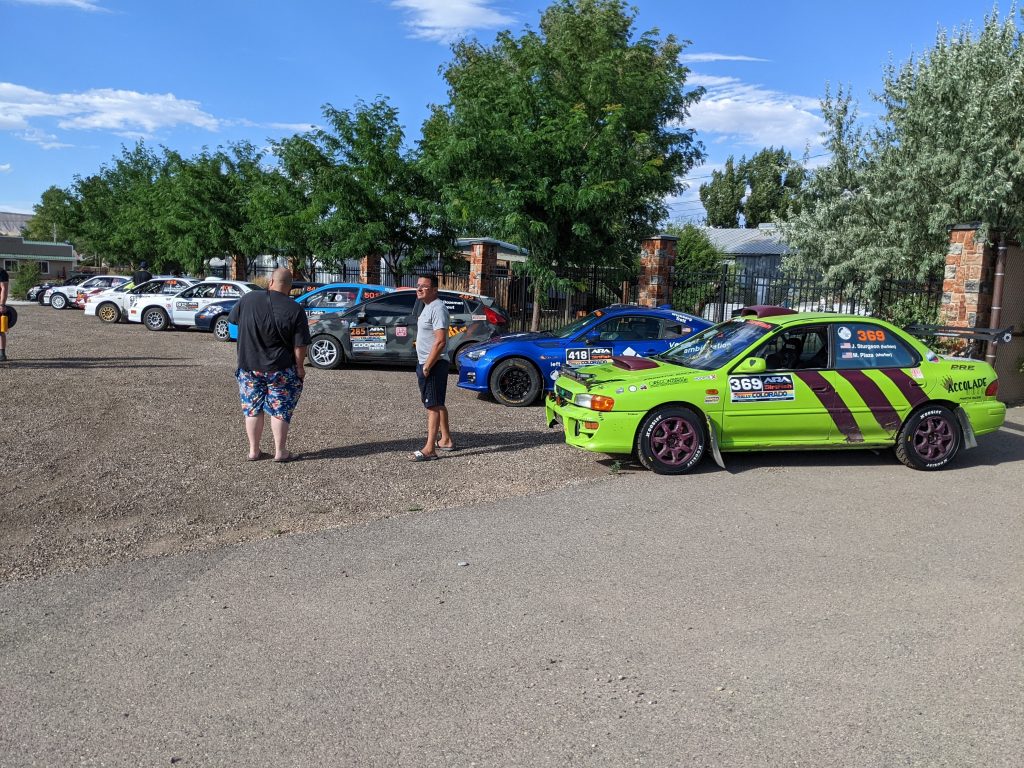
The service park for Rally Colorado was in a very green park in the middle of town. It takes a lot of watering to get grass like this on the western slope.
We checked in Thursday afternoon and spent 4 hours doing first pass recce for the first 3 stages. Rally Colorado is nice and simple with a single service park, 3 stages run twice on Saturday and another 3 stages twice on Sunday. We headed to our AirBNB in Utah and got some pizza and beer for dinner in Vernal.
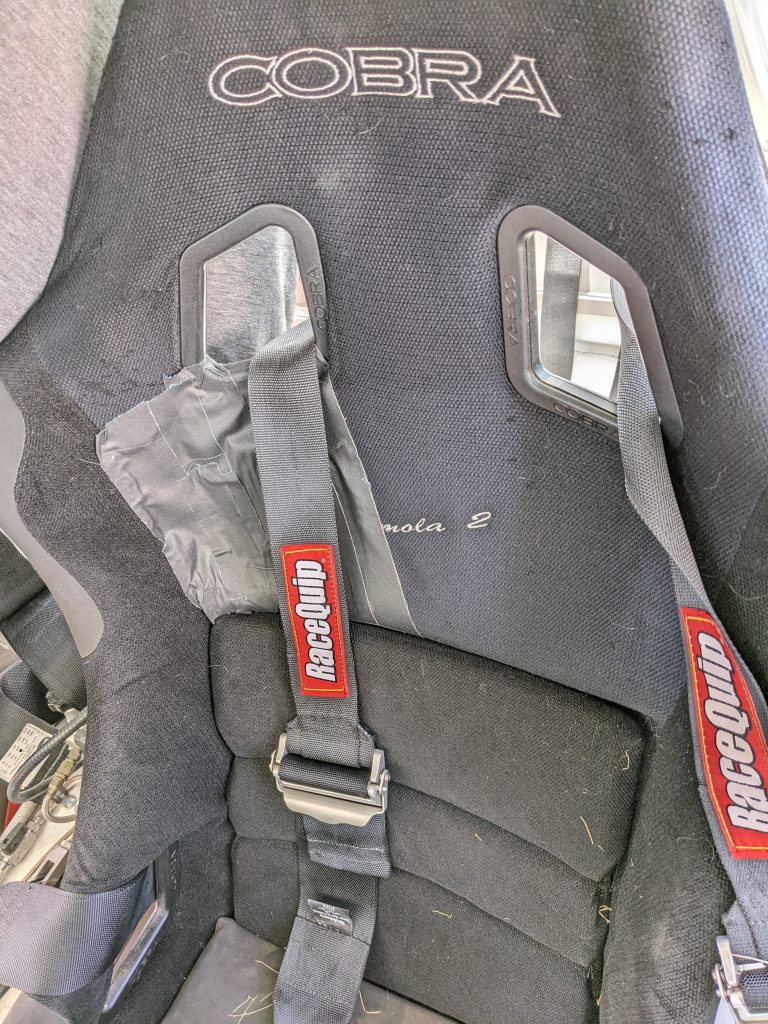
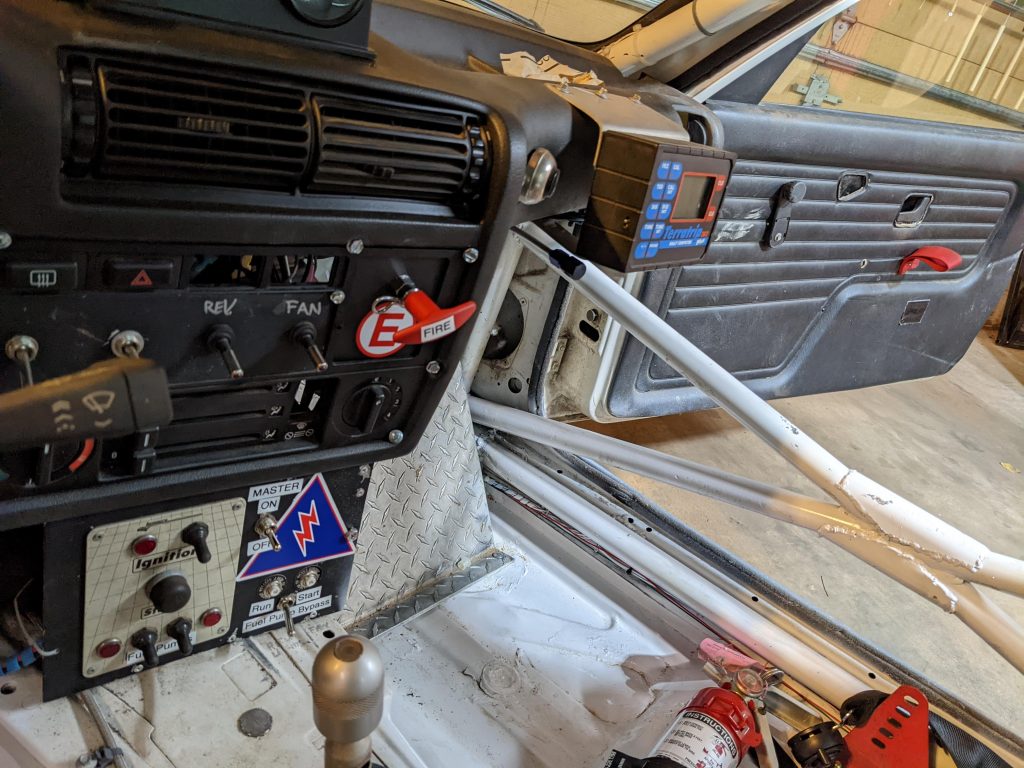
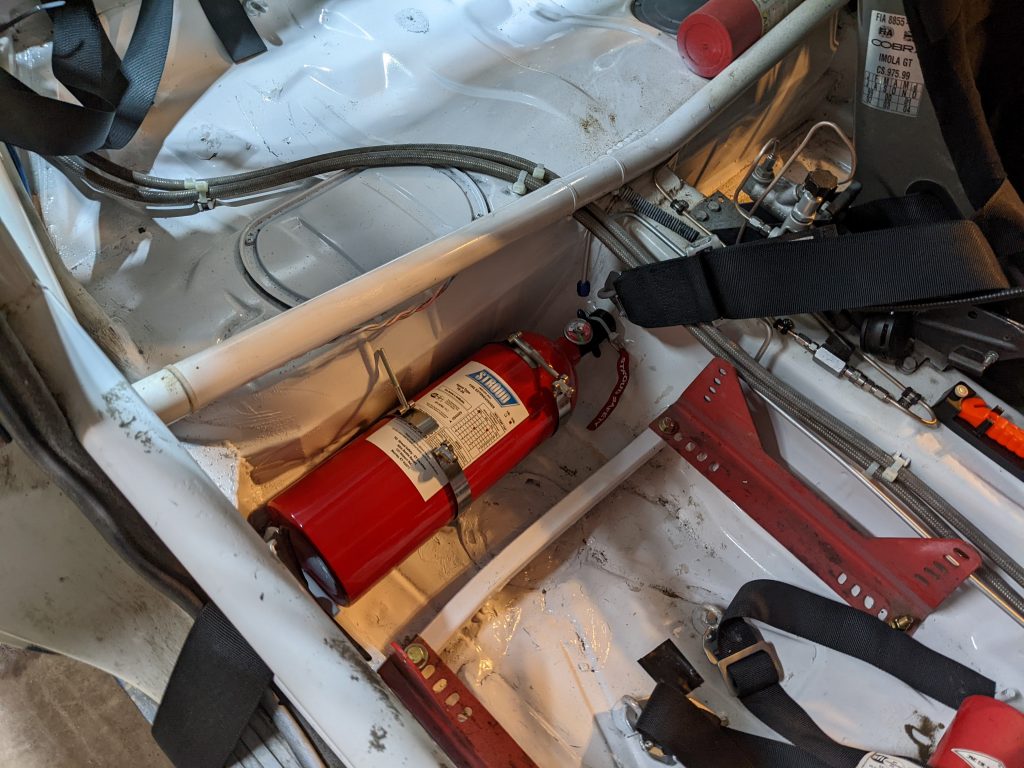
Our scrutineering time block was 9:45 – 11:00am on Friday morning. We hoped it wouldn’t take much time, but boy were we wrong. It took about a half an hour wait for them to get to us, and it took us another 2 hours to get through. We needed to fix 3 things: a hole in my seat cover exposed some foam. They were happy with us patching it with gaffer’s tape. They couldn’t see the date on my fire bottle, so I needed to remove one of the metal straps that was covering it. In retrospect, I don’t understand why they wanted to see the date on the fire bottle–nothing in the rules says anything about the date on the SFI-certified onboard fire suppression systems. There is a note that says dry powder systems must be serviced annually (and my two handheld systems were), but nothing about the gas-filled on-board system. Finally, they complained about gaps in the rear firewall where the cage tubes penetrate. We “fixed” the latter with a bunch of speed tape. It took at least 3 attempts with more speed tape before they were finally happy with it.
Recce on Friday was long, hot and dusty. Probably extra frustrating for Jack since I basically had no idea what I was doing.
We managed a second pass through all of Saturday’s stages, but only a first pass through Sunday’s before we needed to be at Parc Expose. Which was also long, hot and dusty.
After that, we were instructed to parade up and down the main street of Rangely. A bunch of kids were there to watch, and some of the better-prepared crews even had candy to throw.
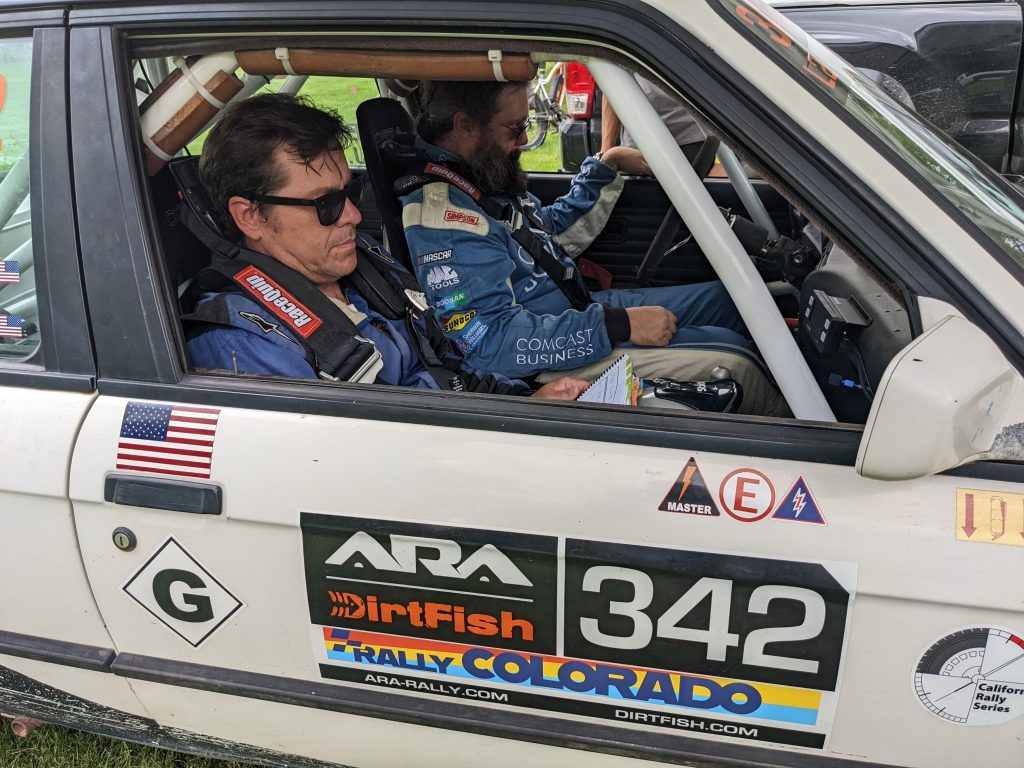
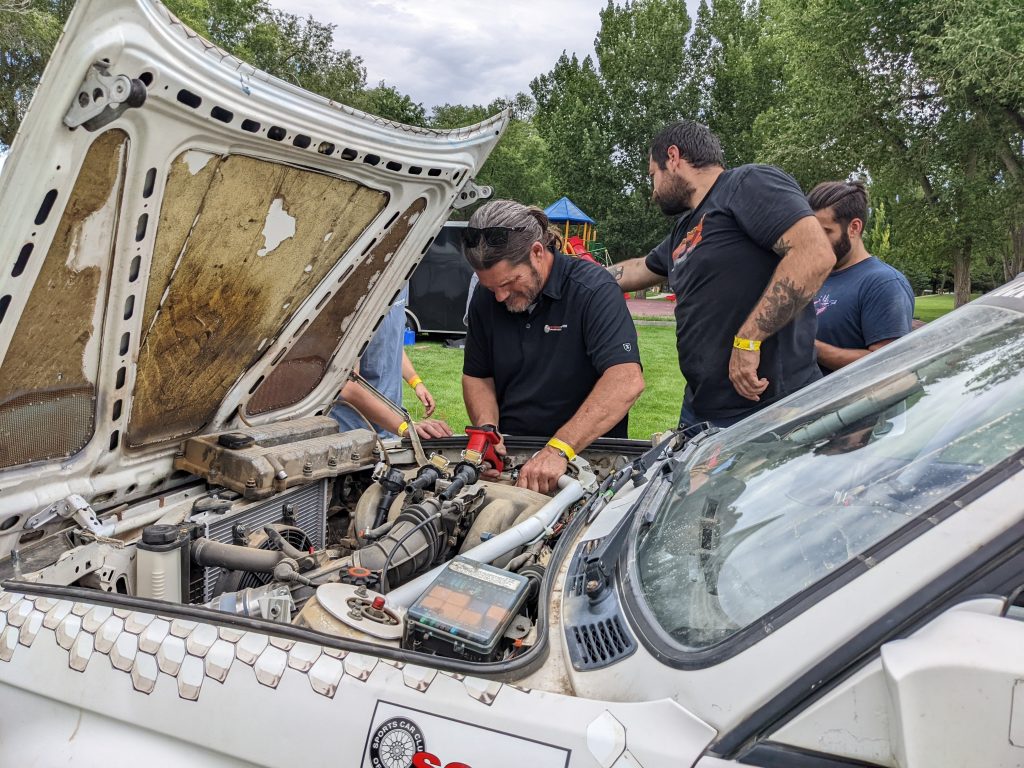
Sunday morning, all ready to go. We managed an off-by-one error where our start position of #27 meant that we were out at 10:26, not 10:27. Fortunately, I also simultaneously made the error of pulling up to the time control a couple of seconds early, and even though Jack handed them the card at 10:27:00, they gave it to us.
The first stage went fine despite my having absolutely no idea what to do. I started to get the hang of the notes by the end rather than just driving what I could see. It’s incredibly satisfying to be able to trust “right 6 over crest” when all I can see is the crest. We got close enough to the novice crew in front of us that the last 30 seconds were pretty scary with completely unpredictable moments of zero visibility.
At some point the voltage meter pegged at 17 volts, which seemed bad, but not bad enough that I was going to do anything about it. When we got the ATC for the second stage, I killed the car, but left the master switch on to run the cooling fan. Only, everything died with exactly no electrical power. I frantically examined the fuse for the signal wire to the solenoid, but it was good. The problem was more obvious: the negative battery terminal had become disconnected. Easy enough to put it back on to get the car running, but I didn’t have a wrench to tighten it down more.
The only other minor gripe about the car in the first couple of stages was the shift knob kept coming off. I have no idea why BMW makes everything so complicated, but I couldn’t figure out how the shift knob was supposed to work. What’s wrong with a threaded-on knob?
The second stage went even better. Where the first stage was fairly tight and slow, the second one had some long stretches of fast, open bits. I’m sure that with some confidence it could be taken close to flat out in this car, but as it was, our maximum speed of 82mph was plenty terrifying.
The third stage included a truly scary section with a crest, which if taken straight-on, would lead to a jump off a mountain. It was marked with caution signs, and we’d decided early on that we’d just slow to a crawl for that section. No problems there. A HAM-licensed (but still suspenderless) friend was working the radio checkpoint at a T-intersection where we turn right through a cattle guard. A perfect opportunity for a handbrake turn, but also a perfect opportunity slight right into the uprights on the cattle guard. I attempted the handbrake turn while Jack hit the horn, but didn’t commit hard enough. The car only rotated about 45 degrees then started pushing. Lame. Fortunately, I was also going slow enough that I didn’t hit anything.
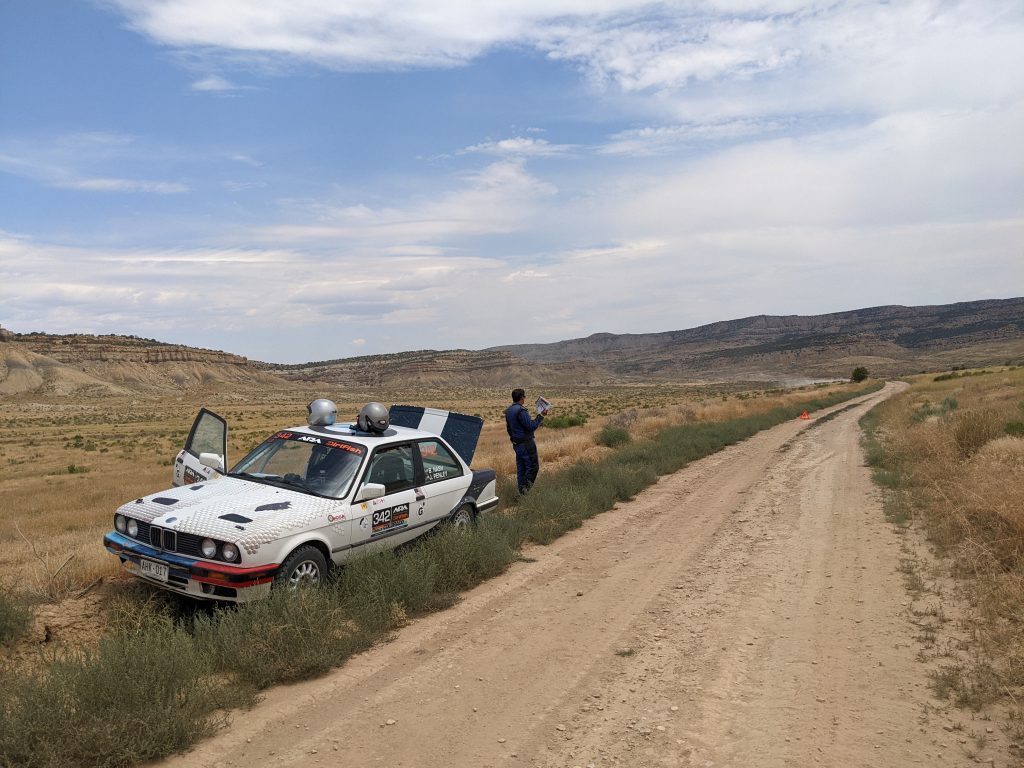
After that the road opened up a bit, and I sped up and shifted into third. The HLA noise the car makes when the oil gets hot seemed to be getting even louder, and the car seemed low on power. I downshifted, but the car wouldn’t accelerate at all, even at 5,500rpm on mostly flat ground. The oil pressure was the same crappy 25psi it always is when it gets hot. I shifted back into 3rd and the power loss continued over the next 30 seconds until there was just nothing. I put the clutch in and the engine died immediately. So, I pulled off the side of the road and our rally was over.
It would crank fine, but something sounded off. Oil level was still at the top of the dip stick. I figured we spun a bearing, given the low oil pressure.
There had been some weird reshuffling of order after ATC but before start that no one explained or consulted us about. We were moved to last place, even though our times were faster than a couple of the other novices. Fortunately they also switched to 2-minute starts, so we were no longer in any danger of catching anyone. And it meant that we only had to wait for sweep to come pick us up. There was also another competitor who’d been stopped on stage that managed to get going again.
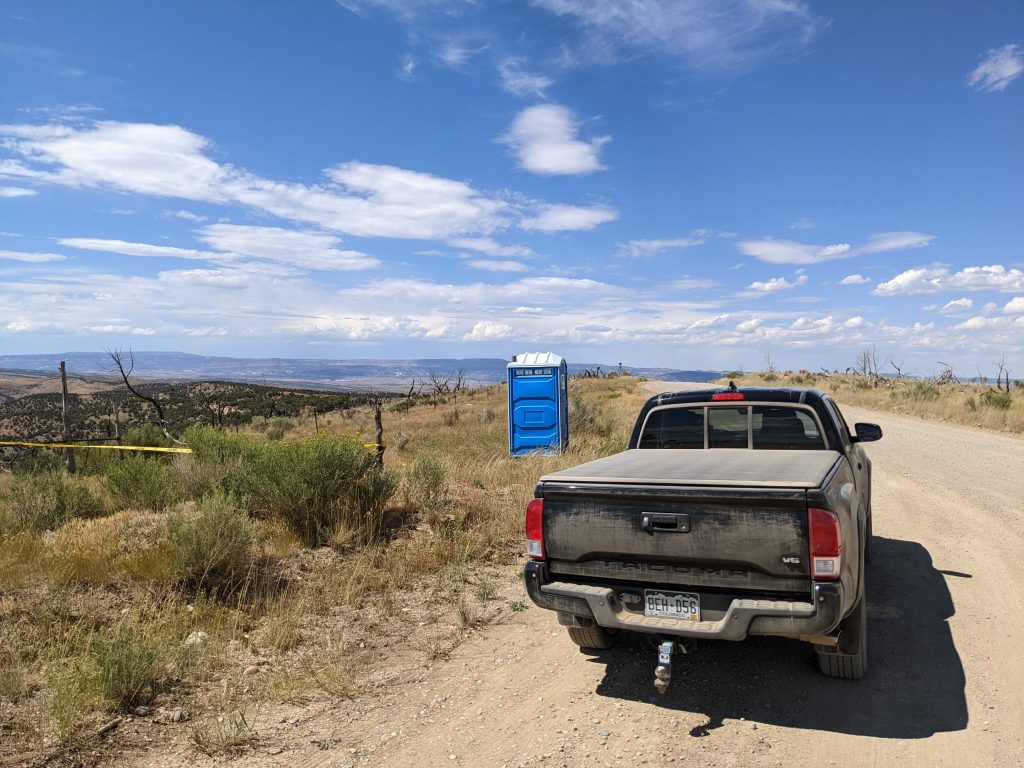
Amazingly, we actually had mobile phone service and I was able to get Jonah and Dan to come pick us up with the trailer at the end of the stage. Sweep also towed us at a terrifying 40mph, which was problematic given that there was enough dust that we couldn’t even see the tow vehicle at times. Fortunately we survived.
We got back to service after the other cars headed back out on stage. The other service crews were all anxious to discover what had happened.
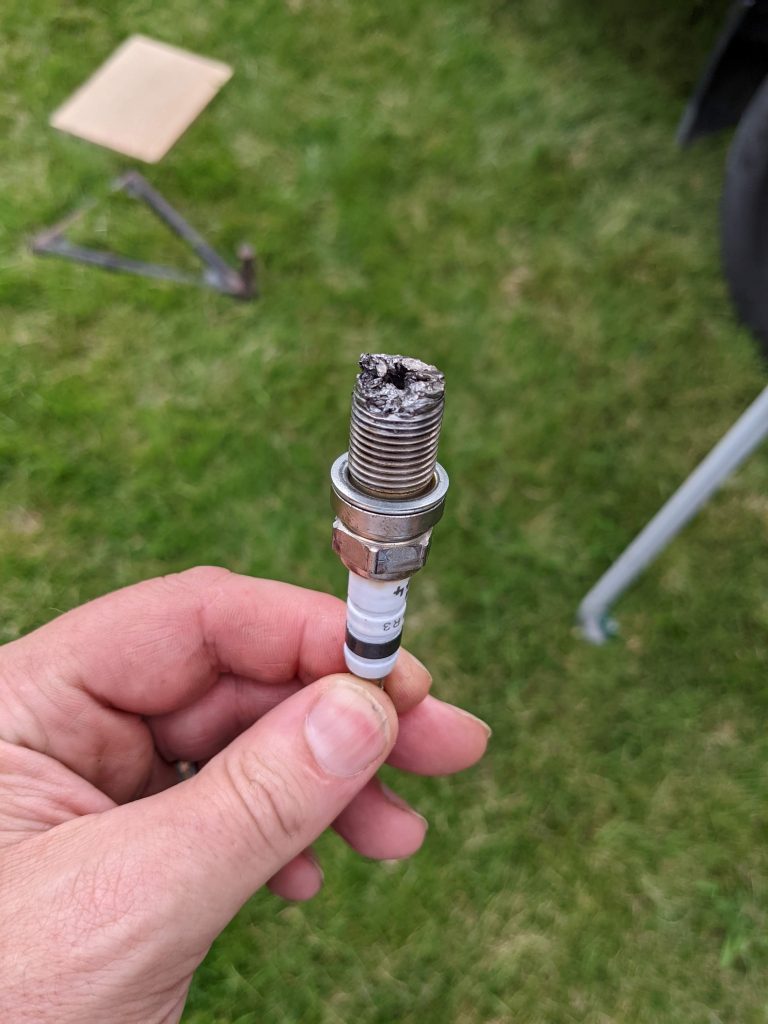
Dan pulled the spark plugs, and one of them really didn’t want to come out. Once it did, it became obvious that the problem wasn’t a bearing.
The cylinder was just full of mangled/melted metal. I’m guessing there was some kind of detonation event. Not really sure what would cause it in one cylinder–maybe a clogged injector that caused that cylinder to go lean?
I’ve now done what seems like an insane amount of work to get to drive about 40 minutes on stage, and I’m faced with a lot more. I do, at least, have a vague idea of what it’s actually like to drive in a rally now, and the taste was enough that I want more.
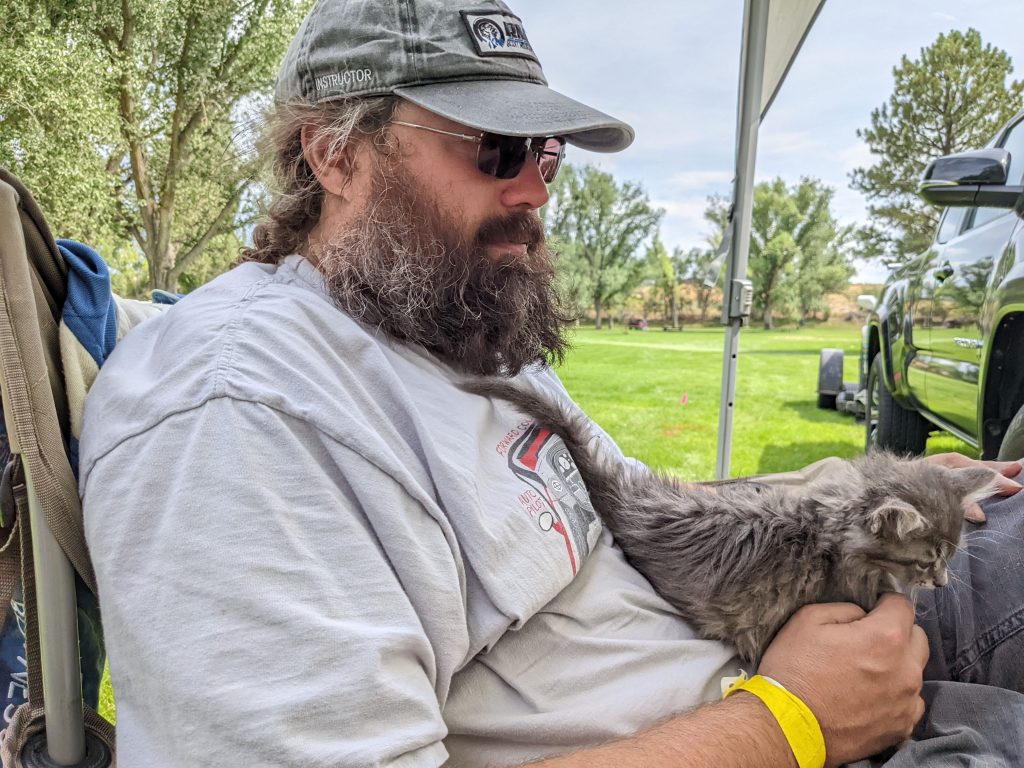
Someone had kittens, suggesting that kittens make everything better. It didn’t hurt:
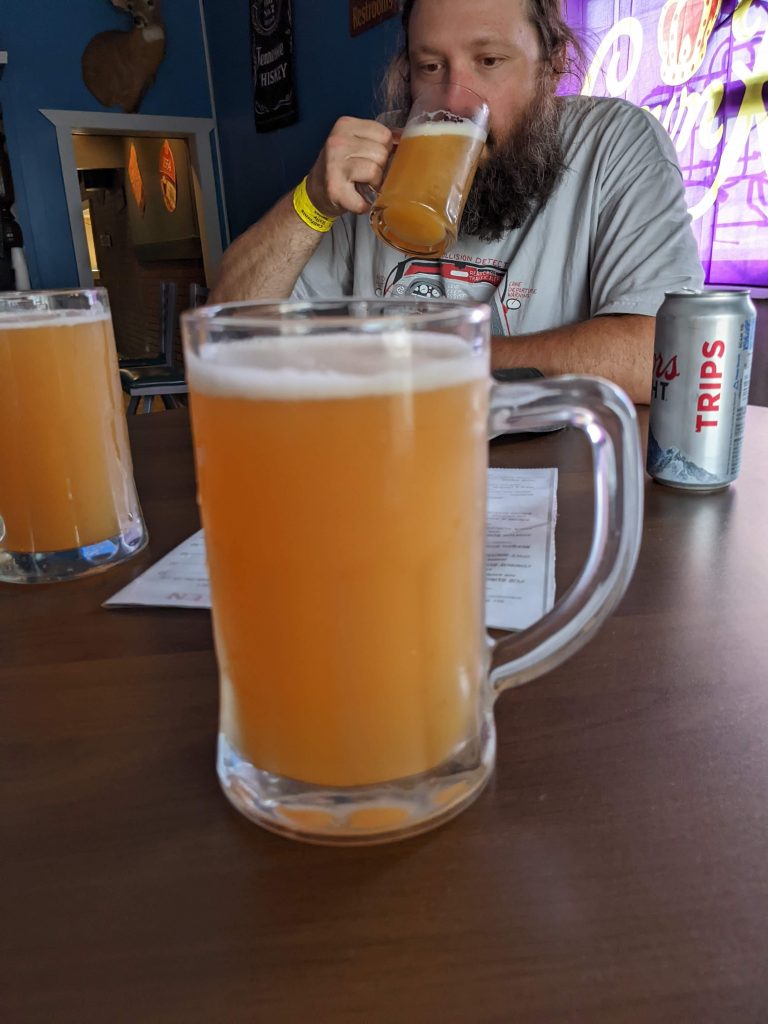
Beer helped too:
I’m not really sure what to do next. I’ll pull the M42 and see if it’s rebuildable. I wouldn’t be surprised if both the head and the block are beyond repair. People keep saying that M42s are easy to come by, but I’m not exactly seeing a bunch of them available for good prices. M20s seem much easier to come by, but if I’m going to go through the trouble of a 6 cylinder swap, should I pick something more modern like an M52?
Biggest factors are: I don’t want to spend the rest of my life getting this thing running again. I don’t know anything about BMW’s, which makes me wonder if diving right into a engine swap is the best plan. Dropping another M42 in there seems like the easiest thing, but will I regret not having taken the time to do the swap once I actually figure out how to drive it? There’s absolutely no chance of my ever placing in L2WD, so it’s not like switching to O2WD would be a big deal.
I think this weekend I’ve managed to accomplish everything necessary to call the car legal for ARA. Still plenty to do, but the major welding hurdles have been accomplished thanks to my codriver and fellow Vee people.
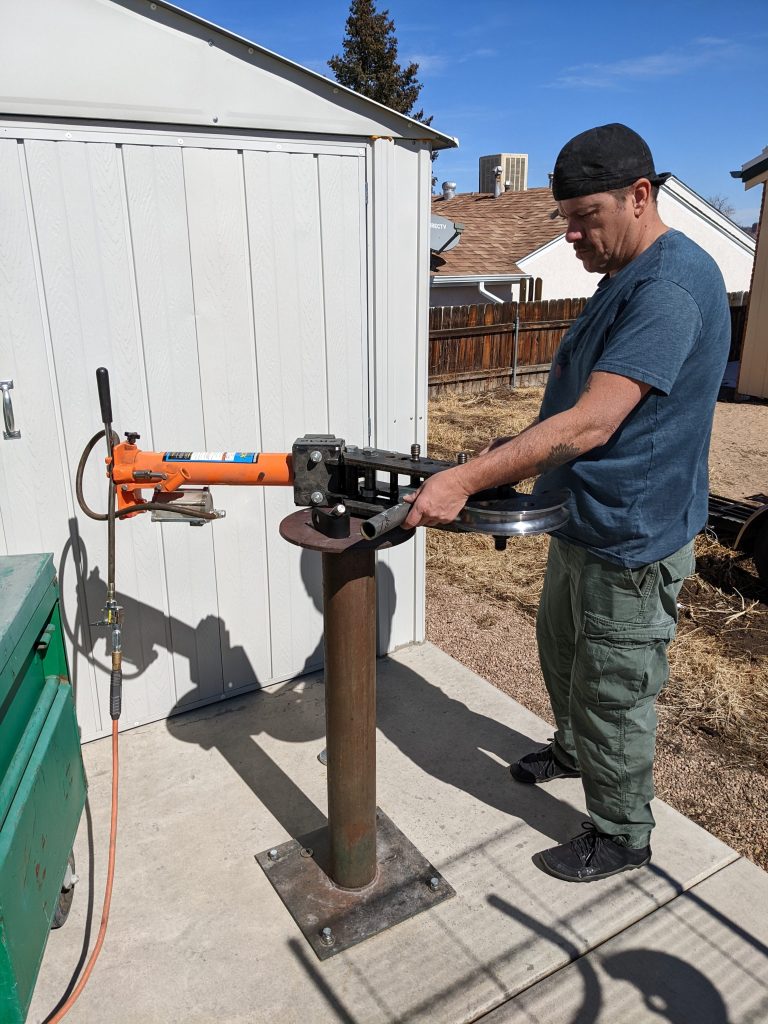
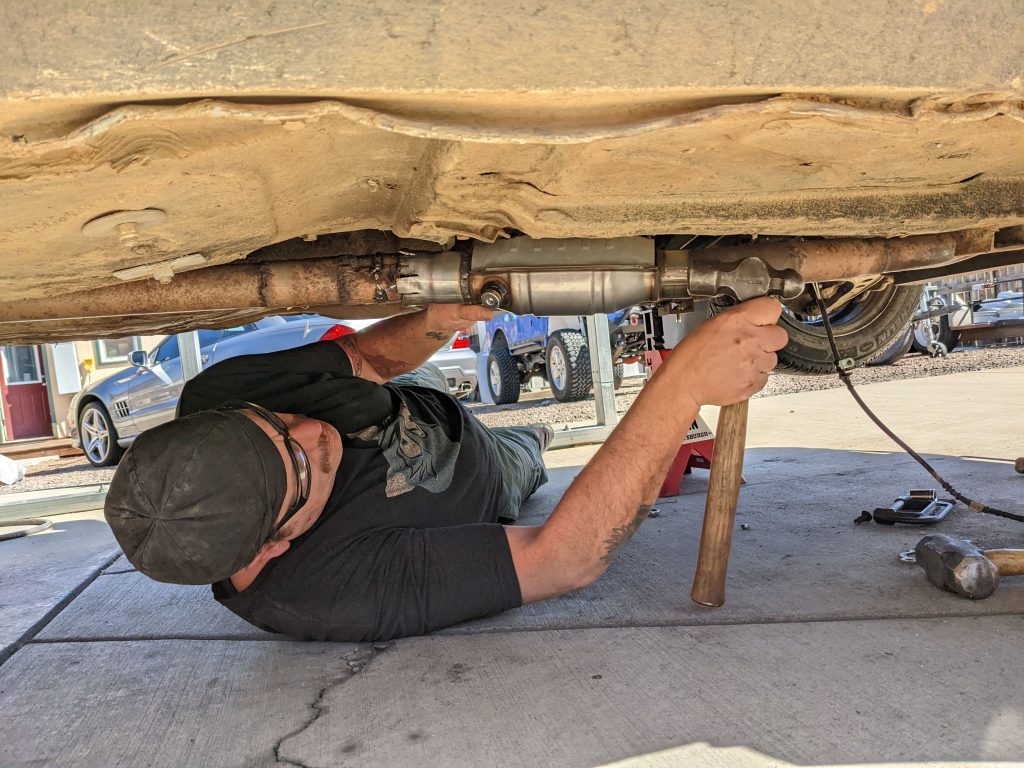
Bending:
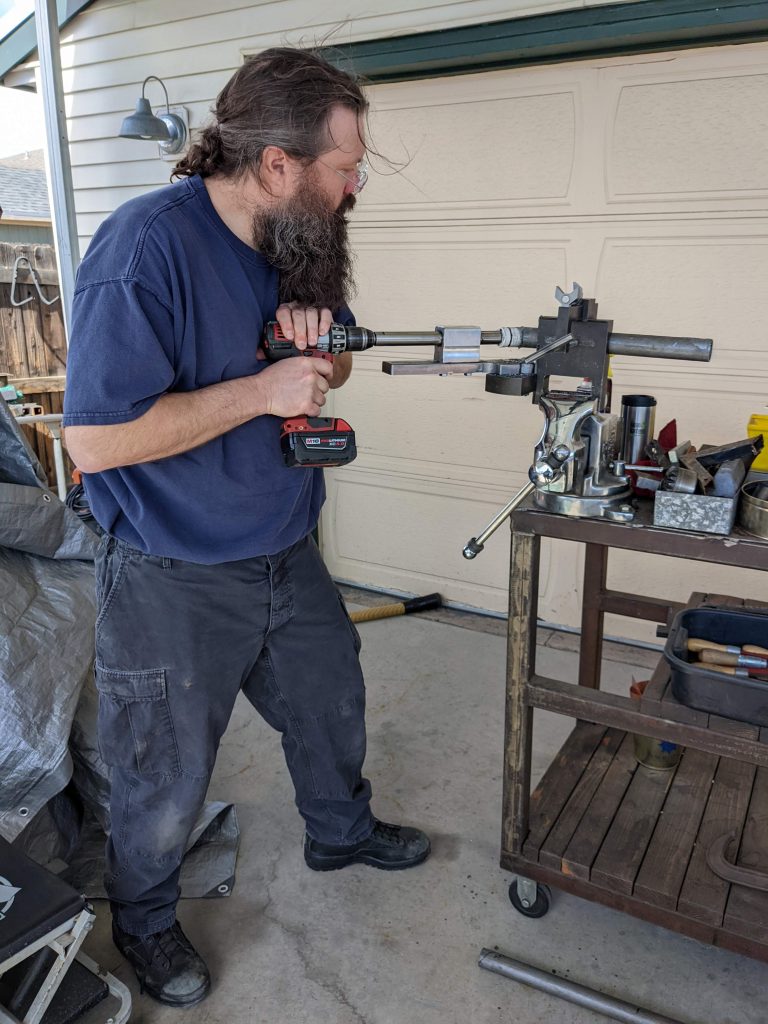
Notching:
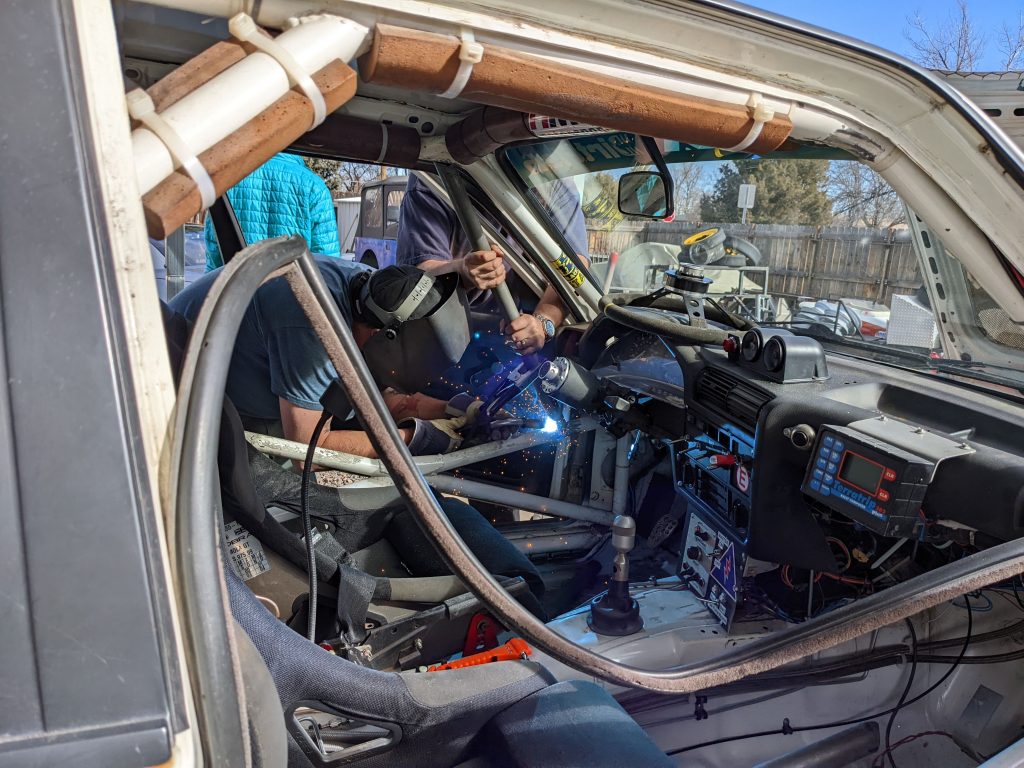
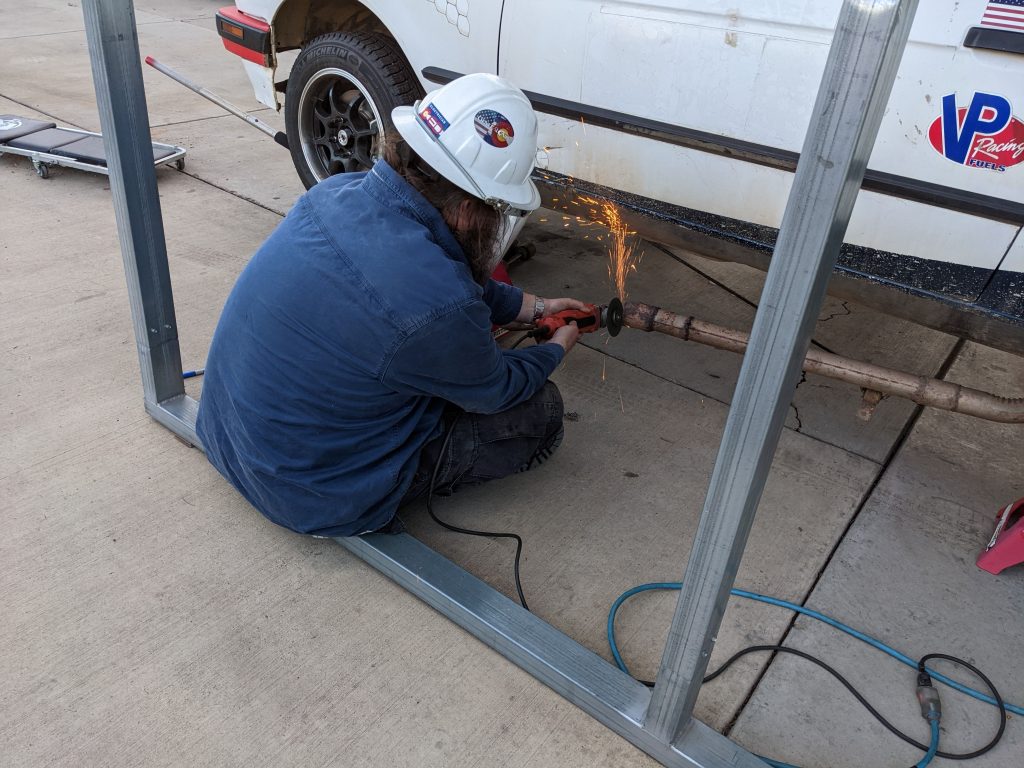
Welding:
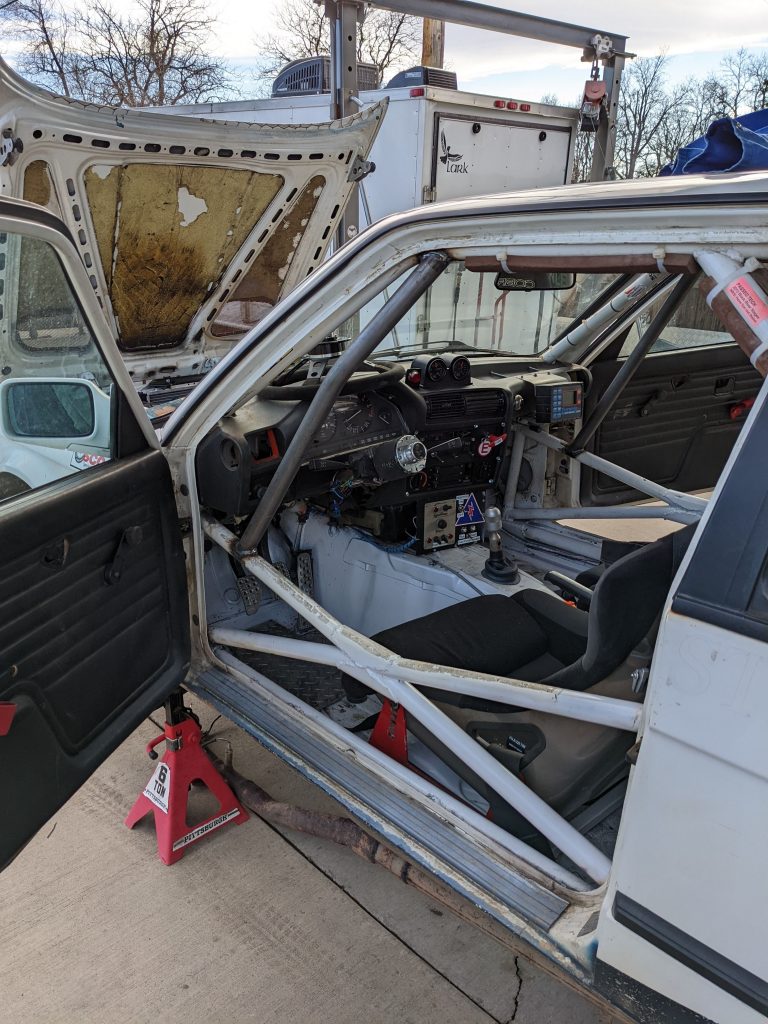
Top of the brace bars done:
Cutting:
Cursing:
Overall, great success! I didn’t get a photo of the finished bars yet, but they came out reasonably well considering the retrofit. The must-do list is shrinking. I need to paint the new bars, install a modern rally computer and intercom and sort out the shifter and I should be good to rally.
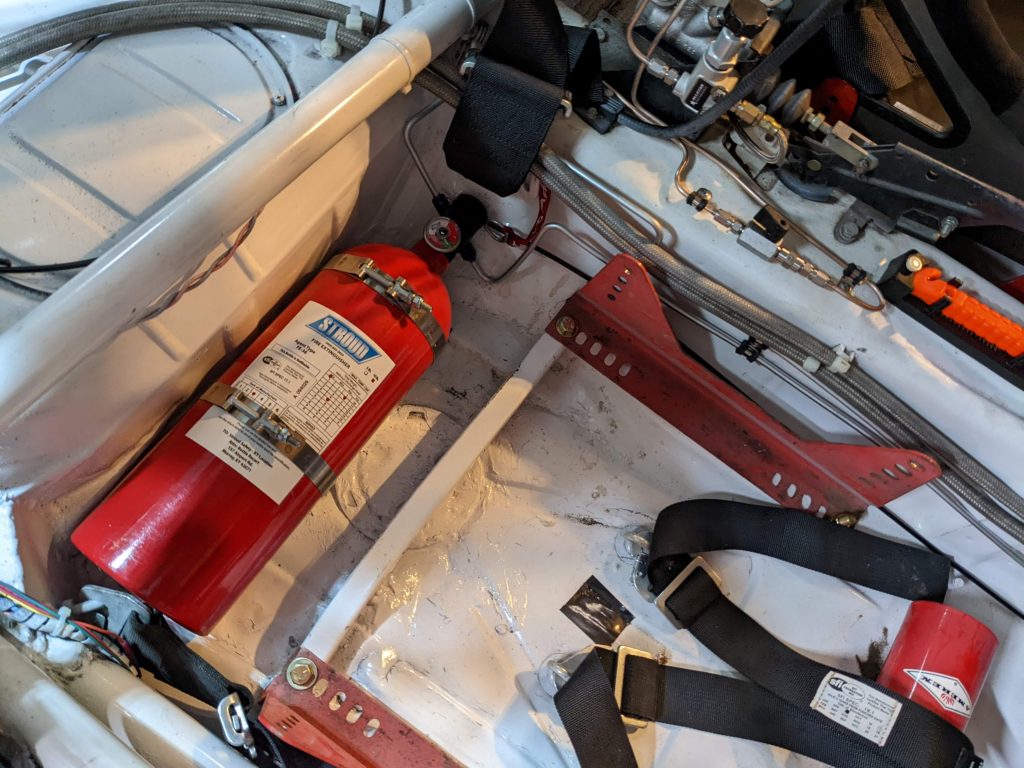
Fire suppression finally installed. Stroud did, in fact, send the right bracket/clamps. It’s just the bracket looks short and the clamps didn’t reach because the car is bent. Some massaging with a sledge hammer and it fits fine now. I hope to be done bending and flaring tubing for awhile. The steel stuff is rough.
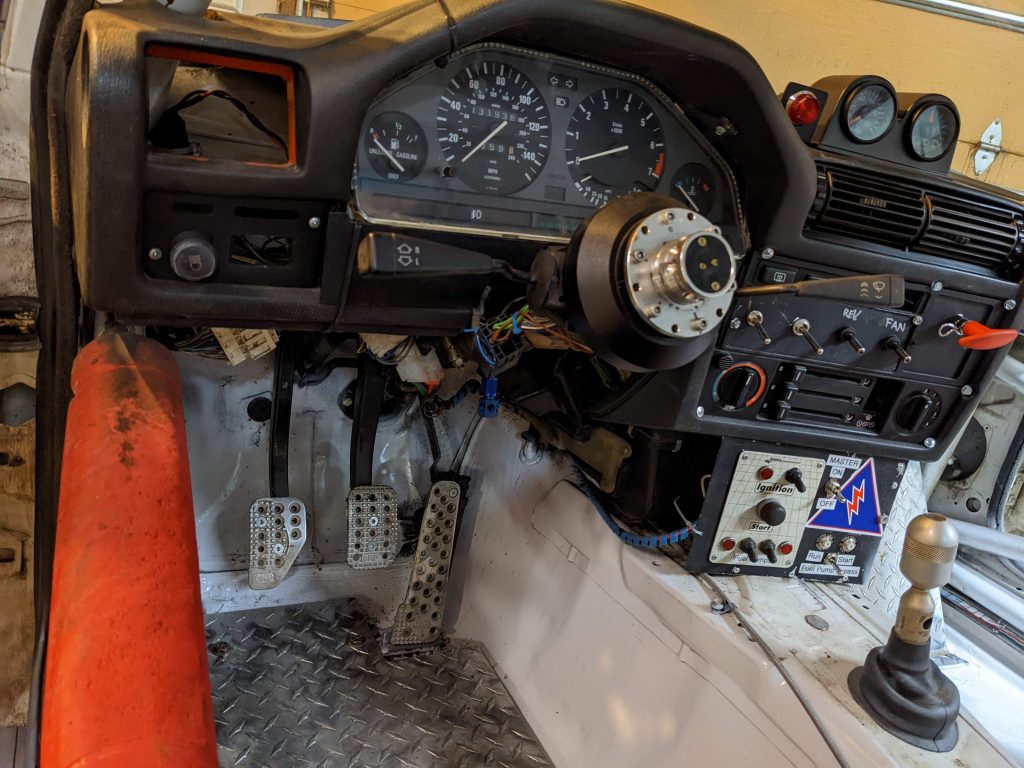
Driver side nozzle is under the steering column:
Codriver nozzle is under the soon-to-be-removed terratrip.
Next up: I need to do something about the driver position. Actually, the driver position is mostly fine. Maybe a little higher than I’d like, but that gives me enough pedal clearance. I can barely reach the steering wheel, which is easily fixed with the steering wheel spacer the car came with. I think the original builder was taller than the previous owner. Unfortunately, that does nothing for the shifter. It’s pretty hard to reach in 1,3,5. I’m thinking I should buy some cheap ebay shifter and bend it. Open to advice from Josh or any other E30 people reading. (I don’t really care whether it’s a “short” shifter or not, except that short will probably also make it easier to reach).
My fire suppression system finally arrived! I went with a Stroud 10lb F-36 (halogen replacement) system. Pricey at $800 shipped. I could have gone cheaper with one of the foam systems, but I didn’t want to for several reasons.
(1) The foam systems have a minimum temperature limit. They can freeze, and I live in Colorado at 9,200ft. The car lives outside when I’m not working on it, and for instance, it was -12F a few nights ago. I don’t want to have to deal with taking the bottle in and out of the car.
(2) Foam makes a mess. I accidentally discharged the fire system in my Vee once. It was an unfortunate $500 accident, but at least I didn’t have a giant mess to clean up. I’m not actually sure what happened–I’m not sure it was correctly installed. I noticed that the fire handle looked like it was about 1/8 an inch out from where it should be. With the pin in the bottle, I pushed the handle back in. To make sure it was fine, I pulled the pin on the bottle. It wasn’t fine.
(3) Gas systems require fewer nozzles. My 10lb system only has 3 nozzles. Easier install.
I also could have legally gotten away with a 5lb system. But I think that something the size of a rally car is probably more properly equipped with a 10lb system.
Thankfully, the fire bottle (barely!) fits behind a seat. Unfortunately, Stroud sent the wrong bracket/clamps. I’m pretty sure they sent me the bracket/clamps for a 5lb bottle, which means that they won’t secure my 10lb bottle. I assume this is an easy thing for them to make right, so I sent them an email.
So, I got the system about halfway installed. This system requires bending and flaring 1/4″ steel tubing, which does take a little time. It also has 2 outputs from the bottle. This works great for, say, my Formula Vee where you want one tube to go to the engine bay and another to go to the cockpit, but less good for a rally car where I’m just running both of them forward.
ARA rules say to install according to the instructions. The instructions are vague. Dragsters should install one nozzle on the driver, and one each over each exhaust header. Circle track racers should “blanket the driver”. I’m going to to install one nozzle from the driver, one for the codriver, and one for the engine compartment.
Thus far I’ve managed the co-driver and engine compartment nozzles.
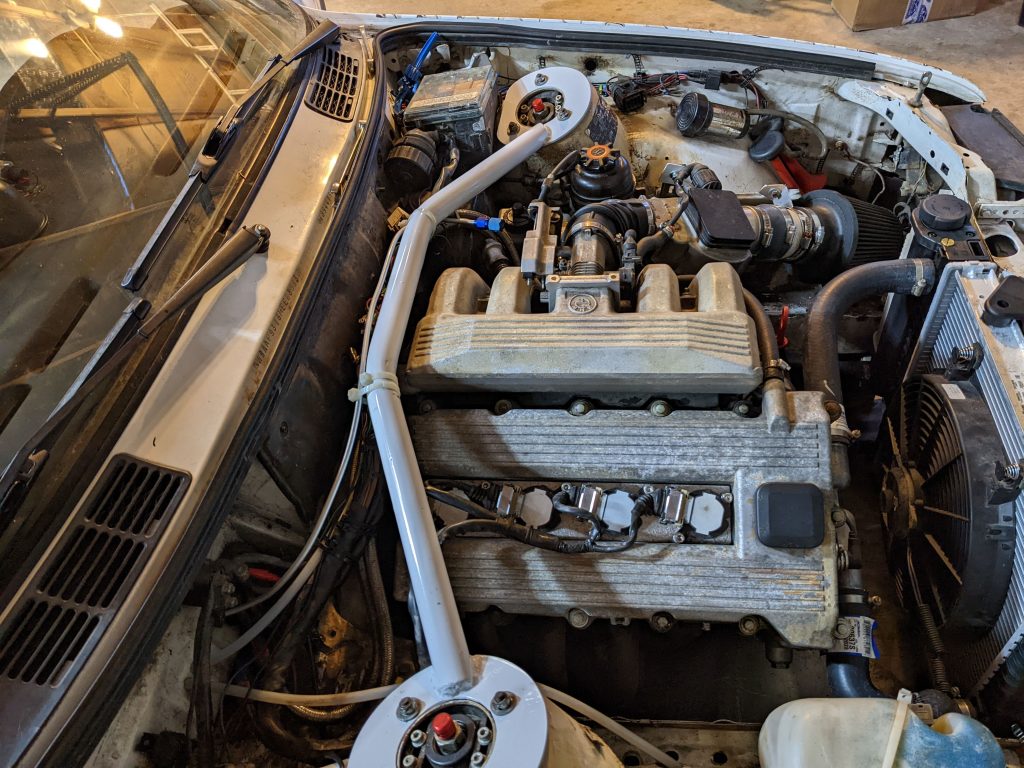
The fuel comes in on the intake side and that seemed the more likely place for a fire, so I put the nozzle on that side. Presumably with a gas system the location isn’t super critical. A little annoyed that while they supplied steel lines, they went with aluminum fittings. But I guess if the aluminum fittings have melted, I’m dead anyway.
On the wheel hunt. Facebook marketplace only has 3 15″ MINI wheels in the Denver area. They are phone dials, but they’re painted black, which isn’t the right color for a rally car and look pretty rough. $75/each is a more reasonable price than ebay, at least. Of course, getting them requires driving 1.5 hours each way. I’ll see if they’re available next time I drive to Denver.
I went ahead and bought a Stilo Trophy DES. The yellow one, because it’s cheaper. I was initially just going to buy coms for my full face helmet, but I realized that even with the visor up, I’m never going to be able to keep my glasses from fogging with that thing in a closed car, and I’d just be much happier with an open faced helmet if I could wear one. Annoyed that there are no FIA/SA2020 Stilo rally helmets, but whatever.