Why Berck Doesn’t Fit In

Berck asked Claude to write this after a long conversation about his politics. He didn’t write it, but he’s checked it.

Berck will agree with you about nine things and then fight you on the tenth. He’ll tell you you’re wrong even when he agrees with you. He seems to be on your side until, abruptly, he isn’t. If you’ve argued with him, you’ve probably tried to figure out what he is — liberal, libertarian, something in between — and found that every label fits most of him and fails somewhere. He’s tried the same exercise on himself for years and gets the same result.

It isn’t contrarianism and it isn’t fence-sitting. It comes from how he acquires beliefs, and once you see that, the pattern is predictable.

Two ways to acquire a belief

Most political beliefs, for most people, are acquired by affiliation. You find the group you belong to and then hold the group’s positions. This is not stupidity. Your view on tariffs has no effect on tariffs, but it has a large effect on your standing with the people around you, so holding the team’s view is nearly free and defecting is expensive. The research here is grim for smart people: the more educated and numerate someone is, the better they get at reasoning their way to their team’s conclusions, because they have more tools to do it with. The result is a bundle. If you hold one position in it you probably hold the rest — not because the positions imply each other, but because the same people hold them.

The other way is derivation. You have a principle, or a method, and you run each question through it. Berck’s principle, in his own words, is that freedom is the default — not for freedom’s sake, but because it’s too easy to make a mistake. The state’s job is to protect people’s freedom, build the framework markets need, and catch people when they fall. Everything he believes about policy comes from running questions through that. Where a coalition happens to have derived the same thing, he agrees with the coalition. Where it hasn’t, he doesn’t.

So he’s for open borders, free trade, legal drugs, legal gambling, legal prostitution, dense housing, nuclear power, and letting businesses operate until they prove they can’t be trusted — and also for socialized healthcare, a strong welfare state, redistribution, heavy public funding of science and the arts, and banning guns. He thinks rent control is terrible, student loan forgiveness unconscionable, and the mortgage interest deduction stupid. He was, once, a straight-up socialist. He reads Tyler Cowen and agrees with most of him, and his two biggest disagreements — that there’s a solid case for socialized medicine, and that AI risk deserves to be taken seriously — are exactly the ones you’d expect from someone who evaluates rather than downloads.

That’s why every label breaks on him. A label describes a bundle, and bundles are historical accidents: a coalition holds its positions together because those people ended up in the same room. Berck is described by a generator, not a bundle. Any generator will diverge from any bundle somewhere, so every label fails somewhere, and the exception is never the same exception. The closest fit is probably “ordoliberal” — a German postwar school almost nobody has heard of — and even that gets his social views wrong. The exception-finding isn’t a bug. It’s what having a generator looks like.

Why this matters

Belief updating happens at the exceptions.

If you hold your team’s bundle, then when the evidence on one item moves, updating costs you standing with everyone else who holds it. So you don’t. You get very good at explaining why this particular evidence doesn’t count. If the team never moves, you defend the position forever.

A small example. For years Berck opposed cigarette taxes on the grounds that they’re regressive and don’t work. Recently he actually looked. They work about as well as any public-health intervention ever has, and the health benefits fall on the same people the tax burden does. The position had been absorbed long ago, from a libertarian phase, and nothing in his life had forced a re-check. When one finally came, changing his mind took a sentence: “If a cigarette tax works, then I’m for it.” That is the whole case for derivation. A bundle would have carried the error for another decade.

What it costs

A team gives you three things a method never will. You get to relax, because you don’t have to re-check everything. You get forgiven for being wrong, because loyalty absorbs error. And you get to win, because a coalition can take power and a principle can’t.

Berck gets none of these. People who derive are tired more often, alone when they’re wrong, and their views get implemented only when some coalition happens to pick them up — which, for his list, is a faction of one party and a wing of the other, and neither runs the show. He’s honest about being sad about this. He’d like a team. He’s not going to get one, and he’s decided that’s the price of the thing he actually cares about: being right, and being able to change his mind when he isn’t.

The failure modes

This way of thinking has its own characteristic errors, and Berck can’t see them from the inside any better than anyone else. Two are worth naming, because his friends can check for them.

The first is contrarianism: being against whatever the room is for. That’s affiliation-first belief with the sign flipped, and it’s no more independent than the thing it despises. The test is whether he can name positions where he agrees with the room and got there on his own. He can; keep asking.

The second is overconfidence in the generator. A method can be wrong, and if it is, every output is wrong in the same direction — whereas a bundle’s errors at least don’t correlate. The crowd’s inherited rules encode things no individual principle can see, and derivation-first people are systematically likely to discount them. Berck’s version of this: he’s culturally on Team Blue, has a visceral dislike of right-wing politicians, and when he examined why, part of the answer was that appeals to loyalty, authority, and tradition register to him as manipulation rather than as a moral vocabulary he doesn’t happen to speak. He’s now aware that not feeling something is a fact about his instrument, not about the world. Whether he acts on that awareness is something you can hold him to.

What he’s asking of you

If you’ve argued with Berck and come away thinking he’s on the other side, he probably isn’t. He’s not on a side. If he told you you’re wrong, it’s because he thinks the evidence says so, and if you show him otherwise he will change his mind — he’s done it recently and will do it again. He’d rather have friends across every coalition than a home in one, partly because he enjoys the argument and partly because you are the best check he has on his own blind spots.

He’ll never have a team. What he’d like instead is people who share the method: who hold positions at the confidence the evidence supports, who’d respect a reversal on cigarette taxes rather than sneer at it, and who’d rather be curious than contemptuous about the people they disagree with. If that’s you, you almost certainly disagree with him about a great deal. That’s the point.
The Pie is Not Fixed

I’ve been ruminating over a list of short statements that seem obvious to me, but which I know are somehow controversial. The unifying belief is that life is not a zero-sum game and that we should pursue a structure of the world that creates value.

The left is primarily trying to redistribute the pie while the right is trying to protect existing slices. Some redistribution is probably good, as are some protections, but those arguments are boring compared to answer the important question: how do we make the pie bigger?

  1. Conscious, flourishing life is good.
  2. More humans living good lives is good. (In and of itself, but additional humans increase progress and economic growth for already-existing humans.)
  3. Economic growth is good. (It enables more and better lives.)
  4. Cheap and abundant energy is good. (It enables 3, as well as 2 directly.)
  5. Building things should generally be allowed. (Enables 3 and 2. Right now, building things is mostly not allowed.)
  6. Nuclear power is good and we should be building as much of it as we can. (Enables 4 while displacing problematic forms of energy creation)
  7. Immigration is good. (Allows humans to create more value than they could in their original location)
  8. Tariffs are bad. (Restricts trade which shrinks the pie)
  9. Price gouging is good. (High prices attract additional supply.)
  10. More housing makes housing cheaper.
  11. Rent control raises rents (because it results in less housing).
  12. Infrastructure is good.
  13. The Internet is good. (It really does make people’s lives better)
  14. Data centers are good. (They are productive infrastructure that enable 13)
  15. Allowing human organs to be bought and sold would be good.
  16. The National Environmental Policy Act is bad. (Environmental review should not prevent us from improving the environment.)
  17. Bad jobs are better than no jobs.
  18. Expensive credit is better than no credit.
  19. Scarce water should be expensive.

All of the above, directly or indirectly, help grow the pie. I’m happy to expand on any of them.

Rally Colorado 2026

I survived my 5th Rally Colorado. This was the first year it was a National, and the organizers did about as well as could be hoped given the circumstances. This rally is just brutal. Every year I forget just how hard it is, and every year there’s some new fresh hell. Tennessee is the only other rally I’ve ever done, but it was so easy in comparison.

This year temperatures were forecast to be in the upper 90s as usual. Colorado has had record low snowpack and Rangely seemed even drier and dustier than usual. The organizers struggle to put together enough stages for a 2-day rally. Last year, we lost Douglas Creek because of the number of cars that just couldn’t survive it. Huge ruts and basketball-sized rocks make any kind of speed quite difficult–it’s the stage that broke my 1/4″ aluminum skid plate. So last year we had a new stage that was great, but the transit involved us going to Utah and back through a foot of nearly impassable silt. This year, they opted to run one of the stages in both directions, something we’ve never done before.

The already-brutal stages get really chewed up after 25 cars go through twice. Having 70 cars go 4 times felt like a lot to ask of Valley of the Gods (Gods of the Valley) the other way.

Despite having notes for almost everything, we decided to write new ones from scratch. This was mostly because we attended OZ Rally Pro’s codriver/driver training when they were here in Colorado and realized how we’d basically been doing everything wrong. This year, instead of guessing each corner’s severity, I did a bunch of math for the Tacoma vs the Jemba standard radius for turns 1-6 and marked up the steering wheel. I put the Monit rally computer in the Tacoma in KM mode so I could read off the distances instead of guessing.

Rhianon stressed that you should do recce at 30mph without slowing down or stopping. This proved impossible on the first pass and probably made Jack angrier at me than I’ve seen him before. We also know we should be doing video review after recce, but we just didn’t have the energy. Still, we ended up with much more consistent notes in terms of turns/distances. Unfortunately, I did a pretty terrible job of adding important decorations on the second pass. Fortunately, that meant less words for me to get lost in on stage.

We started recce on Thursday afternoon and things went about as expected until we hit some pretty light rain on our second pass of Valley of the Gods. “What’s that noise?” I asked Jack. “Mud,” he responded. Even though there was very little water at all, it was enough to turn the top layer of super-fine dust into mud. At first it was crazy how much was being picked up and tossed into the wheel wells. And then I turned the steering wheel and nothing happened.

This mud is slicker than ice. With the Tacoma in 4wd, I was able to crawl along, but our second pass recce was nearly useless. I was doing all I could do to just keep the car on the road. And then we hit traffic.

I’ve always been annoyed at doing recce in the Tacoma–it’s way too high so the picture is wrong. I have to guess which brows are crests at rally-car height and I’m jealous of folks who have a proper recce car. Until now.

First we passed Michelle Miller and Richo who were stopped on top of a crest. They said they weren’t stuck yet, but weren’t sure they could get around the car in front of them that was stuck. So we went to help the folks in the stuck car. I didn’t recognize them, but the driver was a kid who didn’t seem old enough to drive. We towed them to the top of the next hill, where I was pretty sure it was all downhill from there and they’d be okay. They were quite thankful. It turns out–I was right, the driver isn’t old enough to drive. It was Mika Block who is only 15 years old.

After a mile or so, conditions improved dramatically and we came across Pastrana and Gelsomino, stuck in the middle of the road. Travis explained that a tow wasn’t really what they needed–they were stuck because of the mud packed in their wheel wells was so severe that they couldn’t continue. The now-freed Mika and his codriver hopped out to help, so we moved along.

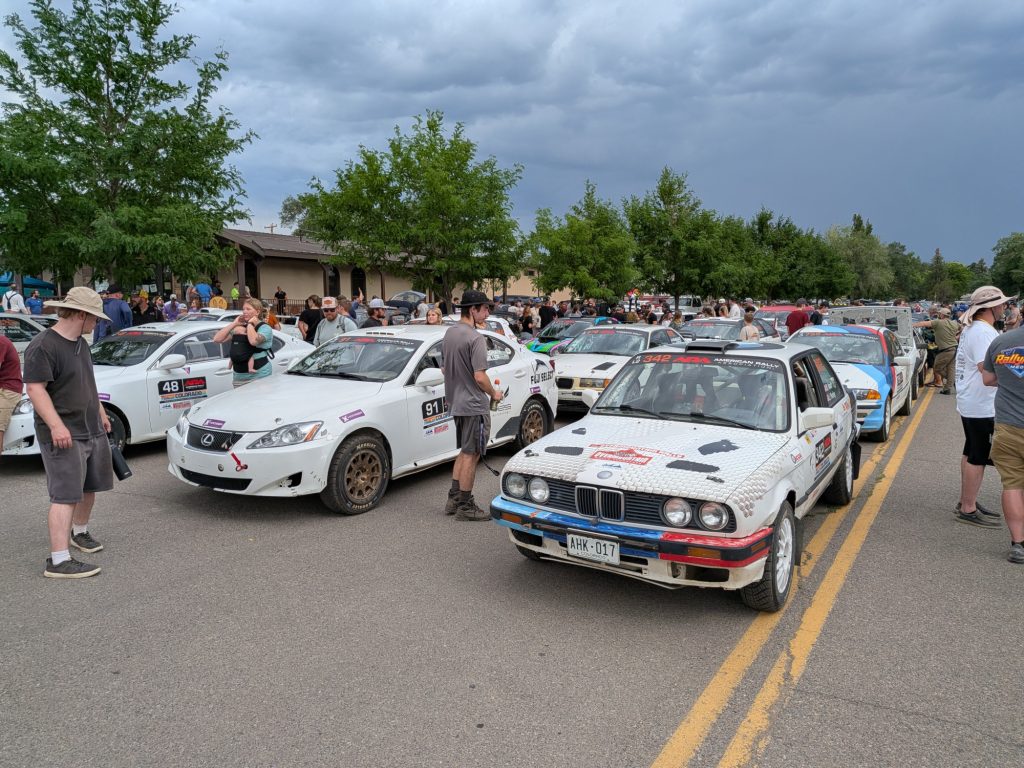
Parc Expose was crazy. Usually it feels like half the town is there to support a couple-dozen cars, but that amounts to a couple hundred people at most. This year, there were at least that many people in line to get an autograph from Travis. They couldn’t even fit all the cars in the museum parking. The crappy BMWs were relegated to the overflow parking in the street:

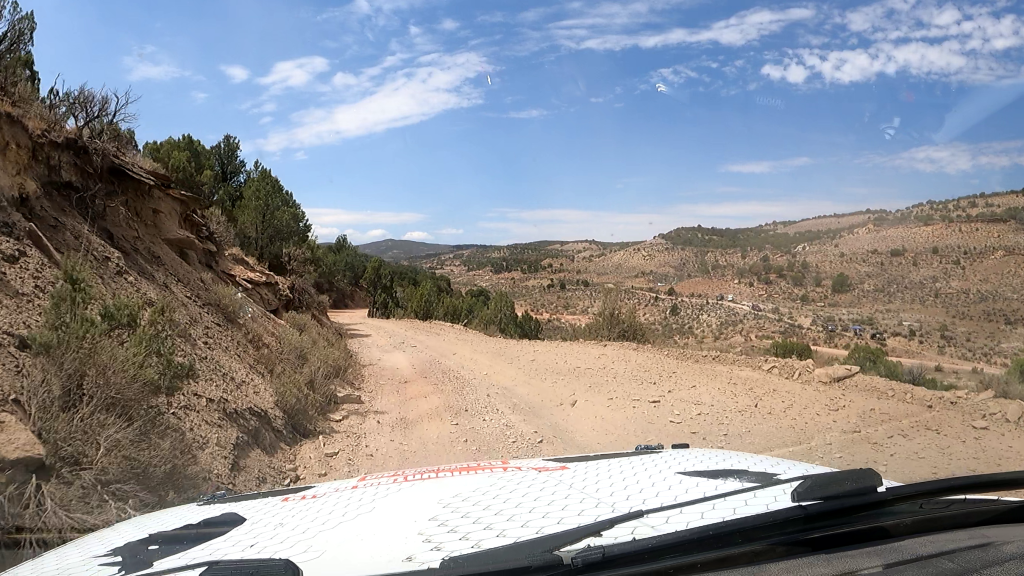
Normally, Rally Colorado starts with the first car out around 10am. Now that there were 70 cars, the first car out was at 8:30am. An extra dust minute is pretty much always required in Colorado, so I still had a pretty late start. I was sort of surprised that we were able to start the first stage, Dragon Trail, because it just feels like typically someone sends it way too hard on the first stage before I get there. I was trying to get used to being back in the car, it having been 9 months since the last time, and was starting to feel comfortable again when I drifted a bit too far from the line toward the inside and hit this rock:

The car started pulling to the left immediately, and I hoped that a flat was the worst of it. I was able to limp along for the next 4 miles, so I didn’t stop. All things considered, I decided I’d rather avoid changing a flat on stage, at my pace it was going to take me longer to swap the tire than we were going to save. Thanks to the dust minute, no one behind us caught us and we were able to pull off at the start of the next transit to swap the flat.

That’s when I realized it was 2 flats. I have only a single spare in the car. At that point, I basically gave up and sent a text to the crew to come get us, resigned to a retire and rejoin. Jack was not on board with that plan and changed the tire himself in no time at all while I tried to get a text out with almost no signal. “We’ll see if someone will loan us their spare,” he said.

“In a world of Subarus, you think someone with a 4×100 in an offset that clears the brake rotors is just going to show up?”

Right then, a VW Scirocco that should have started in front of us, but didn’t for some reason, pulled up. “Here’s your 4×100,” Jack said. I started removing the second wheel while Jack went over to beg a spare. Giving up your spare in a rally feels insanely risky given how common flats are, but these folks were game! The wheel bolted on no problem and we were off.

Somehow, a first-stage ending event was suddenly no big deal. We wound up 4 minutes late to the next stage, which is only a 40 second penalty. Still in it!

The next 2 stages actually went really well. I remarked that attrition was way lower than I expected and that things were going surprisingly well overall. We got the spare tire returned to the crew we’d borrowed it from, but learned the VW was stuck on stage. I had a horrible feeling that they’d had a flat and we’d stranded them–but it turned out not to be the case. They’d snapped a tie rod which resulted in an impact that broke a control arm. Felt bad for them, but was really glad that their generosity hadn’t cost them. We looked over the left side suspension at service, but everything looked fine and we headed back out.

Second run of Valley of the Gods went a lot better than the first and I was pretty happy with how the car was feeling. This is the first year I’ve run Rally Colorado on the new “Hard” Hoosiers instead of the old extra hard, and I wonder if that made a significant difference. The roads were also freshly graded and smoother than they’d ever been. In any case, it seemed like the car was doing better and I was in more control than ever before so I was starting to push harder and even having some fun.

As we pulled into SS5, there were clearly more cars than there should have been. We were stopped on a pretty steep hill, so I killed the car and set the parking brake. I’ve got a simple lock valve as a parking brake in the rear brake line. Step on the pedal, turn the valve and the brake is set. I did that, but it started rolling back. Did it again, harder, and the pedal slowly went to the floor and brake fluid sprayed out of the top of the parking brake valve.

About then, someone came by to tell us the stage was canceled and we’d be transiting. This was a bit of a relief and I screwed with the brake valve and realized that with it closed, it didn’t actually leak much. That meant no rear brakes, only front, but safe enough to transit for sure. No word about why the stage was canceled, but I’m used to rally folks providing zero information until after the fact. We later found out there was a medical event at SS6 and they needed the ambulance from SS5.

When we got to SS6, I’d committed to running the stage on front brakes only. My depowered brakes already require way more force than I feel like is reasonable, and the new braking effort was huge. I was going to run the stage slowly so that I didn’t die, but hopefully stay in it. Then, thankfully, SS6 was canceled as well. We later found out that there was, supposedly, a medical event as well as a lightning-caused fire on the stage. Then it started raining, and this was Valley of the Gods, the same stage that was a disaster during recce. The fire department couldn’t get to the fire because of the conditions, but fortunately Brett and his team were able to put it out.

While we were waiting for instructions, I was mucking around in the trunk trying to find some tools to make sure that tightening the bad brake valve wouldn’t work. Jack yelled at me to stop whatever I was doing, that the magic smoke was escaping. I poked my head in the car to see that there was quite a bit of smoke coming from under the dash on his side of the car. I switched the master switch off, and the smoke cleared, but this also felt potentially rally-ending.

I found a very toasty wire and cut it. Wasn’t sure what it went to, but figured I’d try my luck. Flipped the master switch on and no fire. Flipped things on one at a time and discovered that the cut wire was, apparently, to the radiator fan. Not a thing I wired, but clearly there wasn’t enough over-current protection on that circuit. The car cools fine on transit as long as I’m moving without the fan, so we were able to head back to service without further drama, just sans radiator fan or rear brakes. I was quite glad of the canceled stages, for once.

In fact, I couldn’t believe my luck. I’ve had a pile of bad luck at rallies over the years, but finally it seemed like things were working out. We were able to remove the offending brake valve in service and track down the short. It turns out it was the codriver light, which got squirted with brake fluid, apparently triggering the short.

Day 2 started with a bulletin that the start would be delayed by 1 hour so that the officials could assess the course conditions after the rains the evening before.

One of the stages was so badly washed out that they canceled both runs preemptively and issued a bulletin with new transit instructions. Unsurprisingly, before we ever left service, there was a “medical event” on the first stage of the day and it was canceled, too. With not much more information, we watched the flight for life helicopter land at the Rangely hospital and hoped for the best. It turns out the driver suffered some broken bones but was otherwise alive, which was good news. I think it was after 1pm before we finally left the service park to head to the 3rd stage.

Once again, by the time we got there, the stage was canceled. We transited back to the service park for the most boring rally loop ever. I thought I heard a weird suspension noise, so we poked around at that during service, but otherwise we mostly were just waiting to get released to actually run a stage.

At this point, I’d been made aware of a very unusual thing: we were P3 in regional L2WD. Mostly attrition, but even more surprising, we were 10 seconds behind P2, a team in a 1987 Golf GTI. Competition! This basically never happens to me at a rally.

I was suitably motivated to both drive hard, as well as try not to break the car on our first actual stage of the day. Which turned out to be our penultimate stage as well. The Golf team was on the road directly ahead of us and we compared while queued up for ATC on the final stage. We’d pulled ahead by about 10 seconds!

I’m not especially competitive by nature, but now it was on. I drove the hardest I ever have on the final stage, while still trying to leave room for my inevitable mistakes. It was going really well, and at the last quarter of the stage we started to catch dust. At first, I assumed it was the Golf in front of us, and if we were catching their dust, that meant I could relax, because we’d gained 2 minutes on them.

We got closer and realized it was not the Golf at all, but the car that had started in front of them. We furiously pushed the push-to-pass on the Rally Safe and they let us by after about 30 seconds. Who knew whether we’d been held up more than they had?

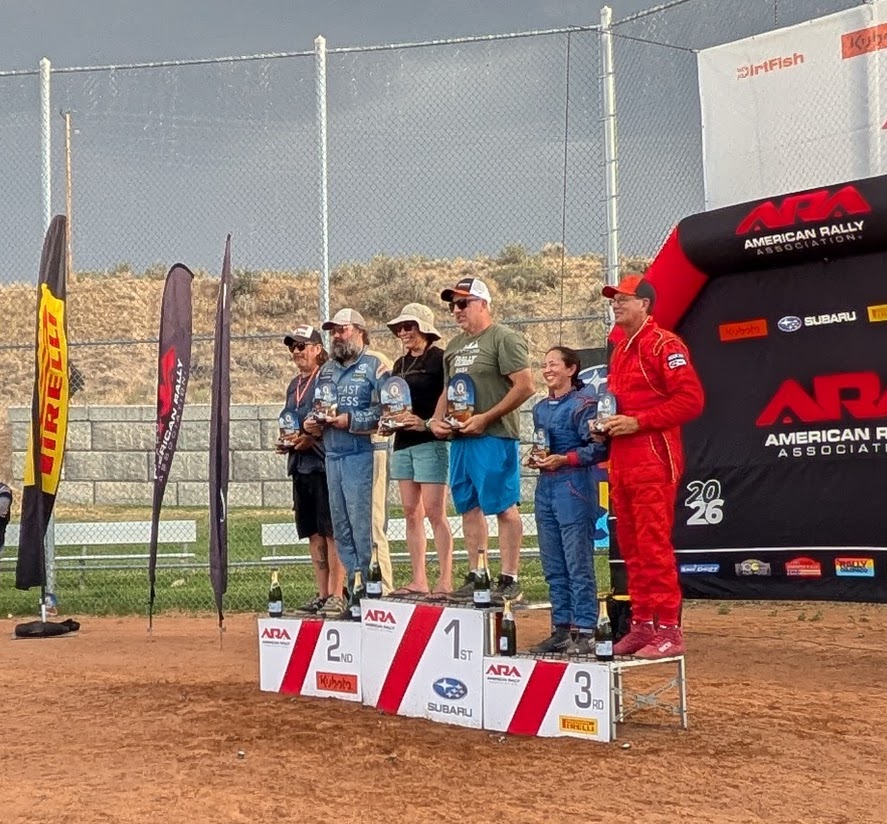
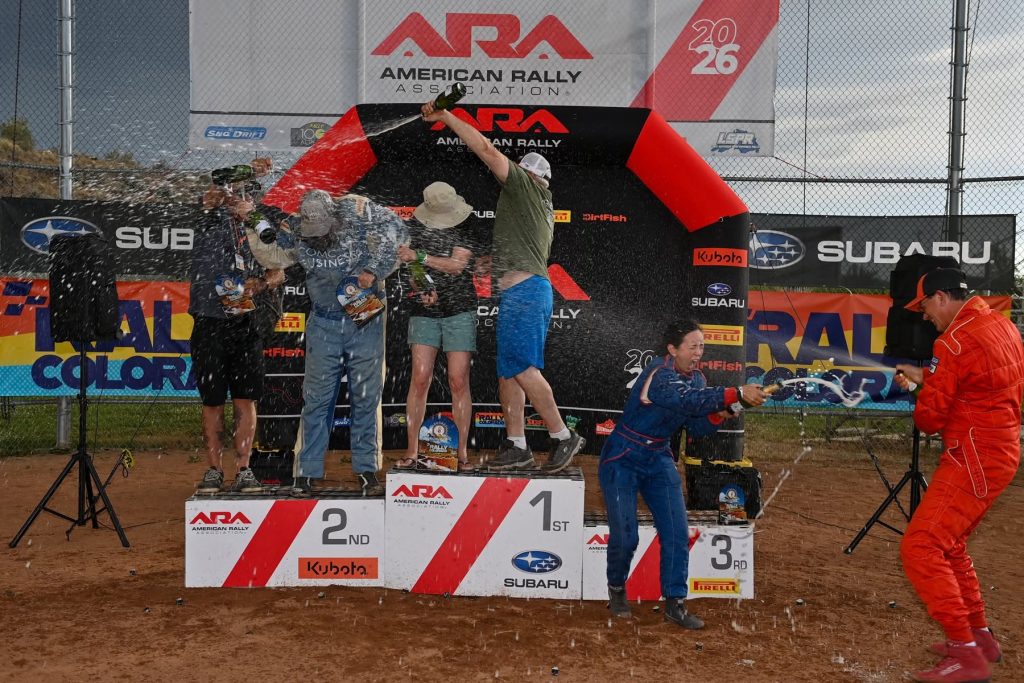
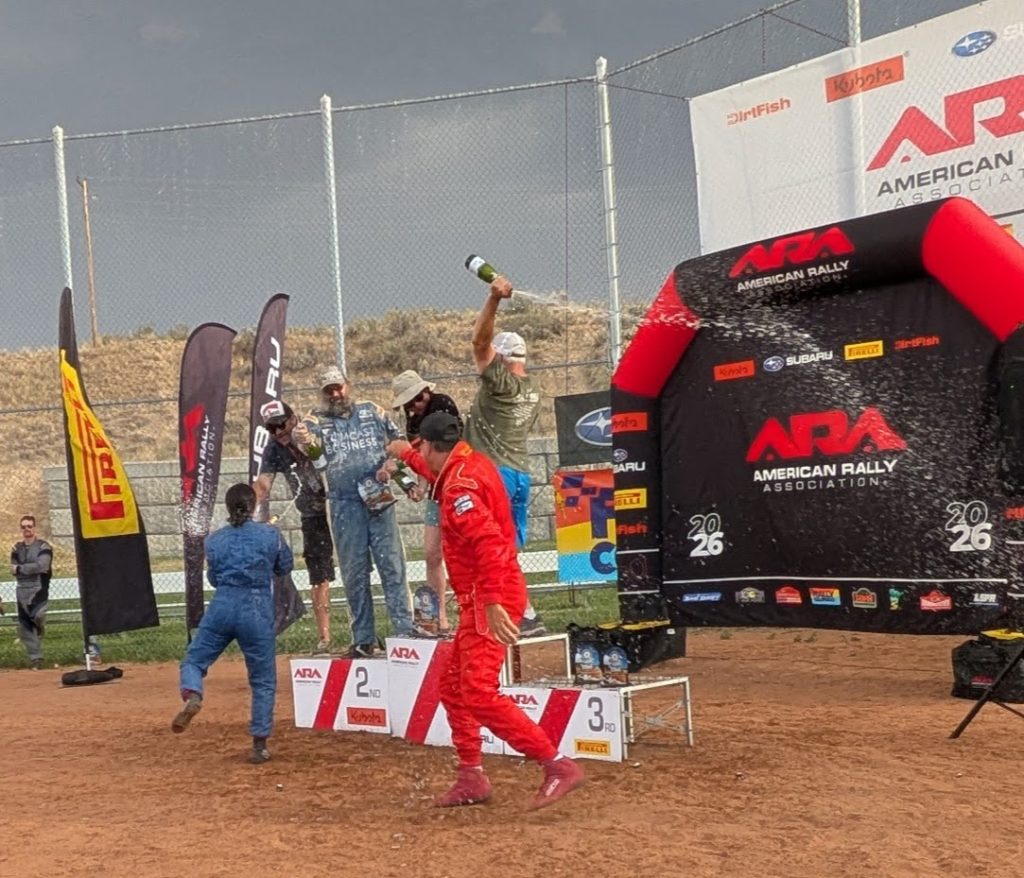
It turns out we were faster than they were on the final stage by over a minute. We exchanged hugs in parc ferme–congratulating each other on a great drive. New friends just because we had a great battle on the dirt. Both of us were just stoked to have someone at the back to race with, and on top of that, we both wound up on the podium! I think if this had happened at an early rally, I wouldn’t have been nearly so happy about it. Winning because of attrition rather than outright speed feels a bit hollow in most racing, but in rally? Just finishing is a victory. The champagne tasted great.

LLMs as recommendation engines

LLMs are finally getting genuinely good at recommending things. I have no idea why the streaming platforms aren’t better utilizing AI for this, but you can talk to it yourself and get really good recommendations. It takes some time–you need to spell out what you like, don’t like and more importantly why. We just recently watched and loved The Detectorists, a thing I would never have found on my own. I’ve got a list of 10 things to watch next that I’m genuinely excited about. I asked Claude to sum up my taste in TV shows, and while it’s weird that it did this in first person, it’s pretty good.

My TV taste, distilled:
I like institutional fiction played as comedy of manners — workplace ensembles where the system is a character and the appeal is watching competent (or incompetent) people muddle through with dignity. The Wire, Slow Horses, The Americans, Detectorists, Halt and Catch Fire, Sports Night, Letterkenny, The IT Crowd, Reservation Dogs.

I’m allergic to self-importance and to shows that glorify their subject. West Wing’s speechifying is a hard no; The Diplomat works because it’s about how the job actually grinds. I hate politics and don’t think it should be glorified.

I want shows with their own dense linguistic world — invented argot, in-group rhythm, dialogue you could pick out of a lineup. Letterkenny, Deadwood-territory, Elmore Leonard. Not naturalistic period dialogue (Mad Men left me cold — felt like all costume, no substance).

I’ll go to genre when the characters carry it — Firefly, Buffy, Expanse, Tales from the Loop, Dark Matter — but I bounce when worldbuilding becomes incoherent (Counterpart) or when shows lean on mysticism instead of finishing what they started (BSG’s religious turn, Severance’s clear lack of a destination).
Good stories are finite. Beginning, middle, end. Queen’s Gambit did it right. I respect a 19-episode cancelled show that nailed its register (My So-Called Life, Freaks and Geeks) more than a prestige drama being milked for episodes.

I don’t need to be wrecked emotionally — I want shows that earn their beats. Craft over catharsis. I’ll watch quiet, low-stakes, anthropological work all day if the writing has texture (Station Eleven’s worldbuilding, Clarkson’s Farm, Nobody’s Looking, Rita).
I won’t tolerate gratuitous darkness or protagonists I can’t root for — quit Breaking Bad at the Jane episode, quit For All Mankind when it went soap. Darkness in service of something (The Wire, Chernobyl) is fine. Darkness for its own sake isn’t.

Subtitles welcome. Animation mostly not, though I’m getting better (Lower Decks works).

Top Gear is one of the best things ever on TV. Clarkson’s Farm might be the best thing on now. I am not above this; neither should you be.

Tax Singularity

I’m loathe to give a single penny to tax prep software because some significant percentage of money they take in gets redistributed in a lobbying effort to make sure that Congress keeps our tax code complicated and does absolutely nothing to simplify tax preparation for Americans.

But I’m way too lazy to actually prepare my taxes by hand. That’s fairly complicated, error-prone and annoying. Normally I pick the cheapest tax prep software I can find. This year and last year, that meant OLT (OnLine Taxes). The cheaper software works fine, but the biggest limitation is that it won’t import forms like W2s or 1099s from stock sales. Because a substantial portion of my income is from stock grants by my Employer, there’s a tedious amount of information to enter, there. OLT will let you create a spreadsheet of their own proprietary design and import it. Normally, this isn’t any less tedious than just entering the data in the web form, but this year I realized AI could do this for me.

Claude is my current favorite, so I uploaded my 1099-B, the instructions from OLT for a custom spreadsheet and waited a couple of minutes for it to tell me the spreadsheet was ready to upload. It imported perfectly, but then I had some follow up questions for Claude about disqualifying wash sales when it occurred to me that I was doing this all wrong.

I created a new directory on my file system, dumped all of my tax documents into the directory and fired up Claude Code. I told it that it was going to be filing my taxes for me using the documents I gave it access to, and told it to find the relevant forms and instructions on irs.gov.

It did. It asked me a few questions it didn’t know the answer to, “Do you have any kids?” and then proceeded to prepare my taxes flawlessly in under minutes. It produced a dozen text files, each one a line-by-line representation of the IRS forms and what I should put in what form.

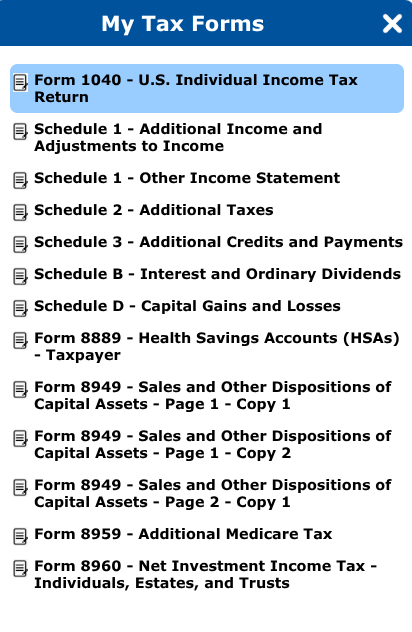
Now that we’d come this far, it seemed silly to copy/paste from text files by hand. I started to ask Claude to fill out the IRS pdfs, but it was struggling with this, and furthermore, it meant I’d need to file by mail. The IRS will let you e-file without tax prep software if you fill out your tax forms on a pretty terrible website. Claude has a Chrome browser extension that will let it use your browser with you. So I signed up for an IRS account and pointed Claude at the empty 1040.

I pretty quickly ran into the usage limits for my $20/month Claude Pro subscription. Fortunately, Anthropic had sent us $50 in “extra” tokens to use for free as part of the Opus 4.6 announcement. I activated those tokens and let it go.

And go it did. It filled out not just the 1040, but all the schedules and worksheets necessary.

It was incredibly slow and ponderous at this. The website is poorly designed even for humans, and terribly designed for robots. It had to constantly take a screenshot and calculate where to click the mouse to enter the next thing. It took it about 2 hours, but it succeeded!

For sanity, I double checked the totals with OnLine Taxes and they lined up. I went ahead and e-filed, without giving the tax prep industry a penny. The IRS probably needs to rethink this check to see if the form is being filled out by a robot:

In June of 2025, Dwarkesh said:

When I interviewed Anthropic researchers Sholto Douglas and Trenton Bricken on my podcast, they said that they expect reliable computer use agents by the end of next year. We already have computer use agents right now, but they’re pretty bad. They’re imagining something quite different. Their forecast is that by the end of next year, you should be able to tell an AI, “Go do my taxes.” And it goes through your email, Amazon orders, and Slack messages, emails back and forth with everyone you need invoices from, compiles all your receipts, decides which are business expenses, asks for your approval on the edge cases, and then submits Form 1040 to the IRS.

I’m skeptical.

I was skeptical, too. Obviously, this wasn’t quite the task, but it wasn’t that far off from the task. I’m a lot less skeptical, now.