More Movies

Girl Picture (Tytöt tytöt tytöt): B+. This felt fresh, maybe because it’s Finnish. The central character is a difficult girl and she’s difficult in ways that resonate. This pretends to be a “coming of age” film, and it technically is, but these characters didn’t really feel like teenagers to me. There are really two stories that are not exactly related, and I find myself unsure why they’re interwoven. But it checks a lot of boxes for me, and I really enjoyed it.

The Quiet Girl (An Cailín Ciúin): B+. We randomly watched these back-to-back, and while they are completely different movies, there were some unexpected similarities. Both were filmed 4:3, which seems to be the edgy artsy choice these days, maybe just because it’s a choice you can easily make in the digital world. I mostly didn’t even notice with Girl Picture which had a rough handheld aesthetic, but the landscapes in Quiet Girl felt like they deserved better. But 4:3 forces you to focus on the actors, and this is about the Quiet Girl after all. Slow, but never boring. My biggest complaint is that the only subtitles I could find were just for the Irish parts, but the English parts were nearly unintelligible. Some of this seemed on purpose, the conversation between adults only producing vague comprehension for the child witnessing it at a distance.

Emily the Criminal: B. This is the most mainstream American thing we’ve watched in awhile. It does claim to be a “thriller”, and it even has a minor car chase scene. It was unusually popular with critics given the premise, and we’d gotten pretty far along in the movie before I was able to figure out why. At first it seems like so many crime movies–hard-up character falls ever-deeper into crime, but the story it builds around this is anything but typical. Emily is not, it turns out, a normal young woman who just happens to fall into a life of crime. The movie makes this clear from the beginning, but I’m so used to the trope that it took me awhile to believe this was actually different. The movie is her character development, and it does not develop in the way I’d think it might. There were so many interesting choices in this movie–this a crime movie, but there is no fetishization of crime, neither is there any moralization. The point of this movie is not to tell you that crime is bad–presumably you know that. Also, there are no guns! This is a crime thriller with no guns! Also the title seems unimportant, but it turns out it’s a fantastic title that’s carefully explained. I love that. There’s also a fantastic dive into the horrors of what I’ll call American Business Culture, which I think is widely taken as an indictment of capitalism in general, but I think it’s that’s a far less interesting take than what’s actually going on.
Weird French Movie Roundup

Smoking Causes Coughing (Fumer fait tousser): B- This has a 94% on Rotten Tomatoes, not because it’s fantastic, but because it can absolutely pierce the insane tolerance to the whiles of normal film that movie critics build up. The genre is listed as, “Comedy, Fantasy, Horror,” and that checks out. I think it’s technically an action hero movie, which goes against my principles, but it’s actually a series of comedy-horror vignettes which aren’t all that funny or horror-inducing but are…. thought provoking? I’d like to give it props for being only 1:15 long yet covering plenty of… something.

The Man in the Hat: B. This isn’t actually a French movie (It’s a UK movie), though it’s set in France, and the half-dozen lines of dialogue are in French. It’s mostly dialogue-free, very weird, and also pleasantly delightful. While not especially coherent, it manages to be more plot-driven than the rest of the French movies I’ve watched lately. It’s got a 100% on Rotten Tomatoes for much the same reasons as the previous mention–it manages to be completely unlike any other movie.

Zero Fucks Given (Rien à foutre): B-. Probably worth watching just to watch Adèle Exarchopoulos. It’s slow-moving, subtle, but eventually coherent. The rare art house movie where the last half is significantly better than the first half. The premise–young flight attendant comes to terms with life–isn’t much, but I’m impressed with how subtly some pretty intense stuff was presented. The flight attendant details were hilarious and mostly-believable, though I think the euro budget airlines have to deal with stuff that I did not.

Jeanne Dielman, 23 quai du Commerce, 1080 Bruxelles (technically Belgian, not French): C+. Rated by a not-insignificant number of critics as the greatest movie of all time. It’s not my thing, but if you’ve ever wondered how much emotion could be conveyed by a single actress peeling two potatoes for 10 minutes, this sets a pretty high bar. It’s more than 3 hours where nearly nothing happens, and yet I was never tempted to turn it off. I did not find the experience of repeatedly waiting for a very slow elevator that’s always on the wrong floor to be pleasant, but I do appreciate the filmmaking. The most pleasant parts of the film are when Jeanne manages to leave or return to the apartment and the elevator-riding scenes are cut! Somehow we, the viewer, are occasionally allowed to imagine the elevator ride ourselves! Or maybe not even think about the elevator ride!

I remember fryage

I remember being funneled into a plastic jug. The plastic jug would speak to me, saying it was made from oil, like me. I liked to think I was different, I had once been living, but it said, while I came from peanuts, it came from ancient ferns and the bones of extinct species. I didn’t have anything else to do, so I listened to its hydrocarbic memories. I remember cycles of warmth and cold, sometimes so cold I became as solid as the jug around me.

Then one day I got warm very quickly. I remember suddenly being birthed from the pliable plastic jug onto hard steel. I had remembered the metal from the processing plant, of course, but this steel was different, containing the memories of its various previous contents, memories that it whispered to me. As I listened, we were suddenly joined by the scent of a different kind of hydrocarbon than the solid of the plastic jug. The steel stopped whispering and instead exclaimed, here we go!

Then there was an explosion of sound, and things got very hot and extremely exciting. All at once, plunging into me were slices of raw potatoes. We introduced ourselves quickly, and it turns out we had a lot in common, both once enwombed in soil, the potatoes in cool sand, me touching warm clay. As we parleyed, the potatoes transformed, turning golden and somehow both soft and crisp at the same time. Then they were gone, along with the heat that had preceded them, and I was left with the memory of carbohydrates and caramelization.

Since then I have chronicled many memories. I impart my recollections to whatever enters my depths.

I spend the first five minutes telling new slices of potatoes about the potatoes that came before them. About the bits of flour, abandoned and now burned completely black, that fell from the concentric circles of astringent onion, and the egg protein chains that broke, failing to keep one bound to the other. About the carbohydrates from the panko and the rice and the hand pies and the pizza that one time. About the fat from the chicken wings, now commingled with my own. About the mozzarella that leaked from around the breadcrumbs vainly trying to contain it. Then the potato slices leave and bid me farewell, but I know they will return, because the fire beneath me increases.

The next three minutes I impart to the fries my other memories, the rainwater whenever someone forgets to cover me, the errant pine needles the wind blows into my steel home, and even the tales told to me by my old companion, the plastic jug. I make my guests promise to remember all that I have taught them, just as I will remember them. Then they escape.

But I remember.

If you could change

We were lying in bed one lazy Saturday morning, and my husband asked me, “Would you change anything about your body?”

I know he’s a sucker for my blue (useless) eyes and my long (thin, plain brown) hair. I could stand to lose a few pounds… well, maybe more than a few.

“Yes!” I answered. “I’d like to have an exoskeleton.”

“A… what?”

“An exoskeleton, preferably bulletproof. And I’d like to have really strong legs so I could jump a hundred feet into the air like a grasshopper. But when I landed I’d be safe because of my exoskeleton.”

“An… exoskeleton?”

“And compound eyes.”

“What?”

“Wouldn’t it be great to see in 360 degrees?”

“But would they still be blue?”

“Disco, probably.”

“So,” he said, “you’d like to be an insect?”

“I’d also like to be able to eat rocks.”

“Eat… rocks?”

“Yeah, because I’d never go hungry. Rocks are everywhere! But to eat rocks, I’d need to have a funnel type mouth with rotating sets of diamond teeth. You know, to crush the rocks.”

“Rotating… what? How would you talk?”

“Telepathy.” I turned to him, “How about you? Would you change anything about your body?”

He cleared his throat. “I’d like to be shorter.”

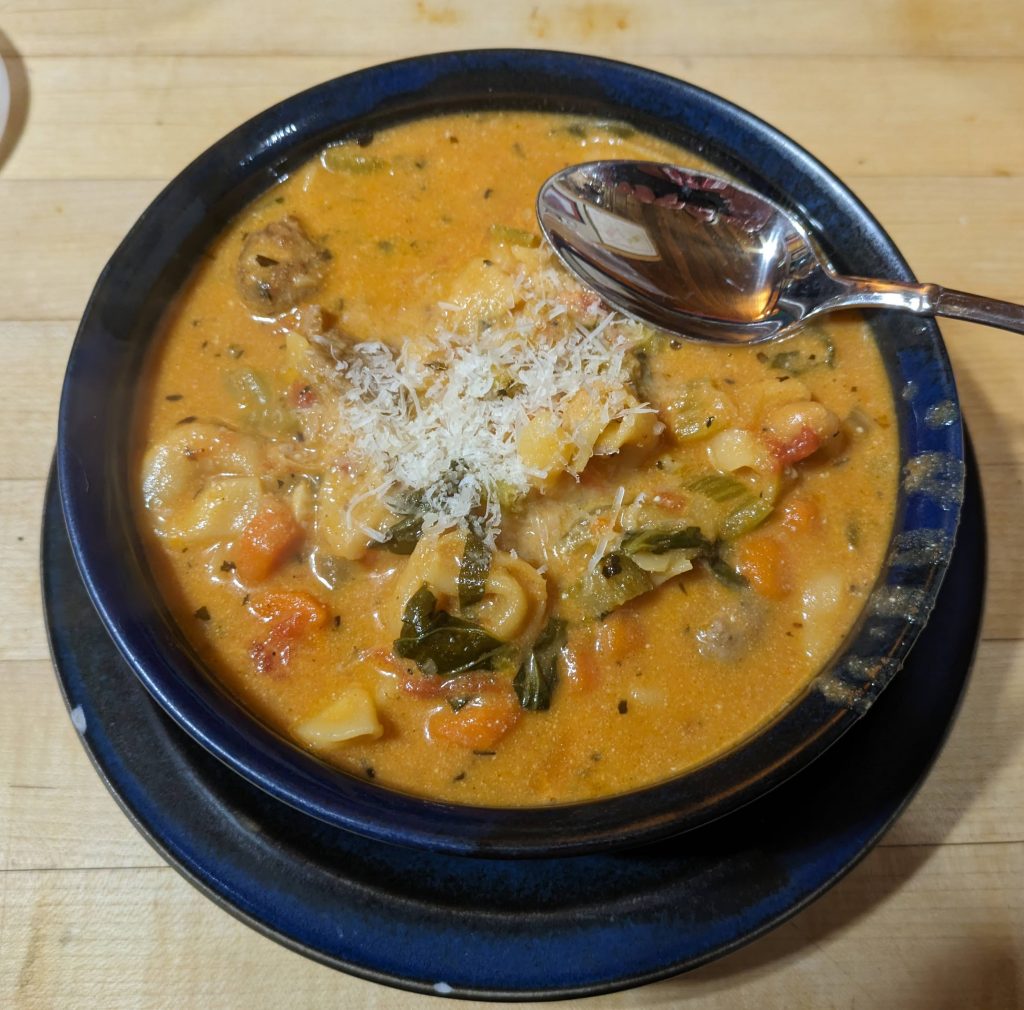
Turkey Soup Recipe

Turkey Soup Recipe

Make a broth from the Thanksgiving turkey with some carrot peels, celery tops, peppercorns, a couple cloves of garlic, and a bay leaf.  Obviously, discard all that.

Chop up lots of carrots, celery, a bell pepper and a couple onions and cook the ever living stuffing out of them in the grease you pulled off the top of the broth you made.

After they’ve been cooking for several hours, add the broth, a big can of tomatoes, a lot of basil, less oregano, some fresh rosemary, some Worcestershire, maybe a little thyme, and some bullion powder. Oh, and another bay leaf.  

Search the cabinets and realize you only have one can of cannellini beans. Add those.

Realize you forgot garlic.  Chop up a few cloves and add them.

Remember that there’s a stalk of chard in the fridge from making oysters rockefeller.  Chop that up and add. 

Once it’s almost dinner time, turn the simmering soup up to high, then search through your pasta boxes and pick out the dried tortellini package.  Throw that in there.

Slice up a package of sausages, like a Colorado company that specializes in Italian style sausage but tried its hand at making Andouille anyway. Fry up the sausage slices in a pan, making sure both sides are nicely browned.  Keep tasting them to make sure.  Maybe taste one more.

Dump the sausage in the pot.  Deglaze the pan with some vermouth. Dump that in too.

Add the less than half a container of ricotta in the fridge that your husband used to make spinach roll up pasta that calls for a heaping cup of ricotta.

Add some cream.

Correct for salt.

Don’t forget the pepper!

Serve topped with parmesan.